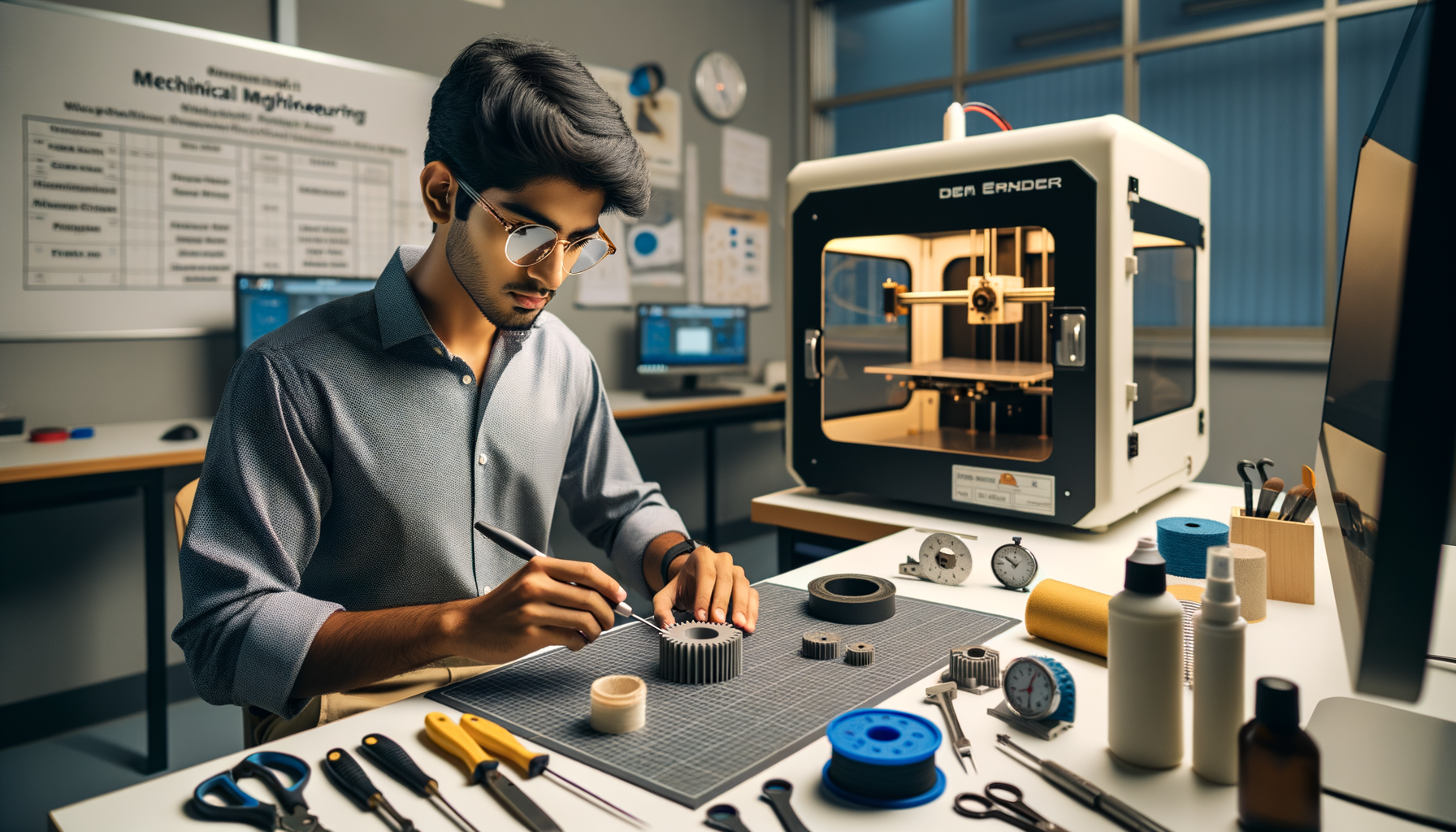
If you already know how to slice, print, and troubleshoot basic failures, the next big jump is post processing. That’s where raw parts start looking and performing like real engineering components. In this advanced guide on 3D print post processing in India 2026, I’ll walk you through the professional workflow used after printing: support removal, cleaning, sanding, curing, surface sealing, painting, and part validation. Here’s the thing — many students focus only on getting a print out of the machine. But in companies and serious labs, the job starts after the print comes off the bed.
If you're aiming for work in prototyping, product development, tooling, medical models, or low-volume manufacturing, you need to understand finishing at a deeper level. Trust me, employers care about the final part quality, not just whether your printer moved correctly. Teams in Pune, Chhatrapati Sambhajinagar, Sangli, and Mumbai working with product prototypes or assembly fixtures expect you to know how to make a part presentable, dimensionally safe, and fit for use.
What is advanced 3D print post processing?
Advanced post processing means going beyond basic support removal. It includes selecting the right finishing method based on material, print technology, use case, and tolerance requirement. An FDM ABS enclosure part needs a different workflow than an SLA dental model or an SLS nylon functional bracket.
What most people don't realize is that post processing affects four things at once: appearance, dimensional accuracy, mechanical performance, and time cost. If you sand aggressively, you may improve looks but lose fit. If you cure too long in resin printing, you may increase brittleness. If you paint without surface prep, the part may look good for one day and fail the next week.
How do professionals remove supports without damaging the part?
Support removal is not a force job. It’s a process decision. For FDM prints, start by planning support settings during slicing: support density, interface layers, Z distance, and support pattern matter more than people admit. In Cura, PrusaSlicer, or Bambu Studio, a well-tuned support interface can save 30 to 40 minutes of finishing on a medium part.
For PLA and PETG, use flush cutters, needle-nose pliers, deburring tools, and a hobby knife in sequence. Don’t twist large support trees from thin walls. Instead, break them section by section from the outer edge toward the contact zone. For ABS, a little controlled heat from a hot air tool can reduce cracking risk, but don’t overdo it.
For SLA prints, remove supports before full final cure if the resin allows it. Semi-cured supports usually detach cleaner and leave smaller witness marks. Use IPA cleaning first, then clip supports, then do a controlled UV cure cycle. For SLS, support removal is not the issue — powder evacuation is. Internal channels, trapped powder cavities, and lattice structures need compressed air, soft brushes, and verification of clean-out.
Which sanding and surface finishing workflow works best?
The good news is, you don’t need random trial and error. A grit sequence solves most surface issues. For FDM visual parts, start at 120 or 180 grit only if the layer lines are heavy. If the print is already decent, begin at 220. Then move to 320, 400, and 600 grit. Wet sanding works better from 400 onward for smoother surfaces and lower heat buildup.
For resin parts, go lighter. Start too aggressively and you’ll flatten edges or remove fine detail. For nylon SLS parts, sanding is less predictable because of the powdery surface texture. In that case, tumbling, bead blasting, or coating often gives a better result than manual sanding.
Here’s a power-user trick: don’t sand the full part uniformly. Classify surfaces first. Cosmetic faces get the full finish cycle. Mating faces get only controlled cleanup. Datum faces and hole zones should be masked or minimally touched. That’s how professionals avoid changing fit while still improving appearance.
How should you cure SLA resin parts for strength and accuracy?
Post-curing is where many advanced users still make mistakes. Resin parts need controlled exposure, not guesswork. The exact cure depends on resin type, wall thickness, and machine ecosystem. A standard tough resin may need a different cycle than a castable or dental resin. Always check manufacturer guidance for systems like Formlabs, Anycubic, Elegoo, or Phrozen materials.
As a practical rule, wash thoroughly first, dry fully, inspect for glossy uncured zones, then cure with consistent orientation. Rotate parts if your curing unit has uneven exposure. Thin snap-fit parts should not be overcured. Functional parts often benefit from test coupons printed alongside production geometry so you can compare flexibility and fracture behavior.
What most people don't realize is that overcuring can reduce performance just as much as undercuring. If a bracket becomes too brittle, the finish may look perfect but the part will fail in use. In industrial prototyping, that’s unacceptable.
How do you get production-quality finish on FDM, SLA, and SLS parts?
Each technology has its own finishing logic.
FDM finishing workflow
Use trimming, progressive sanding, gap filling with spot putty or filler primer, then primer-sand cycles. ABS parts can also be vapor smoothed, but only in controlled conditions with proper safety. Vapor smoothing improves surface quality, but it can round sharp edges and alter dimensions. So don’t use it on tolerance-critical assemblies.
SLA finishing workflow
For display or presentation parts, support scar cleanup, light sanding, primer, and paint work well. Transparent resin parts need polishing compounds and careful grit progression. If you rush, haze remains trapped in the surface.
SLS finishing workflow
SLS nylon parts often need bead blasting, dyeing, sealing, or media tumbling. For end-use parts, surface sealing reduces dustiness and improves appearance. If the part is for a customer demo, dyeing black or grey often gives a more finished look than raw white nylon.
Can painting, coating, or electroplating improve functional parts?
Yes, but only when used for the right reason. Painting is not just for looks. Primers can reveal surface defects before final approval. Protective coatings can improve chemical resistance. Conductive coatings and electroplating can add specific properties, though these are specialist workflows.
For engineering prototypes sent to clients like Tata Technologies, Mahindra Engineering, Bosch, Siemens, or KPIT Technologies, visual quality matters because it signals process control. A rough model may still function, but a clean, coated prototype builds confidence during design reviews.
If you're making jigs, housings, or concept models for teams in Pune or Nashik, use filler primer between sanding cycles. If you’re painting, apply thin coats and respect drying time. Heavy paint hides details and creates edge buildup. Trust me, that’s one of the fastest ways to ruin a good print.
What quality checks should you do after post processing?
Advanced users don’t stop at “looks good.” They verify the part. Check critical dimensions with Vernier calipers or a micrometer. Test fit the component in the intended assembly. Inspect holes, bosses, slots, and mating surfaces after finishing. If you used filler or coating, recheck tolerances because even small material buildup matters.
For presentation-grade parts, inspect under angled light to catch scratches, sink marks, and support scars. For functional parts, perform a simple use simulation: fastening, snap fit, load direction, thermal exposure, or repeated handling. This matters if you're preparing for roles in companies like Bajaj Auto, L&T, Thermax, Kirloskar, Infosys, or TCS where process discipline is valued.
What industry workflow should serious learners follow in Maharashtra?
A professional workflow looks like this: print planning, support strategy, controlled removal, primary cleanup, technology-specific finishing, surface prep, optional coating, dimensional inspection, fit test, and documentation. That last step is underrated. Keep notes on grit sequence, cure time, coating type, and final dimensions. When a customer asks for revision B, you’ll know exactly what worked.
If you're building a career in additive manufacturing, this level of discipline helps in interviews and on the job. In Maharashtra, entry-level 3D printing and prototyping roles often start around ₹2.4 lakh to ₹3.6 lakh per year. Skilled operators and application engineers with strong finishing and validation knowledge can move toward ₹4.5 lakh to ₹7.5 lakh per year. Specialists in industrial prototyping, tooling development, or application support can go higher depending on software skills, machine exposure, and company type.
At ABC Trainings, we tell students one simple thing: printing is only half the skill. The other half is knowing how to deliver a part that looks right, fits right, and survives handling. If you want structured training in additive manufacturing and 3D printing, call 8698270088 or WhatsApp 7774002496. The good news is, once you learn a repeatable finishing workflow, your print quality jumps fast.
Why does post processing matter so much for jobs in 2026?
Because companies don’t hire people just to run a machine. They hire people who can deliver usable output. Here’s the thing — anyone can watch a slicer tutorial. But not everyone can take a raw FDM, SLA, or SLS print and turn it into a presentation-ready or function-ready part. That’s the gap employers notice.
If you're serious about advanced 3D printing, learn to think like a manufacturing person, not just a machine operator. That shift is what separates hobby-level printing from professional additive manufacturing.
Which post processing skill is most important for getting a 3D printing job in Maharashtra?
Support removal and surface finishing are the most visible starting skills, but dimensional control is what really helps in industry. Companies want candidates who can finish a part without spoiling fit or function. If you can explain your workflow for FDM, SLA, and SLS parts clearly in an interview, you’ll stand out.
Do companies in Pune and Mumbai expect knowledge of curing and painting also?
Yes, especially in prototyping, product design, dental, and model-making roles. Many employers expect you to know resin washing, UV curing, sanding, filler primer use, and basic paint preparation. Even if painting is not your main job, understanding the workflow shows production awareness.
Is vapor smoothing used in Indian industry for 3D printed parts?
Yes, mainly for selected FDM thermoplastics and presentation-grade parts, but it’s used carefully. It improves surface appearance, though it can affect sharpness and dimensions. In industrial settings, it’s chosen only when the geometry and tolerance requirements allow it.
Where can I learn advanced 3D printing workflows near Chhatrapati Sambhajinagar or Pune?
You can learn through structured hands-on training that covers printing, post processing, inspection, and project workflow. ABC Trainings offers practical guidance for students who want job-ready additive manufacturing skills in Maharashtra. For course details, call 8698270088 or WhatsApp 7774002496.
Visit Our Centers
Chhatrapati Sambhajinagar
Corporate Office (HQ)
2nd Floor, Kandi Towers, Jalna Road, Amarpreet Chowk, Chhatrapati Sambhajinagar, Maharashtra 431001
Osmanpura Branch
Plot No 14, Shanya Sect, Near Sant Eknath Rang Mandir, Osmanpura, Chhatrapati Sambhajinagar, Maharashtra 431005
CIDCO Branch
Plot No 4, N-3, Cidco, Opp. High Court, Chhatrapati Sambhajinagar, Maharashtra 431003
Pune
Wagholi Branch
1st Floor, ABC Trainings, Laxmi Datta Arcade, Pune - Ahilyanagar Hwy, Wagholi, Pune, Maharashtra 412207
Hadapsar Branch
Bloom Hotel, ABC Trainings 1st Floor, S.no 156/3 Shree Tower Pune - Solapur Rd, Hadapsar, Pune, Maharashtra 411028
Sangli
Sangli Branch
2nd Floor, Vasant Market, Opp. City High School, Sangli, Maharashtra 416416
Start Your Career Journey Today
Join 10,000+ students who transformed their careers with ABC Trainings.
💬 WhatsApp: 7774002496📞 Call: 8698270088