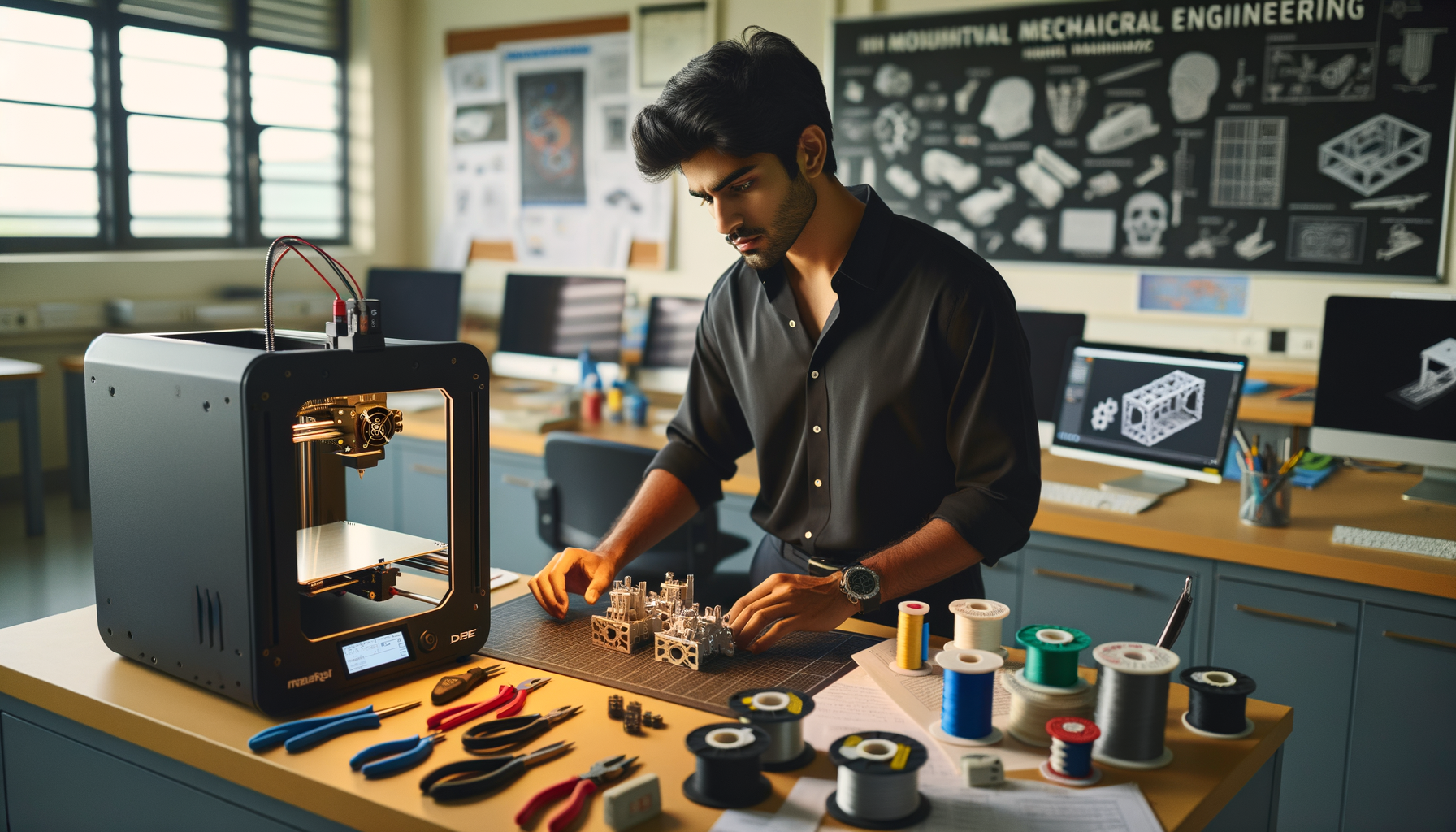
Advanced 3D printing career scope in India 2026 is no longer just a topic for seminars and college presentations. It's becoming a practical career path for mechanical engineers, product designers, production teams, healthcare innovators, and even construction professionals across Maharashtra. If you already know the basics of additive manufacturing, here's the thing: the real opportunity isn't just learning how to print a part. It's understanding where the industry is moving, which workflows companies value, and how to build skills that match actual hiring needs in Pune, Chhatrapati Sambhajinagar, Sangli, and beyond.

The video points toward six high-growth areas: mass customization, healthcare, aerospace and defense, automotive, construction and architecture, and education. Let's go deeper into each one from a working professional's angle, not a textbook angle.
What is the future scope of 3D printing in India 2026?
The future scope of 3D printing in India is strongest where low-volume complexity, faster prototyping, customized components, and shorter development cycles matter. That's why additive manufacturing is gaining attention in automotive, medical devices, aerospace assemblies, tooling, jigs and fixtures, and architectural model making.
What most people don't realize is that companies don't hire just because you can operate a printer. They hire when you understand the full chain: CAD model preparation, STL cleanup, print orientation, support strategy, material selection, tolerance planning, post-processing, and inspection. That's the difference between a hobby user and someone employable by Tata Technologies, Mahindra Engineering, Bosch, Siemens, L&T, or KPIT Technologies.
The good news is, India is still in a growth phase. That means skilled people who can combine design thinking with production logic have a strong edge.
How does mass customization create advanced 3D printing jobs?
Mass customization is one of the biggest reasons 3D printing has serious long-term value. Traditional manufacturing works best when you're making thousands of identical parts. Additive manufacturing starts becoming attractive when every part needs a small change without redesigning expensive tooling.
Think of customized consumer products, orthotic supports, dental aligner models, ergonomic grips, personalized fixtures, and low-volume product variants. In these cases, the advanced skill isn't just pressing print. You'll need to manage parametric design, batch variation, naming standards, nesting logic, and repeatable print settings.
Professionals who go deeper usually build workflows around software like SolidWorks 2024, Fusion 360, Materialise Magics, Cura, or PrusaSlicer. Trust me, if you can show that you know how to prepare 20 customized parts with controlled wall thickness, orientation, and support reduction, you'll stand out much faster than someone who has only printed keychains and miniatures.
In Maharashtra, this matters for startups, dental labs, product design firms, and prototyping vendors serving Pune and Mumbai clients.
Why is healthcare one of the strongest 3D printing sectors?
Healthcare is where 3D printing stops being a cool technology and starts becoming deeply practical. Hospitals, dental labs, prosthetic developers, and medical product teams use additive manufacturing for anatomical models, surgical planning aids, dental patterns, hearing aid shells, and customized prosthetic concepts.
The advanced side of this field involves material suitability, dimensional accuracy, surface finish, and patient-specific geometry. If you're coming from a CAD or mechanical background, you'll need to learn how scan data becomes printable geometry, how support affects delicate structures, and why post-processing can't be treated as an afterthought.
India's medical ecosystem is expanding fast, especially in Pune, Mumbai, and large private hospital networks. A candidate who understands both design and application can move into roles connected to medical modeling, dental manufacturing support, or healthcare product development. Entry salaries for trained freshers may start around ₹2.8 lakh to ₹4.5 lakh per year, while specialized application engineers with hands-on portfolio work can move toward ₹5.5 lakh to ₹8 lakh.
How is 3D printing used in aerospace and defense?
Aerospace and defense use 3D printing where weight reduction, part consolidation, and complex internal geometry matter. This is not beginner-level printing. Here, tolerances, traceability, process control, and inspection become critical.
If you're targeting this sector, you'll need a stronger understanding of design for additive manufacturing. That includes topology-aware design thinking, internal channels, lattice concepts, support minimization, and orientation decisions that affect mechanical performance. Even if you start with polymer training, the mindset matters because the industry's expectations are high.
Companies supporting aerospace supply chains look for professionals who understand documentation, revision control, and quality discipline. That's why candidates with a portfolio showing fixture design, lightweight brackets, or functional prototype validation tend to perform better in interviews. In India, advanced manufacturing vendors and engineering service companies in Pune, Bengaluru, and Hyderabad are actively watching this space.
What advanced opportunities exist in automotive 3D printing?
The automotive sector is one of the most realistic entry points for Indian students and engineers. Bajaj Auto, Tata Technologies, Mahindra Engineering, Bosch, Thermax, and Kirloskar-related manufacturing ecosystems all depend on faster product development and shop-floor efficiency. 3D printing supports both.
Most people don't realize that automotive use cases are not limited to concept models. Real value often comes from jigs, fixtures, gauge aids, assembly supports, low-volume testing parts, enclosure concepts, duct routing models, and ergonomic validation parts.
Advanced professionals reduce iteration time by connecting CAD decisions to printing outcomes. For example, they know when to split a part for better orientation, when to add sacrificial support features, when to increase wall thickness for handling strength, and when a printed fixture saves machining time. That's the level companies notice.
For automotive-focused additive roles in Pune and nearby industrial belts, fresher salaries often range from ₹3 lakh to ₹4.8 lakh, while experienced CAD-plus-manufacturing candidates can move to ₹6 lakh to ₹9 lakh depending on software skills and project exposure.
Can 3D printing really grow in construction and architecture?
Yes, but in India the immediate opportunity is more practical than people assume. Large-scale printed buildings get headlines, but right now many professionals build careers through architectural models, concept prototypes, façade studies, MEP coordination mockups, and presentation-scale structural components.
If you come from civil, architecture, or BIM, 3D printing becomes powerful when tied to design communication. The advanced workflow includes model cleanup, print segmentation, tolerance planning for assembly, and material choices based on display or functional use. It's especially useful for client presentations and construction planning support.
For students in Pune, Chhatrapati Sambhajinagar, and Sangli, this opens a bridge between digital design and physical output. That's valuable in architecture firms, model studios, and design-build environments where speed matters.
Which advanced 3D printing skills do companies actually value?
If you already know the basics, focus on the skills that make you productive in a real project environment:
- Design for Additive Manufacturing: redesigning parts for printability, strength, and material efficiency
- Slicer mastery: layer height logic, infill strategy, shell settings, support control, temperature tuning
- Material selection: PLA vs PETG vs ABS vs resin choices based on use case
- Tolerance planning: clearance, shrinkage, fitment, hole compensation
- Post-processing: sanding, curing, support removal, bonding, finishing
- Failure diagnosis: warping, stringing, layer separation, elephant foot, poor adhesion
- Portfolio building: documenting problem, design logic, print setup, result, and improvement
Here's the thing: a strong portfolio beats a generic certificate every time. If you're training seriously, document each project like an engineer, not like a social media creator.
How should Maharashtra students prepare for 3D printing careers?
Start by choosing one career lane: product design, automotive prototyping, healthcare models, manufacturing aids, or architectural output. Then build a project set around that lane. Don't mix random prints and call it a portfolio.
At ABC Trainings, students who do well usually combine CAD modeling with print planning and application thinking. That combination makes your profile stronger for local employers and service bureaus. If you want structured guidance on additive manufacturing, CAD workflow, and project-based skill building, you can contact ABC Trainings at 8698270088 or WhatsApp 7774002496.
Trust me, the students who get shortlisted faster are the ones who can explain why they chose a print orientation, why they changed support settings, and how they improved a failed part on the second attempt. That's exactly how industry interviews work.
Is 3D printing a good long-term career in India?
Yes, if you treat it as an engineering skill, not a gadget skill. The future belongs to people who can connect CAD, materials, manufacturing logic, and application-specific problem solving. Education and skill development will keep expanding because industries need trained operators, designers, application engineers, prototype specialists, and technical trainers.
That's why 3D printing is becoming relevant not only for engineers, but also for institutes, labs, innovation centers, and startups. As adoption grows, so does the need for people who can train others, standardize workflows, and reduce material waste. The career path is real. But you need depth.
Is 3D printing a good career option in Maharashtra in 2026?
Yes, especially in Pune, Mumbai, and industrial clusters connected to automotive, design, healthcare, and prototyping services. The best opportunities go to candidates who know CAD plus print preparation, not just machine operation. If you build 4 to 6 serious application-based projects, your chances improve a lot.
What salary can a fresher get after 3D printing training in India?
For freshers, salaries commonly start around ₹2.8 lakh to ₹4.8 lakh per year depending on location, software skills, and project quality. In Pune, a candidate with SolidWorks or Fusion 360 plus hands-on additive manufacturing exposure can often target better roles. Specialized application support or prototyping roles may pay more.
Which industries hire 3D printing professionals in Pune?
Automotive, product design, medical modeling, prototyping vendors, architecture model studios, and manufacturing support companies hire such profiles. Employers may include vendors working with Bajaj Auto, Tata Technologies, Bosch, Siemens, and Mahindra Engineering ecosystems. Startups and service bureaus also offer strong entry points.
Should I learn CAD first or 3D printing first for a job?
Learn both, but start with CAD if your goal is employability. A company values someone who can design, modify, and optimize parts before printing. Once your CAD basics are strong, 3D printing becomes much more useful and much easier to apply professionally.
Visit Our Centers
Chhatrapati Sambhajinagar
Corporate Office (HQ)
2nd Floor, Kandi Towers, Jalna Road, Amarpreet Chowk, Chhatrapati Sambhajinagar, Maharashtra 431001
Osmanpura Branch
Plot No 14, Shanya Sect, Near Sant Eknath Rang Mandir, Osmanpura, Chhatrapati Sambhajinagar, Maharashtra 431005
CIDCO Branch
Plot No 4, N-3, Cidco, Opp. High Court, Chhatrapati Sambhajinagar, Maharashtra 431003
Pune
Wagholi Branch
1st Floor, ABC Trainings, Laxmi Datta Arcade, Pune - Ahilyanagar Hwy, Wagholi, Pune, Maharashtra 412207
Hadapsar Branch
Bloom Hotel, ABC Trainings 1st Floor, S.no 156/3 Shree Tower Pune - Solapur Rd, Hadapsar, Pune, Maharashtra 411028
Sangli
Sangli Branch
2nd Floor, Vasant Market, Opp. City High School, Sangli, Maharashtra 416416
Start Your Career Journey Today
Join 10,000+ students who transformed their careers with ABC Trainings.
💬 WhatsApp: 7774002496📞 Call: 8698270088