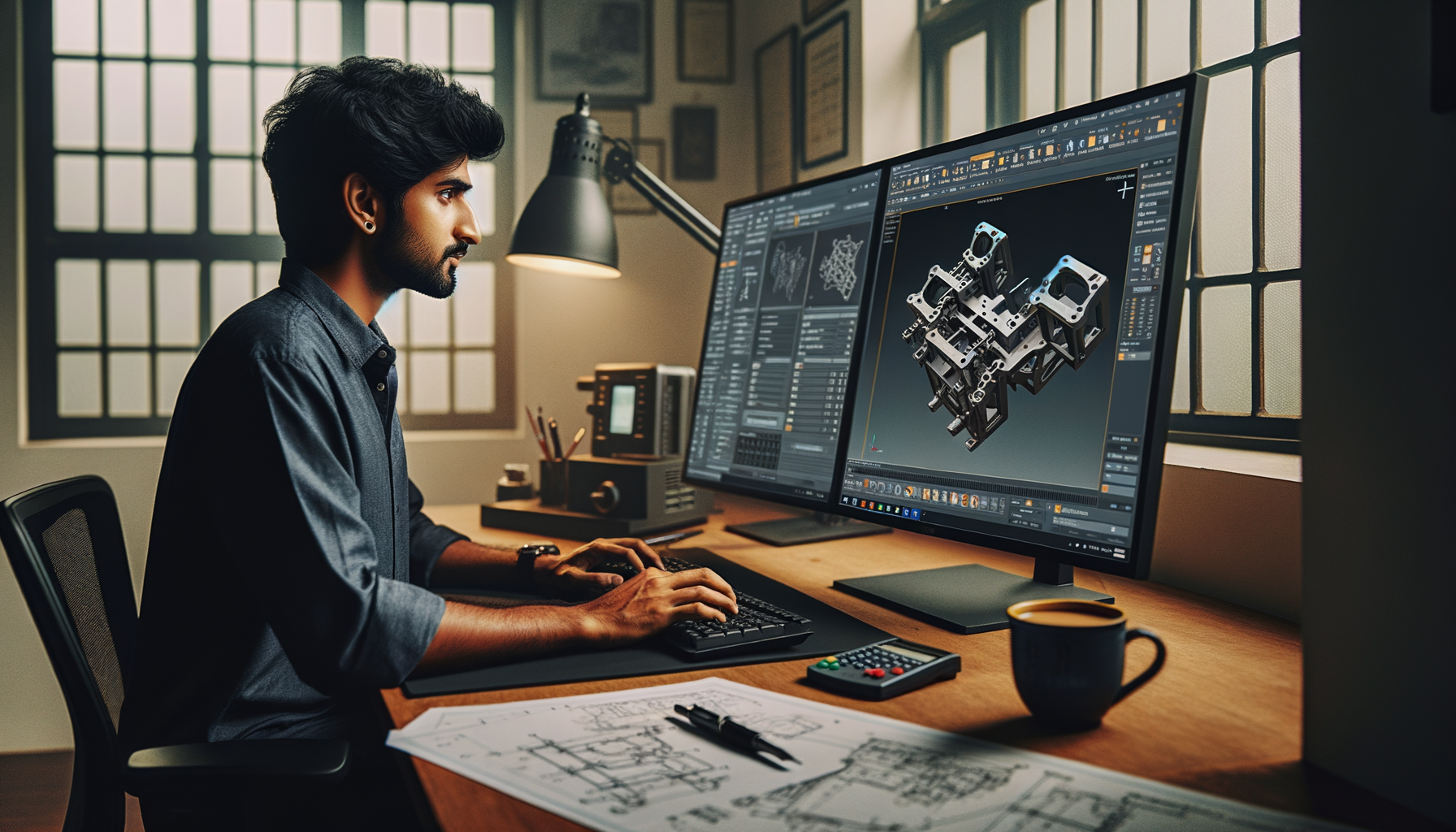
If you already know the basics of CATIA and you're asking how to work faster, smarter, and more like an industry designer, this guide is for you. Advanced CATIA AI workflows in India 2026 aren't about replacing mechanical engineers. They're about reducing repetitive work, improving design decisions, and helping you deliver cleaner models with fewer revisions. Here's the thing: companies hiring for CATIA roles now want engineers who can model well, think in systems, and use AI-assisted methods without losing engineering judgment.

In automotive and aerospace teams, that matters a lot. At companies like Tata Technologies, Mahindra Engineering, Bajaj Auto, Bosch, Siemens, and KPIT Technologies, design speed is important, but design intent is even more important. Trust me, if your CATIA model is fast to build but messy to edit, you're still not working at an advanced level. Let's go deeper into the workflows, settings, and career skills that actually matter.
How is AI changing CATIA work for mechanical engineers in India?
AI is changing CATIA work in a practical way. It's helping designers reduce routine effort in part modeling, drawing preparation, design validation, and data organization. The good news is, most Indian employers still expect strong core CATIA skills first. AI is an add-on advantage, not a shortcut.
What most people don't realize is that AI in mechanical design usually shows up in small productivity gains:
- suggesting geometry patterns based on previous parts
- speeding up repetitive feature creation
- helping classify parts and assemblies inside PLM systems
- improving design search and reuse
- supporting early-stage optimization decisions
In a real design environment, this means you may create variants faster, find similar legacy parts quickly, and reduce avoidable modeling mistakes. But if your sketch constraints, feature tree, and naming structure are weak, AI won't save you. It'll only make bad habits faster.
What advanced CATIA techniques should you master after basics?
Once you've learned sketching, pad, pocket, shaft, rib, and assembly basics, your next step is not random commands. Your next step is control. Advanced CATIA users focus on model stability, editability, and team readability.
Build with design intent, not just geometry
Use parameters, formulas, and relations wherever part families are likely. If you're designing brackets, mounts, trims, or sheet metal support parts, don't rebuild from scratch every time. Create a master logic structure. Keep critical dimensions driven by named parameters such as thickness, hole_pitch, bend_radius, and boss_height.
This is exactly where advanced users save hours during revision cycles.
Use publications and clean references
In large assemblies, published geometry is a lifesaver. Instead of linking randomly to edges and faces that may change later, publish planes, axes, points, and surfaces that are intended for downstream use. This makes top-down design more stable and reduces broken links during updates.
Control your tree structure
Rename sketches and features properly. Group construction elements logically. Separate reference geometry from final features. If another engineer opens your file at L&T, Thermax, or Kirloskar, they should understand your model in two minutes, not twenty.
Which CATIA settings do professionals use for faster work?
Advanced performance often comes from settings, not just skill. Here are a few habits professionals use in CATIA V5 and similar enterprise environments:
- set template parts with preloaded units, material placeholders, annotation standards, and standard planes
- use custom toolbars for frequently used commands instead of hunting through menus
- turn on only necessary display elements to keep large assemblies lighter
- standardize naming conventions across parts, products, and drawings
- save drafting standards aligned with company requirements for dimension text, tolerances, and views
Trust me, even a 10 to 15 second saving per task becomes massive over a full week. In design offices in Pune, Chhatrapati Sambhajinagar, and Nashik, speed matters because deadlines are tight. But speed without standards creates rework, and rework kills productivity.
How do power users handle large assemblies in CATIA?
Large assembly performance is where average users struggle. If your product structure slows down, crashes, or becomes impossible to update, the issue is usually workflow discipline.
Use these advanced habits:
- load only required subassemblies while reviewing
- keep constraints minimal and meaningful
- avoid overdefined assembly relationships
- use skeleton or master reference logic where needed
- review update errors immediately instead of ignoring warning symbols
For automotive BIW, interior trims, brackets, fixtures, and aerospace support assemblies, a clean product structure matters as much as geometry quality. Tata Technologies and Mahindra Engineering teams often value engineers who can maintain assembly discipline because it affects collaboration across design, analysis, and manufacturing.
Can AI help in design validation and optimization inside CATIA workflows?
Yes, but with a clear limit. AI can support faster comparisons, pattern recognition, and data-backed suggestions, especially when combined with simulation workflows. It can help identify likely weak zones, compare versions, or suggest reusable solutions from older projects. But engineering approval still depends on material behavior, manufacturing feasibility, GD&T logic, and application context.
Here's the thing: if you're working on automotive plastic parts, castings, sheet metal parts, or machined components, AI suggestions must still pass through engineering checks. No serious company will accept a model just because a software tool recommended it.
That means your advanced skill set should include:
- basic design-for-manufacturing judgment
- understanding of tolerances and fits
- ability to prepare models for CAE or downstream teams
- clear revision control and documentation habits
What mechanical design career skills matter in 2026 besides CATIA?
If you want better salaries in India, don't stop at CATIA commands. Employers want stacked skills. What most people don't realize is that many fresher candidates know software buttons, but not engineering workflow.
To stay competitive in 2026, add these around your CATIA foundation:
- GD&T interpretation
- drawing standards and manufacturing drawings
- BOM understanding
- basic PLM/PDM exposure
- DFM and DFA thinking
- surface modeling basics for complex parts
- Excel and reporting discipline
- clear communication with production and analysis teams
In Maharashtra, a fresher with basic CATIA may start around ₹2.8 LPA to ₹4.2 LPA. A candidate with stronger assembly control, drafting standards, and workflow maturity can target ₹4.5 LPA to ₹6.5 LPA in Pune and nearby industrial belts. Engineers with 3 to 5 years of solid automotive or product design experience can move toward ₹7 LPA to ₹12 LPA, depending on domain and company.
How should you practice advanced CATIA if you already know the basics?
Don't practice by making random parts from YouTube screenshots. Practice with revision-based projects. That's how real companies work.
Try this structure:
- model one bracket using parameters and formulas
- create three size variants without rebuilding
- assemble it with mating parts
- prepare a manufacturing drawing with proper dimensions
- revise one mounting condition and update everything cleanly
That single exercise teaches more than ten disconnected tutorials. The good news is, once you learn to think in revisions, your confidence changes completely in interviews.
If you want structured guidance, ABC Trainings helps mechanical students and working engineers build job-ready CAD workflows, not just software familiarity. You can call 8698270088 or WhatsApp 7774002496 to check CATIA training options in Maharashtra.
Is CATIA with AI a good career path in Maharashtra in 2026?
Yes, if you approach it correctly. CATIA remains highly relevant in automotive, aerospace, industrial equipment, and product engineering. AI is making the workflow more efficient, but the real value still comes from engineers who can think clearly, model cleanly, and solve design problems under deadlines.
If you're in Pune, Chhatrapati Sambhajinagar, Sangli, Kolhapur, Nashik, or Mumbai, the opportunity is real. Companies such as Bajaj Auto, Bosch, Siemens, TCS, Infosys, and KPIT Technologies are all part of a larger ecosystem where CAD, product engineering, digital tools, and data-assisted workflows are becoming more connected.
Trust me, the engineers who will grow fastest are not the ones chasing every trend. They're the ones who combine CATIA depth, engineering basics, and smart AI-assisted productivity. That's the sweet spot.
If you're serious about moving beyond beginner-level CAD, ABC Trainings can help you build advanced, interview-ready CATIA skills with practical industry logic. Call 8698270088 or WhatsApp 7774002496.
Is CATIA with AI enough to get a mechanical design job in Pune?
Not by itself. Companies in Pune usually expect CATIA plus drawing knowledge, assembly understanding, and manufacturing awareness. AI-assisted workflow knowledge helps you stand out, but employers still test modeling logic and engineering basics. If you're a fresher, build a portfolio with parameter-driven parts, assemblies, and drawings.
Which CATIA version should I learn for jobs in India in 2026?
CATIA V5 is still widely used across automotive and mechanical design companies in India, especially in supplier and design service environments. Some larger organizations also work with 3DEXPERIENCE-based workflows. The safest path is to get strong in CATIA V5 fundamentals and advanced modeling logic first, then understand how collaborative platforms fit into the workflow.
What salary can an advanced CATIA engineer earn in Maharashtra?
A fresher with only basic software exposure may get around ₹2.8 LPA to ₹4.2 LPA. If you have stronger project work, assembly discipline, drafting quality, and some domain understanding, you can target ₹4.5 LPA to ₹6.5 LPA. With 3 to 5 years of solid experience in automotive, aerospace, or industrial design, salaries often move into the ₹7 LPA to ₹12 LPA range.
How do I know if my CATIA skills are advanced enough for industry?
Ask yourself whether you can create editable models, manage revisions, handle assemblies, and produce proper drawings without confusion. Advanced skill means your model survives design changes cleanly. It also means another engineer can open your file and understand your intent quickly. If you still model everything as one-off geometry, you're not there yet.
Visit Our Centers
Chhatrapati Sambhajinagar
Corporate Office (HQ)
2nd Floor, Kandi Towers, Jalna Road, Amarpreet Chowk, Chhatrapati Sambhajinagar, Maharashtra 431001
Osmanpura Branch
Plot No 14, Shanya Sect, Near Sant Eknath Rang Mandir, Osmanpura, Chhatrapati Sambhajinagar, Maharashtra 431005
CIDCO Branch
Plot No 4, N-3, Cidco, Opp. High Court, Chhatrapati Sambhajinagar, Maharashtra 431003
Pune
Wagholi Branch
1st Floor, ABC Trainings, Laxmi Datta Arcade, Pune - Ahilyanagar Hwy, Wagholi, Pune, Maharashtra 412207
Hadapsar Branch
Bloom Hotel, ABC Trainings 1st Floor, S.no 156/3 Shree Tower Pune - Solapur Rd, Hadapsar, Pune, Maharashtra 411028
Sangli
Sangli Branch
2nd Floor, Vasant Market, Opp. City High School, Sangli, Maharashtra 416416
Start Your Career Journey Today
Join 10,000+ students who transformed their careers with ABC Trainings.
💬 WhatsApp: 7774002496📞 Call: 8698270088