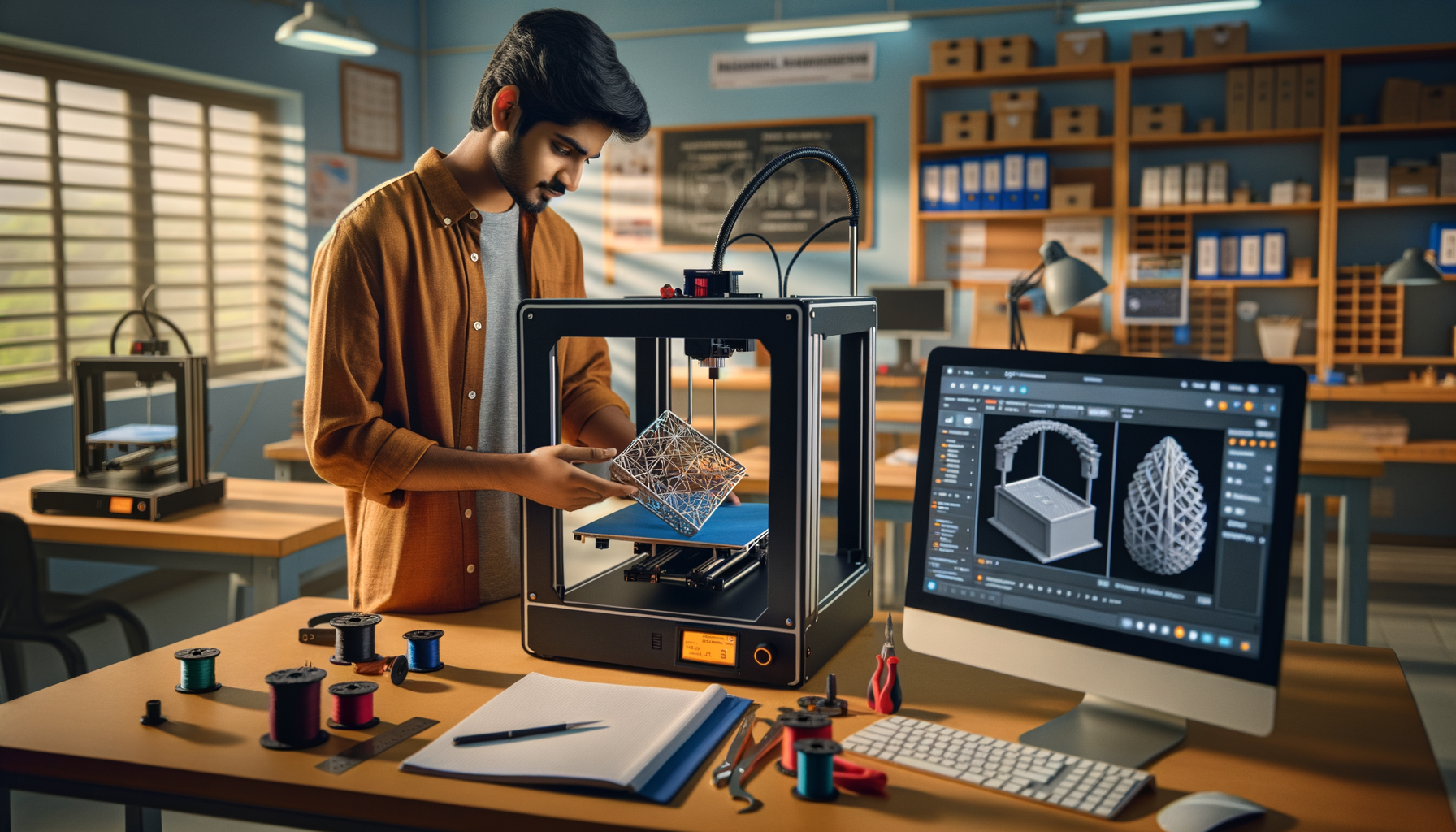
If you already know the basics of additive manufacturing, the next real skill is not just making a print run. It's making it finish flat, dimensionally stable, and production-ready. Advanced warping control in 3D printing India 2026 is a topic serious learners can't ignore, because warping is where hobby-level printing ends and professional workflow begins. Here's the thing: most failed parts don't fail because the model is wrong. They fail because heat flow, adhesion, geometry, and slicer strategy weren't managed together. This is exactly where experienced operators save time, material, and rework.

The video points to a common but important issue: warping happens when model corners curl and lift from the build plate due to uneven cooling and contraction. That sounds simple, but trust me, the fix is rarely one setting. What most people don't realize is that warping is a system problem. Bed prep, chamber temperature, first-layer compression, part orientation, infill style, and even factory air movement all matter. If you're planning to work in prototyping, tooling, or production support roles in Pune, Chhatrapati Sambhajinagar, Sangli, or larger manufacturing hubs, you'll need this deeper workflow.
Why does warping happen in 3D printing even after basic setup?
At beginner level, people blame only bed temperature. At advanced level, you start reading the full thermal story of the part. Warping starts when upper layers cool and shrink at a different rate than lower layers that are still bonded to the build plate. The internal stress pulls corners upward. With materials like ABS and Nylon, this effect is stronger. Even PLA can warp on long flat parts if cooling, adhesion, or part geometry is poor.
In Indian workshops, one practical issue is environmental instability. A printer near a window, fan, or AC vent in summer-winter transitions can behave differently from one in a closed lab. The good news is you can control most of this with a repeatable setup. Professionals don't guess. They standardize.
Which slicer settings reduce warping the most?
If you're using Cura 5.x, PrusaSlicer 2.7, Bambu Studio, or Simplify3D, start by treating first-layer settings as a precision tool, not a default screen you skip. Your first layer height should usually be slightly generous, but not sloppy. For a 0.4 mm nozzle, many professionals run 0.2 to 0.28 mm first layer depending on material and surface. First-layer speed should be slow enough to let the filament wet the bed properly, often 15 to 25 mm/s.
Bed temperature needs to match both material and local conditions. PLA may hold well around 50 to 60°C, PETG around 70 to 85°C, ABS around 90 to 110°C depending on the sheet and machine. Nozzle temperature also matters because poor layer bonding can increase internal stress. If the print is under-extruded or too cold, you'll see edge lift sooner on large footprints.
Use these advanced slicer controls carefully:
- Brim width for long-edge stabilization on flat parts
- Mouse ears on sharp corners where stress concentrates
- Reduced cooling for first layers, especially with ABS and PETG
- Gradual fan ramp-up instead of instant full cooling
- Bottom layer count high enough to resist early distortion
- Infill pattern choice, because grid and line patterns shrink differently
Here's the thing: a brim is not a magic fix. If your Z offset is wrong or the bed isn't uniformly heated, a brim only delays failure.
How do professionals set up the print bed for zero-lift parts?
Bed preparation is where advanced users separate themselves from casual users. Cleanliness is basic, yes, but surface matching is the deeper skill. Smooth PEI, textured PEI, glass with adhesive, Garolite, and engineering sheets all behave differently with PLA, PETG, ABS, TPU, and Nylon.
For example, PETG can grip too aggressively on some smooth sheets, while ABS benefits from enclosed heat and a stable surface. Many labs use glue stick not just for sticking parts down, but as a release control layer. What most people don't realize is that over-adhesion can damage the surface and create inconsistent first layers in the next print.
A professional bed setup checklist includes:
- Manual or mesh leveling verified with a hot bed, not a cold one
- Z offset tuned using actual filament, not paper-only method
- Bed temperature soak for 5 to 10 minutes before printing large parts
- Surface-specific adhesion method documented per material
- Corner inspection during the first three layers, not just layer one
How should you orient a part to prevent warping?
Part orientation is one of the most underused advanced tools. If you place the largest flat face directly on the bed, it may seem stable, but it can also create the maximum stress area. Sometimes rotating the part, splitting it, or adding sacrificial tabs gives better results than forcing a full flat print.
Long rectangular parts are common warping victims. In such cases, adding fillets to sharp corners, reducing footprint stress with cutouts, or printing in sections can improve yield. In real design teams at companies like Tata Technologies, Mahindra Engineering, Bosch, Siemens, and L&T, engineers often modify the print strategy, not just the CAD model, to get a usable prototype faster.
Trust me, if you're printing fixtures, housings, jigs, or concept models for production review, orientation decisions can save hours of machine time and material cost.
Which materials warp more and how should you tune them?
PLA is forgiving, but not immune. PETG is stable for many applications, though stringing and bed interaction need control. ABS and ASA demand enclosure discipline. Nylon adds moisture sensitivity on top of thermal contraction. The deeper skill is understanding that every material needs its own process window.
For PLA, don't overcool very large flat parts in the early layers. For PETG, avoid too much squish and keep adhesion controlled. For ABS, use an enclosure and minimize drafts completely. For Nylon, dry the filament properly before tuning bed and chamber conditions. If you skip drying, you'll chase the wrong problem.
In job roles linked to additive manufacturing in Pune and nearby industrial belts, candidates who can tune materials practically are valued more than those who only know machine names. Entry-level operators may start around ₹2.4 lakh to ₹3.6 lakh per year, while skilled prototyping and application support professionals often move into ₹4.5 lakh to ₹7.5 lakh roles. In stronger product development environments, pay can go higher based on CAD, material, and process knowledge.
Do enclosures and room conditions really matter that much?
Yes, especially once you move beyond PLA hobby prints. An enclosure reduces thermal shock and keeps the print environment stable. Even a good printer can produce poor results if ambient air keeps changing. In Maharashtra, seasonal heat, dust, and airflow variation can affect consistency more than people expect.
The good news is you don't always need an expensive industrial chamber. For many professional desktop setups, a controlled enclosure, proper spool storage, and repeatable room placement solve a big part of the problem. That's why training matters. At ABC Trainings, we tell students not to memorize settings blindly. Learn why a setting works, and you'll troubleshoot faster on any machine.
What is the advanced workflow for debugging warping fast?
Use a structured sequence. Don't change six settings at once. Start with bed surface and Z offset, then verify temperature stability, then cooling, then orientation, then material condition. Print a small corner-stress test before re-running the full model. Keep a logbook or spreadsheet with machine, filament batch, nozzle, bed temp, fan profile, and result. This is how production teams work.
If you're serious about additive manufacturing careers, build a portfolio of solved print failures, not just successful models. Employers at Bajaj Auto, Thermax, Kirloskar, KPIT Technologies, Infosys, TCS, or manufacturing vendors supporting them want people who can solve process issues under pressure.
If you want hands-on guidance on additive manufacturing, slicer tuning, print troubleshooting, and job-ready workflows, you can connect with ABC Trainings at 8698270088 or WhatsApp 7774002496. One or two good mentoring sessions can save you weeks of random trial and error.
How do you build an industry-standard anti-warp workflow in 2026?
Keep it simple and repeatable. Create material-wise print profiles. Standardize bed surfaces. Label successful settings by machine. Use geometry checks before slicing. Preheat properly. Review first layers closely. And after every failed print, identify whether the cause was thermal, mechanical, material-related, or procedural.
Here's the thing: advanced 3D printing isn't about fancy words. It's about control. Once you can predict why a corner lifts before it happens, you've moved from beginner to professional.
Which 3D printing material is best for beginners in Maharashtra weather?
PLA is usually the easiest starting point because it prints at lower temperatures and is less sensitive to enclosure conditions. For students in Pune, Sangli, or Chhatrapati Sambhajinagar, it's a practical way to learn slicer tuning and bed setup. Once you're consistent with PLA, move to PETG and then ABS or Nylon based on your application needs.
Can I fix warping without buying a new 3D printer?
Yes, in many cases you can. Start with bed cleaning, leveling, Z offset correction, proper brim settings, and stable room conditions. A basic enclosure, correct filament storage, and better slicer control often solve more problems than a machine upgrade. Don't spend money before you diagnose the process.
Is additive manufacturing a good career option in Pune in 2026?
Yes, especially if you combine 3D printing with CAD, product design, or manufacturing process knowledge. Pune has strong automotive, engineering, and product development activity, so prototyping and application support roles continue to grow. Students with practical troubleshooting ability usually stand out more than those with only theory certificates.
Where can I learn advanced 3D printing with hands-on practice in Maharashtra?
Look for a training institute that teaches machine setup, slicer tuning, material behavior, print failure analysis, and project workflow, not just basic demo prints. Hands-on exposure matters because every material and machine behaves differently. You can contact ABC Trainings at 8698270088 or WhatsApp 7774002496 to check current batches and practical training options.
Visit Our Centers
Chhatrapati Sambhajinagar
Corporate Office (HQ)
2nd Floor, Kandi Towers, Jalna Road, Amarpreet Chowk, Chhatrapati Sambhajinagar, Maharashtra 431001
Osmanpura Branch
Plot No 14, Shanya Sect, Near Sant Eknath Rang Mandir, Osmanpura, Chhatrapati Sambhajinagar, Maharashtra 431005
CIDCO Branch
Plot No 4, N-3, Cidco, Opp. High Court, Chhatrapati Sambhajinagar, Maharashtra 431003
Pune
Wagholi Branch
1st Floor, ABC Trainings, Laxmi Datta Arcade, Pune - Ahilyanagar Hwy, Wagholi, Pune, Maharashtra 412207
Hadapsar Branch
Bloom Hotel, ABC Trainings 1st Floor, S.no 156/3 Shree Tower Pune - Solapur Rd, Hadapsar, Pune, Maharashtra 411028
Sangli
Sangli Branch
2nd Floor, Vasant Market, Opp. City High School, Sangli, Maharashtra 416416
Start Your Career Journey Today
Join 10,000+ students who transformed their careers with ABC Trainings.
💬 WhatsApp: 7774002496📞 Call: 8698270088