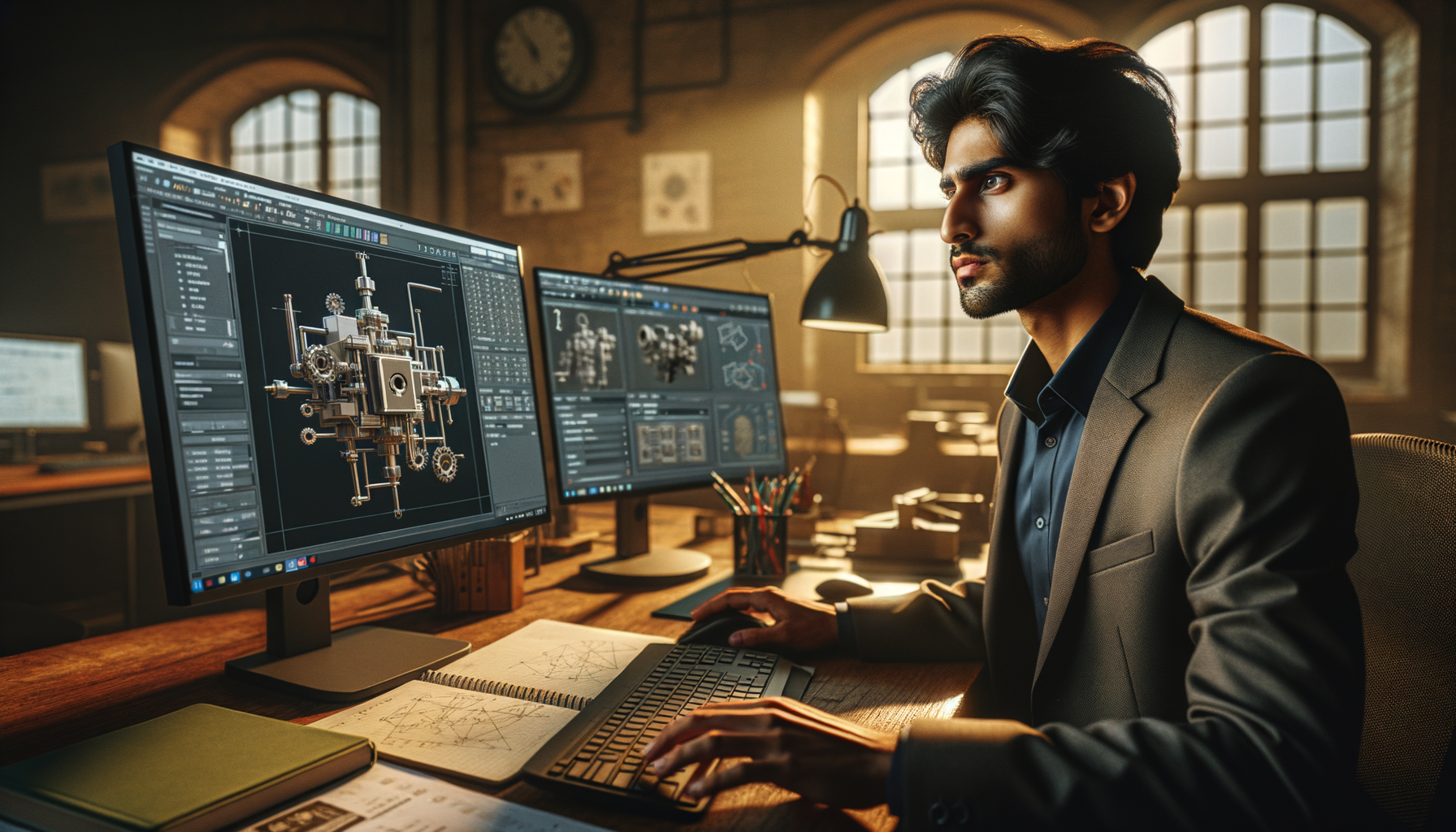
If you already know the basics of 3D CAD and you're wondering what comes next, this is where AI powered 3D CAD modelling starts to matter. In India 2026, mechanical engineers are no longer judged only on whether they can sketch, extrude, revolve, or assemble parts. Employers want speed, cleaner design logic, faster iterations, and the ability to work with modern AI-assisted tools like Zoo CAD software. Here's the thing: basic modelling gets you shortlisted, but advanced workflow thinking gets you hired and promoted.

The raw promise behind Zoo is simple: create complex 3D models in minutes instead of spending hours building every feature manually. But what most people don't realize is that AI CAD isn't magic. If your design intent is weak, your constraints are messy, or your feature tree is unstable, AI suggestions won't save you. Trust me, the engineers who get the best results are the ones who combine strong fundamentals with smart automation habits.
What is AI powered 3D CAD modelling and why does it matter in India 2026?
AI powered 3D CAD modelling means the software assists you in generating geometry, predicting design features, speeding up repetitive operations, and reducing manual rework. Instead of building every shape from scratch, you guide the software with dimensions, intent, references, and design goals. The good news is that this fits perfectly into how manufacturing companies in Maharashtra are changing.
At companies like Bajaj Auto, Mahindra Engineering, Tata Technologies, Bosch, Siemens, and Kirloskar, design teams are under pressure to deliver faster revisions, lightweight components, manufacturable geometry, and better documentation. That means engineers who can move from concept to editable production-ready models quickly have a real advantage. In Pune, Chhatrapati Sambhajinagar, and Sangli, this is becoming a practical skill, not just a trend topic.
How do advanced users actually work faster in Zoo CAD software?
Advanced users don't just click faster. They build models with intent. If you're moving into AI-assisted CAD, your first upgrade should be structure, not speed. Start every model by deciding three things: which dimensions must never change, which features are likely to vary, and which manufacturing process will control the final form.
In Zoo or any modern AI CAD environment, that means:
- Using master sketches only where they simplify control, not where they overcomplicate edits
- Keeping reference planes named clearly for repeat operations
- Separating cosmetic features from critical production geometry
- Applying constraints in a predictable order
- Grouping pattern-driven features logically so AI suggestions stay usable
Here's the thing: if your model tree is chaotic, AI-generated edits become risky. One small change can break downstream geometry. A clean feature strategy is still the backbone of professional modelling.
Which advanced settings improve AI CAD results the most?
This is where many intermediate users get stuck. They try advanced software with default settings and assume the tool is average. Don't do that. In 2026 workflows, you should review system settings before serious modelling.
Template and unit control
Set up templates for millimeters, material defaults, drafting standards, and part naming. Indian manufacturing teams usually expect metric consistency, and one wrong unit assumption can ruin supplier communication.
Constraint visibility
Keep geometric constraints visible while building early-stage sketches. Hide them later if needed. What most people don't realize is that under-constrained sketches are one of the biggest reasons AI-assisted geometry behaves unpredictably.
Regeneration and update settings
For large parts and assemblies, adjust rebuild behavior so every tiny edit doesn't trigger full model regeneration. This alone can save serious time on workstation-heavy projects.
Tolerance and precision display
Use high enough display precision for fit-critical parts, especially if you're preparing models for CNC, casting, or sheet metal validation. Visual rounding creates avoidable mistakes.
How should mechanical engineers use AI without losing design control?
Use AI for acceleration, not blind dependency. That's the professional mindset. Let Zoo help with concept generation, repetitive feature creation, pattern logic, and geometry alternatives. But always verify manufacturability, clearances, wall thickness, mating logic, and drafting feasibility yourself.
For example, if you're modelling an enclosure, bracket, impeller housing, or machine support component, AI may propose a shape that looks efficient but creates tooling issues or poor machining access. Trust me, design departments at L&T, Thermax, Bosch, and Siemens still value engineers who can catch production problems before release.
A strong workflow looks like this:
- Create the base design intent manually
- Use AI to generate or refine repetitive geometry
- Stress-test edits by changing key dimensions
- Check assembly compatibility
- Review manufacturing constraints
- Prepare clean documentation and revision control
What advanced modelling techniques should you master after the basics?
If you've already learned sketches, extrudes, revolves, fillets, and assemblies, go deeper into techniques that actually matter in industry.
Multi-body modelling
This is essential for conceptual machine parts, welded structures, molded products, and mechanism layouts. It lets you test interactions before final part separation.
Top-down assembly logic
Instead of creating isolated parts first, drive geometry from assembly-level references where appropriate. This is useful in fixtures, packaging systems, and machine design.
Configuration management
Create controlled design variants without copying files repeatedly. This matters for product families, vendor-specific versions, and customer modifications.
Surface-assisted solid modelling
Even if you're not a full surfacing expert, you should know how to use surfaces to repair, trim, guide, and transition difficult forms cleanly.
Design automation with parameters
If Zoo supports AI-assisted parametric logic, use it for dimensions that repeat across product lines. The good news is that even moderate parameter discipline can cut hours from revision cycles.
What are the biggest mistakes engineers make with AI CAD tools?
The most common mistake is trusting the first output. AI-generated geometry can be visually impressive but structurally poor. Another major issue is feature tree laziness. Engineers assume the software will handle bad modelling habits. It won't.
Watch for these mistakes:
- Using AI-generated shapes without checking wall thickness or draft needs
- Ignoring sketch constraints because the model “looks fine”
- Overusing auto-features that create hard-to-edit history trees
- Skipping naming conventions for planes, sketches, and bodies
- Failing to test what happens when dimensions change late in the project
Here's the thing: advanced CAD isn't about flashy commands. It's about predictable output under pressure.
What job roles and salaries can AI CAD skills unlock in Maharashtra?
If you combine traditional mechanical design with AI-assisted modelling, you can target roles like CAD Design Engineer, Product Design Engineer, Mechanical Modelling Specialist, Design Automation Engineer, and CAD Application Engineer. Freshers with strong portfolios in Pune or Chhatrapati Sambhajinagar may start around ₹2.8 lakh to ₹4.5 lakh per year. Engineers with 2 to 5 years of relevant modelling skill can move into ₹5.5 lakh to ₹9 lakh roles, especially in automotive, industrial equipment, and product development environments.
At firms connected to automotive, manufacturing, and engineering services such as Tata Technologies, KPIT Technologies, Bajaj Auto, Mahindra Engineering, and Bosch, faster modelling plus cleaner revisions can directly improve your value. If you can show advanced CAD workflow discipline instead of only software familiarity, you stand out.
Where can you learn advanced AI CAD workflows in Maharashtra?
If you're serious about building this skill properly, don't just watch isolated software demos. You need guided practice with modelling logic, settings, design intent, and revision strategy. ABC Trainings works well for students and working engineers who want practical CAD learning connected to real job expectations in Maharashtra. If you want course details, call 8698270088 or WhatsApp 7774002496.
The good news is that AI CAD tools are making advanced modelling more accessible. But trust me, software alone won't create an expert. Repetition, correction, and project-based practice will. That's why many learners from Pune, Sangli, and Chhatrapati Sambhajinagar prefer structured training at ABC Trainings rather than random trial and error.
Should you switch from traditional CAD to AI-assisted CAD now?
Yes, but don't abandon fundamentals. The smartest approach is hybrid. Keep your core mechanical design skills sharp and add AI-assisted workflow speed on top. What most people don't realize is that companies aren't replacing engineers with software. They're replacing slow, inconsistent workflows with faster, smarter ones.
If you already know CAD basics, 2026 is the right time to go deeper. Learn how to control AI, not just use it. That's the difference between an average operator and a design professional.
Is AI powered CAD useful for fresh mechanical engineers in Maharashtra?
Yes, especially if you already know basic 2D and 3D modelling. Companies in Pune and nearby industrial areas increasingly value engineers who can produce faster design iterations and cleaner parametric models. If you're a fresher, AI CAD won't replace fundamentals, but it can make your portfolio and interview performance much stronger.
Can Zoo CAD software help me get a job in Pune automotive companies?
It can help if you use it to build industry-relevant projects, not just random practice models. Automotive employers look for design intent, assembly understanding, manufacturability, and revision control. If your Zoo-based work shows those skills clearly, it can support job applications at companies linked to Bajaj Auto, Tata Technologies, and Mahindra Engineering.
What should I learn after basic 3D modelling in CAD?
Focus on parametric control, top-down assemblies, configurations, multi-body modelling, and surface-assisted workflows. You should also learn how to organize feature trees, manage templates, and validate design edits properly. These are the skills that separate a basic CAD user from someone ready for production work.
Where can I learn advanced CAD with AI features in Maharashtra?
Look for training that teaches workflow, not just commands. A good institute should cover real modelling strategy, design intent, project practice, and industry-ready settings. For Maharashtra students and working professionals, ABC Trainings is one practical option; you can call 8698270088 or WhatsApp 7774002496 for details.
Visit Our Centers
Chhatrapati Sambhajinagar
Corporate Office (HQ)
2nd Floor, Kandi Towers, Jalna Road, Amarpreet Chowk, Chhatrapati Sambhajinagar, Maharashtra 431001
Osmanpura Branch
Plot No 14, Shanya Sect, Near Sant Eknath Rang Mandir, Osmanpura, Chhatrapati Sambhajinagar, Maharashtra 431005
CIDCO Branch
Plot No 4, N-3, Cidco, Opp. High Court, Chhatrapati Sambhajinagar, Maharashtra 431003
Pune
Wagholi Branch
1st Floor, ABC Trainings, Laxmi Datta Arcade, Pune - Ahilyanagar Hwy, Wagholi, Pune, Maharashtra 412207
Hadapsar Branch
Bloom Hotel, ABC Trainings 1st Floor, S.no 156/3 Shree Tower Pune - Solapur Rd, Hadapsar, Pune, Maharashtra 411028
Sangli
Sangli Branch
2nd Floor, Vasant Market, Opp. City High School, Sangli, Maharashtra 416416
Start Your Career Journey Today
Join 10,000+ students who transformed their careers with ABC Trainings.
💬 WhatsApp: 7774002496📞 Call: 8698270088