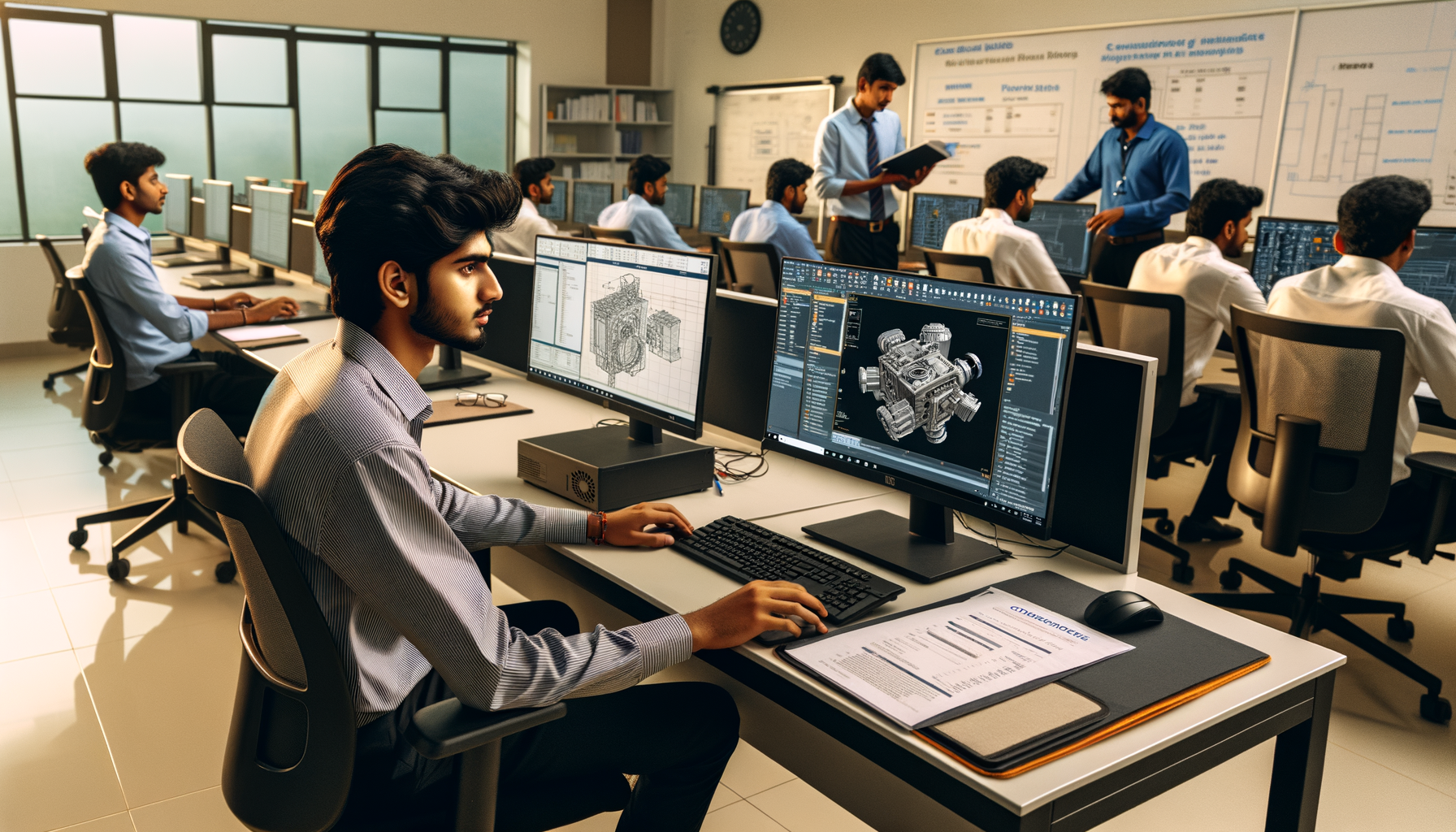
Degree but no job in Maharashtra 2026 is no longer a rare problem. It's a daily reality for students across Latur, Pune, Chhatrapati Sambhajinagar, Sangli, and many other cities. Here's the thing: the issue is usually not the degree itself. The issue is the gap between what colleges teach and what companies actually expect on day one. In a recent discussion around education and industry alignment, this truth came out very clearly: if education and industry don't work together, students end up qualified on paper but stuck in real hiring.
If you've already understood the basics of career planning and now want the deeper strategy, let's go beyond generic advice. This is about advanced career positioning, industry-standard preparation, and the practical workflow serious students use to become employable faster.

Why do degree holders still struggle to get jobs in Maharashtra?
What most people don't realize is that companies don't hire degrees. They hire capability, consistency, communication, and problem-solving. A mechanical student may know theory but fail a design test in AutoCAD 2026 or SOLIDWORKS 2025. A civil student may know classroom concepts but struggle with Revit, quantity takeoff logic, or project documentation. An IT student may know syntax but freeze during a practical task, debugging round, or client-style assignment.
That gap is visible across hiring in companies such as Tata Technologies, Mahindra Engineering, Bosch, Siemens, Infosys, TCS, KPIT Technologies, Thermax, Bajaj Auto, Kirloskar, and L&T. These employers want students who can contribute with minimal hand-holding. Trust me, recruiters can spot the difference in 10 minutes.
In many colleges, students still follow a marks-first approach. Industry follows an output-first approach. That's the mismatch.
What is the real gap between education and industry?
The good news is, this gap is specific. That means it can be fixed. In most cases, the problem sits in five areas:
1. Tool exposure is too basic
Students often stop at introductory software knowledge. Industry expects production-level accuracy. For example, in design roles, basic drafting is not enough. You should know templates, layers, annotation standards, revision control, plotting discipline, file naming, and team handoff workflows.
2. Students don't build proof of work
A degree certificate tells recruiters you studied. A portfolio tells them you can do the job. That's a huge difference. Mechanical students need model sets, manufacturing drawings, assemblies, and tolerance-based documentation. Civil students need plans, sections, BOQ-linked outputs, and BIM-based coordination samples. IT students need GitHub projects, test cases, dashboards, or live applications.
3. Communication is weak in technical context
Many students can speak casually but cannot explain their own project clearly. In interviews, that becomes a problem. Industry wants structured communication: problem, method, tool, output, result.
4. No exposure to deadlines and review cycles
Real work means revisions, comments, client changes, and submission pressure. College assignments rarely simulate that properly. So students get shocked in their first job.
5. Training is not mapped to local hiring demand
A student in Pune should know which industries are actively hiring nearby. The same applies to Chhatrapati Sambhajinagar, Latur, Kolhapur, Nashik, and Sangli. Skills must match local demand, not random internet trends.
How should advanced students prepare beyond the basics?
If you've already completed your degree or you're in the final year, don't repeat beginner mistakes. Use an advanced preparation workflow.
Start with role-based skill mapping
Pick the exact role first: Design Engineer, BIM Modeler, QA Tester, MIS Executive, Full Stack Developer, CNC Programmer, Electrical Design Engineer, or Data Analyst. Once the role is clear, map the exact software, interview tasks, and output expectations.
For example, if you're targeting a mechanical design role in Pune or Chakan, your stack may include AutoCAD 2026, SOLIDWORKS 2025, GD&T basics, BOM structure, assembly logic, and drawing release workflow. If you're targeting IT support or software roles, your preparation may include SQL, Excel automation, ticket handling logic, API basics, testing flow, and documentation.
Train on industry-standard settings, not classroom defaults
This is where serious students move ahead. Don't just learn the software interface. Learn professional settings. In CAD, that means units, templates, title blocks, annotation scales, dimension styles, plotting standards, revision tables, and layer discipline. In IT, that means naming conventions, file structure, code readability, test documentation, and version control habits.
What most people don't realize is that these "small" settings create a professional impression immediately.
Build project sets, not isolated files
One drawing or one coding file is not enough. Industry works in sets. Create mini-project packs. A mechanical student can create part files, assemblies, 2D manufacturing drawings, exploded views, and BOM output. A civil student can create coordinated sheets, schedules, and model snapshots. An IT student can build one complete workflow: login, validation, database logic, reporting, and testing notes.
That's how you show depth.
Which advanced habits actually improve employability?
Let's keep this practical. These are the power-user habits that separate shortlisted students from ignored ones.
Document every project properly
Name files correctly. Maintain version history. Save screenshots of stages. Write a short note on what problem you solved. This matters because interviewers often ask you to explain your own project process, not just the final output.
Practice under time limits
If a design task normally takes you 3 hours, train yourself to finish a clean version in 90 minutes. If a testing assignment takes 2 hours, practice a one-hour version. Speed with accuracy matters.
Learn review correction workflow
At companies like Siemens, Bosch, TCS, or L&T, your first version is rarely the final version. Learn how to receive comments, fix them, and resubmit without confusion. That's a real professional skill.
Use interview language, not student language
Don't say, "I know software." Say, "I created assembly models, generated manufacturing drawings, and maintained drawing standards using SOLIDWORKS 2025." Don't say, "I did a coding project." Say, "I built CRUD functionality with database integration and tested validation scenarios."
How much salary can students realistically expect in 2026?
Let's be honest. Salary depends on skill proof, city, and role readiness. For freshers in Maharashtra, realistic starting numbers often look like this:
Core CAD or design support roles: ₹2.4 lakh to ₹4.2 lakh per year.
Mechanical design roles with solid software skills: ₹3 lakh to ₹5.5 lakh per year.
BIM or civil modeling roles: ₹2.8 lakh to ₹5 lakh per year.
Entry-level IT support, testing, or developer roles: ₹3 lakh to ₹6 lakh per year.
MIS, Excel, and reporting roles: ₹2.5 lakh to ₹4.5 lakh per year.
Students with weak practical skills usually stay near the lower end. Students who can demonstrate real outputs often move faster, especially in Pune, Mumbai, and industrial belts around Chakan, Pimpri-Chinchwad, and Nashik.
What should colleges and training institutes do differently?
The strongest message from education leaders who understand this problem is simple: education and industry must work together. Colleges can't stop at syllabus delivery. They need project-based training, employer interaction, practical tool exposure, review-based assignments, and local industry alignment.
Training institutes also have a responsibility. ABC Trainings, for example, works best when students use the institute not just for certificate collection but for skill sharpening, mock interviews, and project building. That's where employability improves.
Here's the thing: a certificate can open a door, but only practical ability keeps you inside the room.
What is the best action plan if you already have a degree but no job?
If you're stuck right now, follow this sequence:
First, choose one target role only.
Second, list the exact tools and tasks that role needs.
Third, spend 6 to 12 weeks building project-based proof.
Fourth, improve technical communication and interview answers.
Fifth, apply with a role-specific resume and portfolio, not a generic one.
Trust me, students waste months because they stay vague. The moment your target becomes specific, your progress becomes measurable.
If you want help identifying the right CAD or IT path in Maharashtra, you can speak with ABC Trainings at 8698270088 or WhatsApp 7774002496. Whether you're from Latur, Pune, Sangli, or Chhatrapati Sambhajinagar, the good news is your degree is not useless. It just needs to be matched with employable skill depth.
Degree complete ho gaya, ab job ke liye sabse pehle kya karun?
Sabse pehle random applications band karo and one target role choose karo. Us role ke liye required software, project type, and interview questions list karo. Uske baad 6-8 weeks ka focused practice plan banao with proof of work. Maharashtra mein employers generic fresher se zyada role-ready fresher ko prefer karte hain.
Maharashtra mein degree ke baad short-term skill course useful hai kya?
Haan, but only if the course is job-role based and practical ho. Agar course mein projects, software practice, review corrections, and interview prep hai, tab uski value real hoti hai. CAD, BIM, testing, Excel-MIS, and programming based short-term courses Pune, Chhatrapati Sambhajinagar, and Sangli mein useful ho sakte hain. Sirf certificate ke liye course karna time waste ho sakta hai.
Engineering students ke liye companies kis type ka practical skill check karti hain?
Companies usually software handling, problem-solving, drawing or coding accuracy, and communication check karti hain. Mechanical roles mein drafting standards, assemblies, and documentation poocha ja sakta hai. Civil roles mein model understanding, plans, schedules, and quantity logic dekha ja sakta hai. IT roles mein SQL, debugging, testing flow, Excel, or basic development tasks common hote hain.
Freshers ko Pune ya Maharashtra mein kitna package mil sakta hai?
Freshers ke liye ₹2.4 lakh se ₹6 lakh per year ka range common hai, depending on role and skill level. Basic knowledge wale students usually lower bracket mein start karte hain. Agar aapke paas project portfolio, software depth, and confident interview performance hai, to better package mil sakta hai. Pune, Mumbai, and industrial zones generally better salary opportunities dete hain compared to smaller towns.
Visit Our Centers
Chhatrapati Sambhajinagar
Corporate Office (HQ)
2nd Floor, Kandi Towers, Jalna Road, Amarpreet Chowk, Chhatrapati Sambhajinagar, Maharashtra 431001
Osmanpura Branch
Plot No 14, Shanya Sect, Near Sant Eknath Rang Mandir, Osmanpura, Chhatrapati Sambhajinagar, Maharashtra 431005
CIDCO Branch
Plot No 4, N-3, Cidco, Opp. High Court, Chhatrapati Sambhajinagar, Maharashtra 431003
Pune
Wagholi Branch
1st Floor, ABC Trainings, Laxmi Datta Arcade, Pune - Ahilyanagar Hwy, Wagholi, Pune, Maharashtra 412207
Hadapsar Branch
Bloom Hotel, ABC Trainings 1st Floor, S.no 156/3 Shree Tower Pune - Solapur Rd, Hadapsar, Pune, Maharashtra 411028
Sangli
Sangli Branch
2nd Floor, Vasant Market, Opp. City High School, Sangli, Maharashtra 416416
Start Your Career Journey Today
Join 10,000+ students who transformed their careers with ABC Trainings.
💬 WhatsApp: 7774002496📞 Call: 8698270088