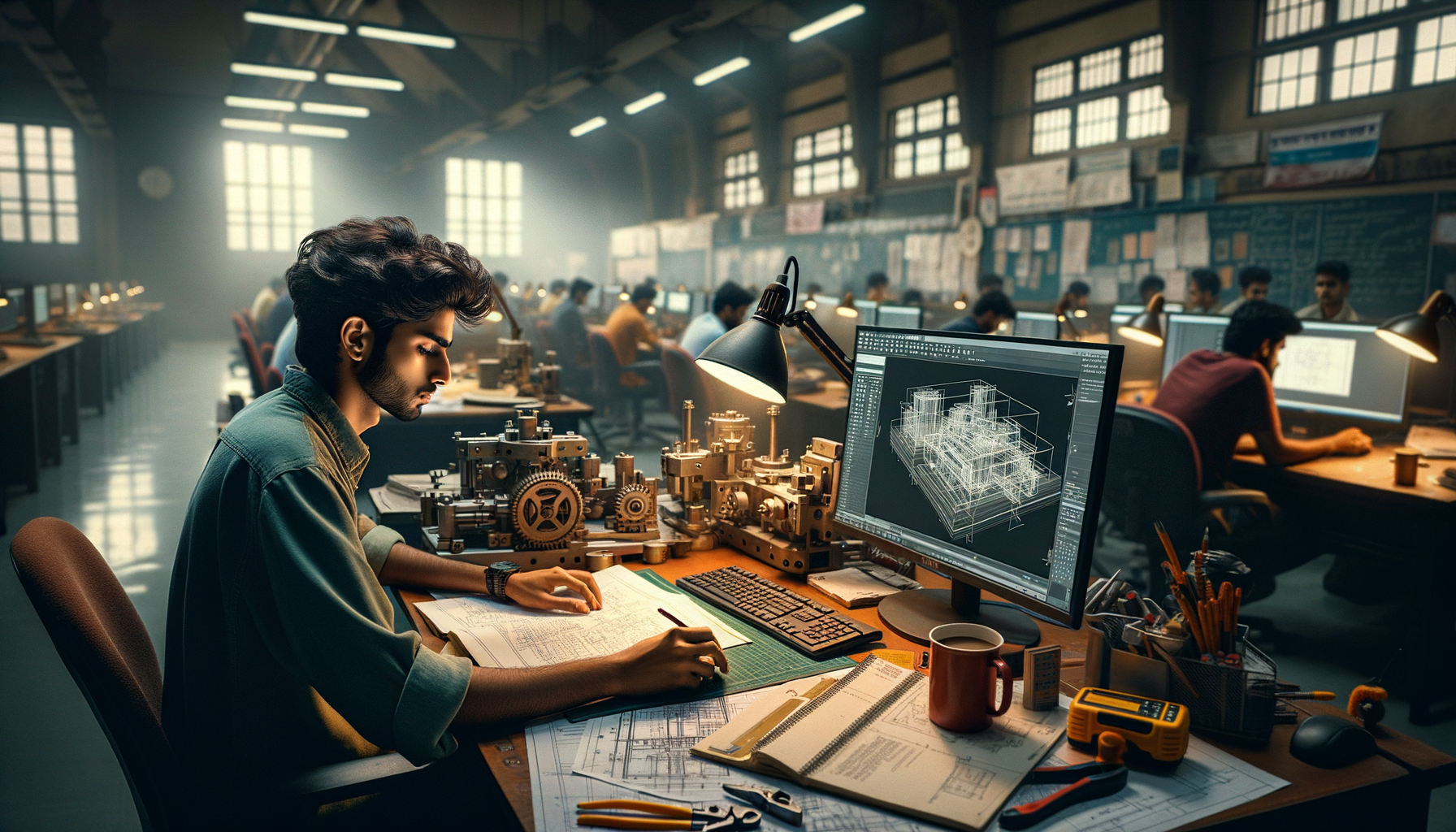
If you're searching for a Diploma in Product Designing in India, you probably already know the basics of CAD and mechanical drawing. Now you want the real picture: what an advanced diploma should actually teach, which software matters in industry, and how to move from classroom sketches to production-ready models. Here's the thing: most students don't struggle because they lack interest. They struggle because they learn commands, not workflows. A serious product designing diploma in 2026 must train you like a design engineer, not just a software operator.

The video overview of ABC Trainings' diploma points in the right direction: practical software, project-based learning, and career support for mechanical engineering and diploma students. The good news is, if you choose the right training path, you'll build skills relevant to companies like Bajaj Auto, Tata Technologies, Mahindra Engineering, Bosch, Siemens, Kirloskar, and Thermax.
What should a Diploma in Product Designing include in 2026?
A proper diploma should go far beyond 2D drafting. At advanced level, you should be trained in the full product development cycle: concept sketching, 3D part modelling, assembly design, motion checks, manufacturing drawings, tolerance control, and design change management.
At minimum, the software stack should include tools commonly used in Indian industry such as AutoCAD 2026 for documentation, SolidWorks 2025 for parametric design, CATIA V5 for complex product surfacing and assembly work, and Creo for production-oriented modelling in manufacturing environments. If your course stops at basic extrude, revolve, and assembly mating, trust me, that's not enough.
What most people don't realize is that companies don't hire just because you can model a bracket. They hire when you can create editable, revision-friendly, manufacturable design data.
Which advanced product design skills do companies actually expect?
Once basics are clear, industry expects speed, structure, and decision-making. Advanced learners should focus on these areas:
- Parametric modelling strategy: building features in the right order so edits don't break downstream geometry
- Top-down assembly workflows: using master sketches, layout parts, and references for controlled design changes
- GD&T and tolerance stack-up: understanding how design intent reaches manufacturing and inspection
- Sheet metal and weldment design: common in fabrication, enclosures, frames, and industrial products
- Surface modelling: essential for consumer products, automotive trims, housings, and ergonomic parts
- Drawing automation: templates, BOM tables, revision blocks, and standard views for faster release
- Design for manufacturing: casting, machining, injection moulding, bending, and assembly constraints
These are the skills that separate a fresher from a candidate who can contribute from month one.
How do advanced CAD workflows improve your job readiness?
Let's be direct. Basic learners model one part at a time. Advanced learners think in systems. Suppose you're designing a gearbox housing, a jig fixture, or a sheet metal control box. A professional workflow means you'll define naming conventions, use standard planes properly, avoid unstable references, and maintain clean feature trees.
In SolidWorks 2025, that means using equations, design tables, configurations, and library features where needed. In CATIA V5, it means managing publications, constraints, and assembly structure correctly. In Creo, it means controlling parent-child relationships so regeneration doesn't become a nightmare.
Here's the thing: interviewers at firms supporting L&T, Siemens, Bosch, or Tata Technologies often ask scenario-based questions. They want to know how you'll update 25 related parts after one dimension changes, not whether you remember where the fillet icon is.
What projects should you build in a serious product designing diploma?
Project quality matters more than the course brochure. A strong diploma should include parts and assemblies that reflect real manufacturing work in Maharashtra and across India. Good project themes include:
- Machine components like couplings, housings, shafts, pulleys, and bearing supports
- Industrial sheet metal enclosures with flat patterns and bend deductions
- Fixture and jig assemblies for manufacturing setups
- Consumer product casings requiring surfacing and split-body logic
- Automotive subassemblies such as brackets, mounts, covers, and support systems
- BOM-driven assemblies with exploded views and manufacturing drawings
Trust me, one well-documented assembly project with proper drawings, tolerances, and revision logic is worth more than ten random practice files.
Which settings and standards should advanced learners master?
This is where many students lose marks in interviews and test assignments. You should be comfortable with industry-standard settings, not just default software options.
- Units and templates: mm, decimal precision, ISO standards, custom material libraries
- Drawing standards: first-angle projection, line weights, annotation styles, title blocks
- Tolerance standards: limits, fits, geometric tolerances, datums, surface finish symbols
- File management: version naming, folder discipline, linked references, revision backups
- BOM structure: part numbering, descriptions, quantities, purchased vs manufactured parts
The good news is, once these habits become routine, your work starts looking professional immediately. That's one reason students from structured institutes like ABC Trainings tend to perform better in practical tests.
What are the efficiency tricks power users know?
Advanced product designers don't just work hard. They remove repetitive work. Here are some high-value habits:
- Create reusable templates for parts, assemblies, and drawings
- Use keyboard shortcuts and mouse gestures instead of hunting commands
- Build standard hardware libraries and toolbox components
- Use symmetry and pattern logic early to reduce edit time
- Keep sketches fully defined and simple rather than overloaded
- Use configurations for size variants instead of separate files
- Automate title blocks, BOMs, and drawing notes wherever possible
What most people don't realize is that design productivity is a hiring advantage. If two candidates know the same software, the one who works 30% faster with fewer model failures usually gets selected.
What jobs can you get after a product designing diploma in Maharashtra?
After completing a strong diploma, typical entry roles include Design Engineer Trainee, Junior Mechanical Design Engineer, CAD Engineer, Product Design Executive, Production Design Support Engineer, and R&D Design Assistant. In cities like Pune, Chhatrapati Sambhajinagar, Nashik, Sangli, and Kolhapur, demand is tied to automotive, industrial equipment, fabrication, and manufacturing support sectors.
Freshers with only basic software exposure may start around ₹2.4 lakh to ₹3.2 lakh per year. Candidates with a project-rich portfolio, GD&T understanding, and assembly workflow skills can target ₹3.5 lakh to ₹5.5 lakh per year. In strong clusters around Pune, candidates placed through vendor ecosystems supporting Mahindra Engineering, Bajaj Auto, KPIT Technologies, Bosch, or Tata Technologies can grow faster after 12 to 24 months of experience.
How should you choose the right institute for product designing?
Don't choose based only on certificate design or course duration. Ask sharper questions. Will they train you on real projects? Do they cover drawings and tolerances, not just 3D modelling? Will you learn editing strategies, assembly methods, and manufacturing logic? Is there interview preparation for design roles?
If you're in Maharashtra, ABC Trainings is one name many students consider because of its practical orientation and strong presence. If you want details about the Diploma in Product Designing, call 8698270088 or WhatsApp 7774002496.
Here's the thing: a diploma becomes valuable only when it changes how you think. You should finish the course able to open a design problem, plan the model structure, build it cleanly, document it correctly, and explain manufacturing intent with confidence. That's what companies pay for in 2026.
Is a Diploma in Product Designing good for mechanical diploma students in Maharashtra?
Yes, especially if you already understand basic engineering drawing and want job-ready CAD skills. Mechanical diploma students from Pune, Chhatrapati Sambhajinagar, Sangli, and nearby cities often use this path to enter design, production support, or R&D roles. The key is choosing a course that includes projects, drawings, and advanced workflows instead of only basic commands.
Which software should I learn first in a product design diploma?
Start with AutoCAD for drafting discipline, then move into SolidWorks or Creo for parametric 3D modelling and assemblies. CATIA V5 becomes important if you're targeting automotive or complex surface-based roles. In India, the best sequence depends on your target industry, but for most students, drafting plus one strong 3D platform is the minimum.
What salary can a fresher get after a product designing course in Pune?
For freshers, salaries commonly start between ₹2.4 lakh and ₹3.2 lakh per year if skills are basic. If you have strong assembly projects, GD&T knowledge, and interview-ready drawings, ₹3.5 lakh to ₹5.5 lakh per year is realistic in Pune and surrounding industrial belts. Actual numbers depend on software depth, portfolio quality, and communication during technical interviews.
How do I know if a product design course is advanced or just basic?
Check whether the syllabus includes parametric modelling strategy, top-down assemblies, GD&T, sheet metal, surfacing, BOMs, and manufacturing drawings. A basic course teaches commands; an advanced course teaches problem-solving and revision-safe workflows. Ask for sample student projects before joining, and if you need help comparing options, contact ABC Trainings at 8698270088 or WhatsApp 7774002496.
Visit Our Centers
Chhatrapati Sambhajinagar
Corporate Office (HQ)
2nd Floor, Kandi Towers, Jalna Road, Amarpreet Chowk, Chhatrapati Sambhajinagar, Maharashtra 431001
Osmanpura Branch
Plot No 14, Shanya Sect, Near Sant Eknath Rang Mandir, Osmanpura, Chhatrapati Sambhajinagar, Maharashtra 431005
CIDCO Branch
Plot No 4, N-3, Cidco, Opp. High Court, Chhatrapati Sambhajinagar, Maharashtra 431003
Pune
Wagholi Branch
1st Floor, ABC Trainings, Laxmi Datta Arcade, Pune - Ahilyanagar Hwy, Wagholi, Pune, Maharashtra 412207
Hadapsar Branch
Bloom Hotel, ABC Trainings 1st Floor, S.no 156/3 Shree Tower Pune - Solapur Rd, Hadapsar, Pune, Maharashtra 411028
Sangli
Sangli Branch
2nd Floor, Vasant Market, Opp. City High School, Sangli, Maharashtra 416416
Start Your Career Journey Today
Join 10,000+ students who transformed their careers with ABC Trainings.
💬 WhatsApp: 7774002496📞 Call: 8698270088