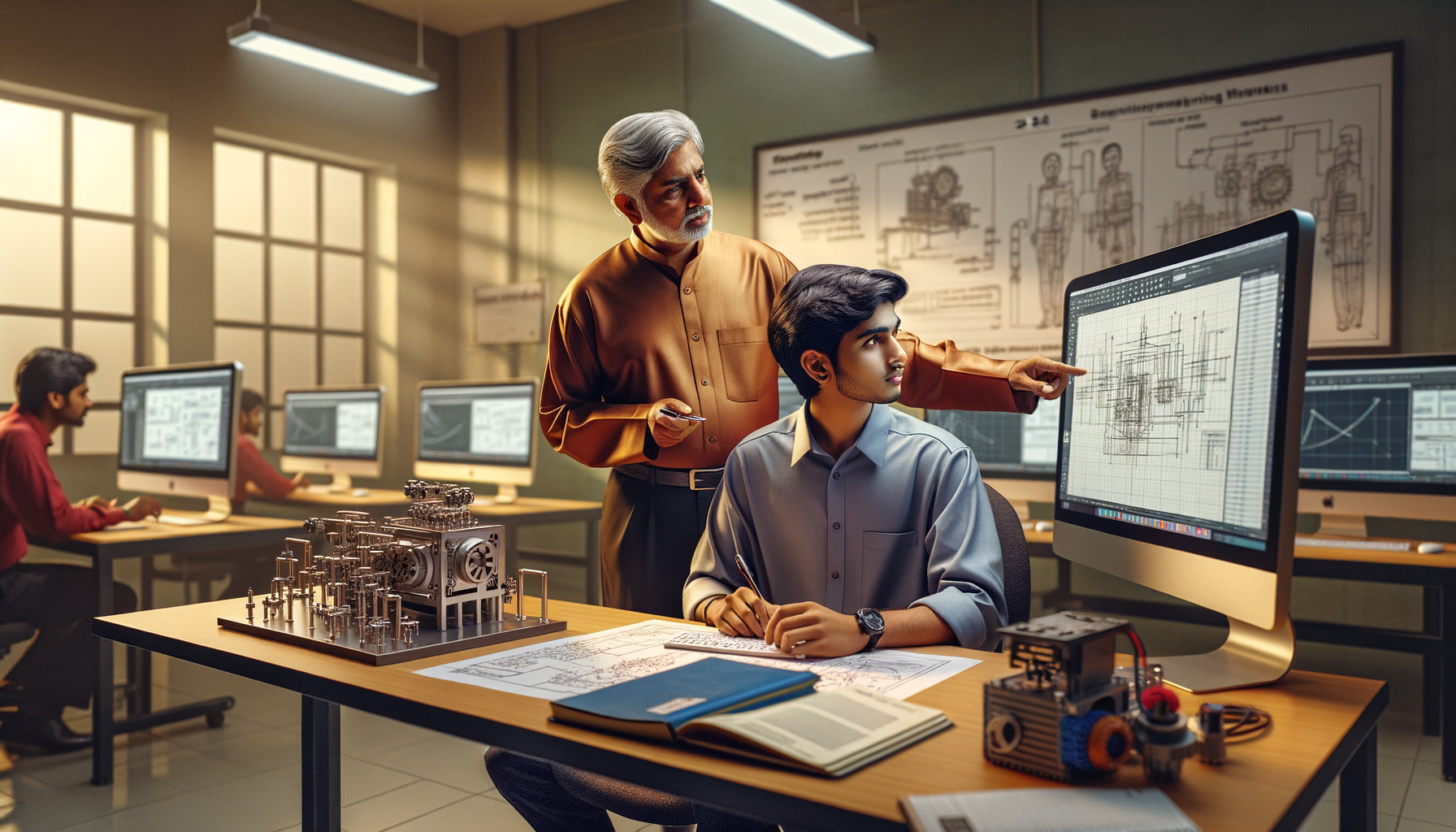
If you're searching for an engineering career roadmap India 2026 and you already know the basics, you're asking the right question. A degree gives you theory, but hiring teams at companies like Tata Technologies, Mahindra Engineering, L&T, Bosch, Siemens, KPIT Technologies, TCS, and Infosys usually expect much more. Here's the thing: students who grow faster aren't always the toppers. They're the ones who build depth in software, projects, documentation, communication, and interview proof. This guide is for that stage where you know the fundamentals, but you want a serious plan to become industry-ready.

The video from ABC Trainings points in a simple direction: move step by step from college learning to practical skills, real-time projects, and job preparation. The good news is, once you understand that roadmap, you can start making smarter choices instead of collecting random certificates. Let's go deeper into the advanced version of that roadmap, the one professionals actually respect.
What is the advanced engineering career roadmap after college basics?
At the beginner level, most students focus on passing exams and learning one or two software tools. At the advanced level, the roadmap changes. Now the goal is to become employable for a specific role.
That means you need five layers working together:
- Core domain clarity — Mechanical, Civil, Electrical, or IT
- Software depth — not just opening the tool, but using industry-standard workflows
- Project evidence — work you can explain in interviews
- Documentation and communication — drawings, reports, presentations, email discipline
- Placement readiness — resume, mock interviews, aptitude, salary positioning
What most people don't realize is that recruiters often reject students not because they lack talent, but because their skills look disconnected. Your roadmap should show progression: basics to specialization to proof of work to interview conversion.
How should Mechanical students go deeper in 2026?
If you're from Mechanical, don't stop at basic AutoCAD or basic modeling. Trust me, companies don't pay for button clicks. They pay for accuracy, revision control, manufacturability, and speed.
An advanced roadmap for Mechanical students usually looks like this:
- CAD mastery in AutoCAD 2026, SOLIDWORKS 2025, or CATIA-based workflows depending on target companies
- Drawing standards — GD&T basics, tolerancing logic, BOM structure, title block discipline
- Assembly strategy — top-down vs bottom-up modeling
- Design intent — parametric control so edits don't break the model
- Manufacturing awareness — sheet metal, weldments, machining constraints
- Project package — 3D model, 2D drawings, exploded view, BOM, revision notes
If you're aiming for Bajaj Auto, Bosch, Kirloskar, Thermax, or Tata Technologies, your portfolio should show more than parts. Build one full assembly and explain why dimensions, materials, and tolerances were selected. That's what separates a trained student from a job-ready candidate.
How should Civil students build an industry-ready roadmap?
Civil students often make one mistake: learning software without linking it to actual project workflow. Knowing commands in AutoCAD or Revit is useful, but companies care about how you read plans, coordinate services, prepare quantities, and avoid site-level confusion.
An advanced Civil roadmap should include:
- AutoCAD 2026 for drafting speed and layer discipline
- Revit 2025 for model-based documentation
- BOQ and estimation logic using Excel
- Drawing interpretation — architectural, structural, and MEP coordination awareness
- Sheet setup standards — scales, annotation, title blocks, plotting
- Project-based output — residential, commercial, or infrastructure drawing set
For employers like L&T or contractors working in Pune, Chhatrapati Sambhajinagar, Nashik, and Nagpur, speed matters, but coordination matters more. The student who can spot drawing clashes and explain them clearly will always stand out.
What is the best advanced roadmap for Electrical and IT students?
Electrical and IT students need a roadmap that mixes technical depth with practical execution.
For Electrical students, the advanced path should include CAD-based electrical drafting, panel layout understanding, SLD interpretation, load schedule logic, and documentation habits. If you're targeting industrial roles around Pune, Aurangabad region, or Kolhapur belts, companies value candidates who can connect design with execution.
For IT students, the roadmap must go beyond coding syntax. Focus on project architecture, debugging discipline, database structure, version control, testing, and deployment basics. Infosys, TCS, KPIT Technologies, and Siemens teams usually prefer candidates who can explain how a project was built, not just what language they learned.
Here's a practical rule: if your project can't survive five interview questions, it's not ready for your resume.
Which advanced software and workflow settings matter in real jobs?
This is where serious students gain an edge. Software knowledge becomes valuable when you use professional settings and repeatable workflows.
For CAD and design roles
- Create and use templates with proper units, dimension styles, text styles, and layers
- Build custom blocks or library components for repeated elements
- Use sheet standards so every drawing looks consistent
- Follow revision naming rules for files and exports
- Learn keyboard shortcuts and command aliases to reduce drafting time
For Excel and reporting work
- Use structured tables instead of random ranges
- Clean data with formulas before making reports
- Build reusable dashboards instead of one-time sheets
- Document assumptions so your manager can trust the output
For IT project work
- Use Git and proper commit messages
- Maintain folder structure and naming standards
- Write README files that explain project setup
- Test edge cases before demo day
What most people don't realize is that hiring managers notice these habits immediately. They signal maturity.
How do you build projects that actually help in placements?
Don't collect ten weak projects. Build two or three strong ones. That's the better strategy.
Your project should answer these questions:
- What problem were you solving?
- What software or tools did you use?
- What standards or assumptions did you follow?
- What errors or constraints did you face?
- What final output did you generate?
For Mechanical, that could be a machine assembly with complete drawings and BOM. For Civil, a coordinated building model with sheets and quantity logic. For Electrical, panel or wiring documentation. For IT, a deployed app with database and testing notes.
The good news is, even a student project can look professional if it's documented properly. Add screenshots, version notes, calculations, and final outputs in one clean PDF portfolio.
How should you prepare for engineering interviews in Maharashtra?
Students in Pune, Chhatrapati Sambhajinagar, Sangli, Satara, and Solapur often ask why interviews go wrong even after training. Usually it's because preparation is too generic.
Advanced interview prep means:
- Role-based answers — design engineer, BIM modeler, CAD drafter, QA engineer, support engineer
- Project storytelling — explain your project in 90 seconds and 5 minutes
- Software defense — justify why you used a feature or workflow
- Salary awareness — freshers may start around ₹2.4 lakh to ₹4.8 lakh annually, while stronger software-plus-project profiles can push toward ₹5.5 lakh in the right role and city
- Mock interviews — especially technical and HR rounds
Trust me, confidence doesn't come from motivation videos. It comes from repetition. Practice explaining your work until it sounds natural, specific, and believable.
What does a smart 6-month roadmap look like for advanced learners?
Here's a structure that works well if you already know the basics:
Month 1-2: Skill Deepening
Choose one role and one main software track. Clean up fundamentals, templates, standards, and shortcuts.
Month 3-4: Project Execution
Build one serious project with proper documentation. Keep weekly review checkpoints.
Month 5: Portfolio and Resume
Create a role-specific resume, project PDF, LinkedIn updates, and interview answers.
Month 6: Placement Conversion
Apply, attend mock interviews, improve weak areas, and target companies by role and city.
If you want guided support, ABC Trainings helps students map this journey properly instead of jumping from one course to another. If you'd like to discuss the right path for your branch, call 8698270088 or WhatsApp 7774002496.
Why does this roadmap work better than random certification chasing?
Because employers hire for outcomes, not certificate count. A student with one serious portfolio, software depth, and interview clarity often beats someone with five unfinished courses.
Here's the thing: your roadmap should make a recruiter think, "This candidate can join and contribute." That's the benchmark. Not whether you've watched many tutorials. Not whether you've saved many PDFs. Actual contribution.
And that's why the approach shown by ABC Trainings matters. It starts with clarity, then practical skills, then projects, then job readiness. That's exactly how an engineering career should be built in 2026.
Which engineering course is best after degree in Maharashtra?
The best course depends on your branch and target job role. Mechanical students usually benefit from advanced CAD and design documentation, Civil students from AutoCAD, Revit, and estimation workflows, and IT students from project-based development skills. In Maharashtra cities like Pune and Chhatrapati Sambhajinagar, employers prefer candidates with software plus project evidence, not just theory.
Can I get a job with only software training after engineering?
Software training alone helps, but it usually isn't enough for better opportunities. You also need project work, documentation, interview preparation, and a resume matched to a specific role. If you combine these properly, fresher opportunities become much stronger in companies and vendor ecosystems across Pune, Nashik, and industrial belts.
What salary can a trained engineering fresher get in 2026?
For many fresher roles in India, salaries can start around ₹2.4 lakh to ₹4.8 lakh per year depending on branch, city, and company type. Candidates with stronger portfolios, better communication, and role-specific software depth may reach ₹5 lakh to ₹5.5 lakh in select openings. Pune usually offers more volume, while specialized roles can pay better when your project quality is strong.
How do I know which engineering career path is right for me?
Start by checking three things: your branch strength, the type of work you enjoy, and the software or tools used in that role. Then compare job descriptions for design, drafting, site, analysis, support, or IT roles and see where your interest matches market demand. A structured counseling session and skill roadmap can save months of confusion and wrong course choices.
Visit Our Centers
Chhatrapati Sambhajinagar
Corporate Office (HQ)
2nd Floor, Kandi Towers, Jalna Road, Amarpreet Chowk, Chhatrapati Sambhajinagar, Maharashtra 431001
Osmanpura Branch
Plot No 14, Shanya Sect, Near Sant Eknath Rang Mandir, Osmanpura, Chhatrapati Sambhajinagar, Maharashtra 431005
CIDCO Branch
Plot No 4, N-3, Cidco, Opp. High Court, Chhatrapati Sambhajinagar, Maharashtra 431003
Pune
Wagholi Branch
1st Floor, ABC Trainings, Laxmi Datta Arcade, Pune - Ahilyanagar Hwy, Wagholi, Pune, Maharashtra 412207
Hadapsar Branch
Bloom Hotel, ABC Trainings 1st Floor, S.no 156/3 Shree Tower Pune - Solapur Rd, Hadapsar, Pune, Maharashtra 411028
Sangli
Sangli Branch
2nd Floor, Vasant Market, Opp. City High School, Sangli, Maharashtra 416416
Start Your Career Journey Today
Join 10,000+ students who transformed their careers with ABC Trainings.
💬 WhatsApp: 7774002496📞 Call: 8698270088