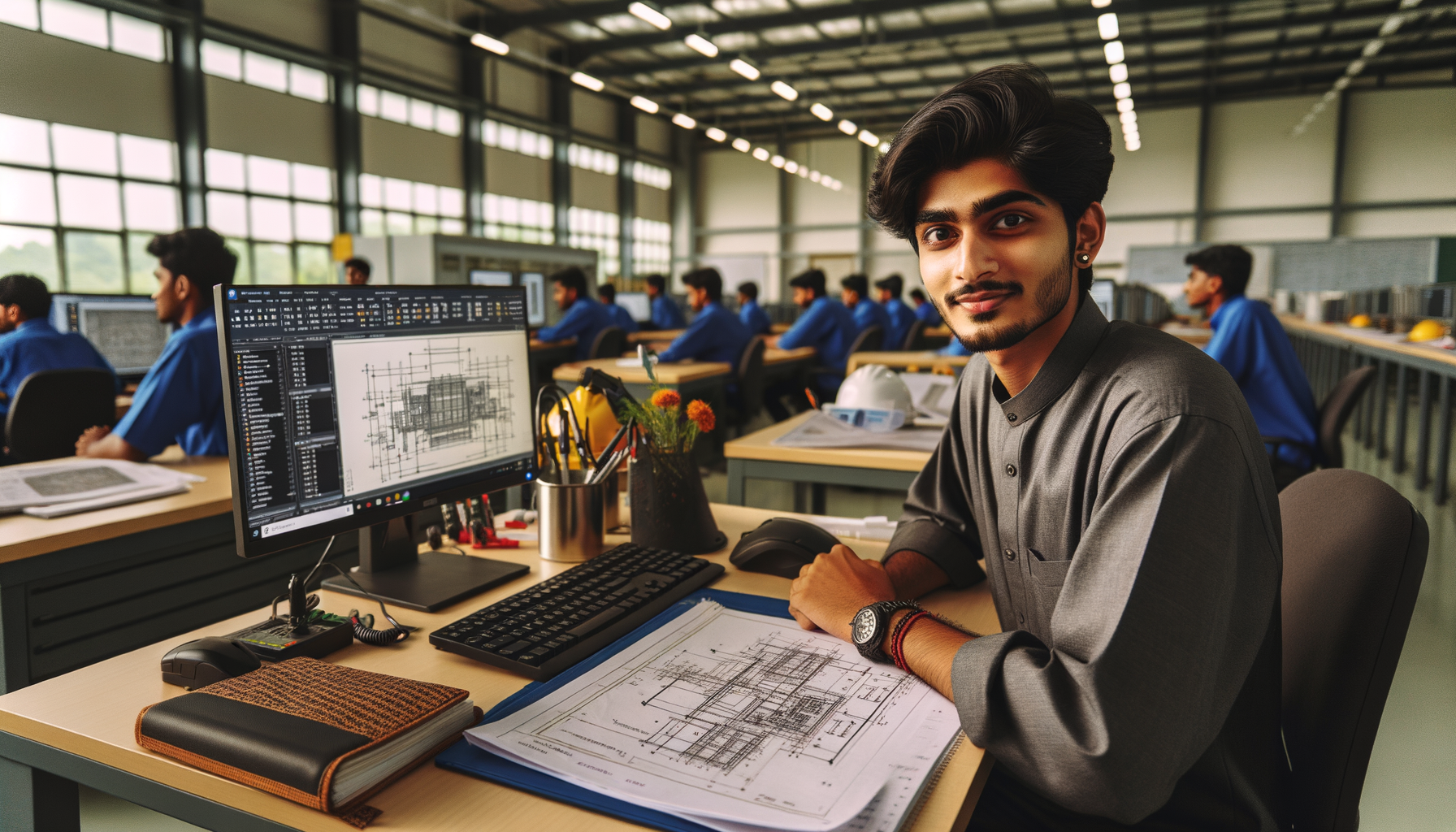
Job-ready engineer skills in India 2026 are no longer limited to your degree, marks, or final-year project title. That's the reality students across Pune, Chhatrapati Sambhajinagar, Sangli, Nashik, and Nagpur are facing right now. Companies want engineers who can work on actual tools, read real drawings, solve practical problems, communicate clearly, and contribute from week one. Here's the thing: college gives you theory, but industry pays for execution. If you already know the basics and want to go deeper, this guide will help you understand the advanced skills, workflows, and habits that make employers take you seriously.

The good news is, you don't need to wait for your syllabus to catch up. You can build these skills intentionally. And trust me, when recruiters from companies like Tata Technologies, Bosch, Siemens, KPIT Technologies, L&T, Thermax, Bajaj Auto, and TCS interview freshers, they can instantly tell who has gone beyond college-level learning.
Why is a degree alone not enough for engineering jobs in India?
Because most companies don't hire for knowledge alone. They hire for output. A mechanical student may know manufacturing theory, but can they create clean production drawings in SolidWorks 2024 or AutoCAD? A civil student may know design concepts, but can they manage quantity takeoff, drawing revisions, and coordination? An electrical student may know control theory, but can they troubleshoot PLC logic or read a panel layout properly?
What most people don't realize is that recruiters are not only checking whether you studied a subject. They're checking whether you can work inside a team, follow standards, meet deadlines, and avoid basic mistakes. That's where many freshers struggle.
At entry level in Maharashtra, a general engineering fresher with only a degree may get offers in the ₹1.8 lakh to ₹2.8 lakh per year range. Candidates with practical software skills, project exposure, and strong communication often move into the ₹3 lakh to ₹4.8 lakh range faster. In some roles linked to design, automation, and IT support, the gap becomes even wider after 12 to 18 months.
What advanced technical skills should an engineer learn beyond college?
If you already know the basics, don't stop at menu-level learning. Go into production-level workflows. That's what gets you hired.
Software depth, not just software names
Many students say they know AutoCAD, CATIA, Revit, SolidWorks, Python, or Excel. But when asked to complete a task with proper layers, templates, tolerances, naming rules, BOM structure, or revision control, they freeze. Advanced learning means understanding how professionals actually use the software.
For example:
- In AutoCAD 2025, learn layer standards, dynamic blocks, sheet sets, plotting styles, and annotation scaling.
- In SolidWorks 2024, go deeper into configurations, design tables, assemblies, mates, exploded views, weldments, and manufacturing drawings.
- In Revit 2025, understand worksharing, view templates, schedules, families, and coordinated documentation.
- In Excel and Power BI, move beyond formulas into dashboards, lookup logic, cleaning messy data, and reporting trends.
- In PLC environments like Siemens TIA Portal V18, learn diagnostics, fault handling, tag structuring, and HMI integration.
Here's the thing: companies don't pay extra because you attended a course. They pay because you can complete work faster, cleaner, and with fewer corrections.
Reading and interpreting real project documents
This is one of the most underrated job-ready skills. Learn how to read GA drawings, electrical schematics, P&ID diagrams, panel layouts, fabrication drawings, BOQs, inspection sheets, and client comments. At companies like Mahindra Engineering or Kirloskar, engineers are expected to understand documentation flow, not just isolated software tasks.
Version control and file discipline
Professionals don't save files as final_v2_last_new.dwg. They use structured naming, revision dates, issue status, and folder logic. Whether you're in CAD, BIM, automation, or IT, file discipline matters. Trust me, even talented freshers lose credibility if they create confusion in shared project data.
Which power-user workflows make freshers look experienced?
Let's talk about the habits that make a fresher look like someone who's already handled project pressure.
Template-based working
Don't start every file from scratch. Build and use templates for drawings, reports, presentations, checklists, and calculations. Professionals save time because they standardize repeat work. What most people don't realize is that speed in industry often comes from preparation, not typing faster.
Checklists before submission
Before sending any work, verify dimensions, spelling, title block details, units, material specs, revision notes, and output format. This one habit reduces rework massively. At L&T or Bosch, missing one small detail can delay approvals and make the whole team look careless.
Shortcut mastery and workspace customization
Advanced users customize ribbons, quick access tools, keyboard shortcuts, default paths, object snaps, sheet settings, and export presets. It sounds small, but over a full day, this saves serious time. If you're using software eight hours a day, micro-efficiency becomes a big advantage.
Documentation while working
Strong engineers keep notes of assumptions, pending points, changes requested by seniors, and unresolved issues. This is critical in project environments. If a manager asks what changed between revision 1 and revision 2, you should answer clearly in 20 seconds.
What communication skills do companies actually expect from engineers?
A lot more than students think. You don't need fake corporate English. You need clear, useful communication.
Can you explain a problem without rambling? Can you write a short status update? Can you ask a technical doubt properly? Can you present your project in a way that shows understanding, not memorization?
Companies like Infosys, TCS, KPIT Technologies, and Siemens expect engineers to coordinate with teams, report issues, and document work. Even in core engineering companies like Thermax or Bajaj Auto, communication affects daily performance.
Focus on these advanced communication habits:
- Write concise email updates with action points.
- Speak using data, not vague statements.
- Present technical work with screenshots, numbers, and logic.
- Ask better questions after attempting a solution first.
- Summarize meetings in 4 to 5 bullet points.
The good news is, this skill improves quickly when you start practicing in project-style environments.
How should engineering students build practical experience before getting a job?
Don't wait for internships alone. Build proof of work.
Create 3 to 5 portfolio projects that look like actual industry tasks. Not college chart-paper projects. Real files. Real outputs. Real problem-solving.
For example, a mechanical student can create a full assembly model with drawings and BOM. A civil student can prepare a set of coordinated plans and quantity sheets. An electrical student can create a control logic demo with fault conditions. An IT-oriented student can build dashboards, scripts, or support documentation.
Then prepare to explain:
- What was the objective?
- Which software version did you use?
- What standards or assumptions did you follow?
- What errors did you face?
- How did you improve the output?
That's how you move from "I learned this" to "I can do this." Big difference.
What salary difference do extra skills make for freshers in Maharashtra?
Let's keep this practical. In Pune, Chakan, PCMC, Nashik, Aurangabad, and Kolhapur industrial belts, the market rewards usable skills. A degree-only fresher may start lower and spend the first year just catching up. A trained candidate with practical software ability, documentation habits, and interview confidence often enters better roles sooner.
Typical ranges in 2026 can look like this:
- Degree only, limited practical exposure: ₹15,000 to ₹22,000 per month
- Job-ready with software + project portfolio: ₹22,000 to ₹35,000 per month
- Niche skills in CAD, automation, data, or design support: ₹28,000 to ₹45,000 per month in stronger companies
Of course, city, branch, company type, and your interview performance matter. But yes, skills change earning speed. That's the honest answer.
How can you become a job-ready engineer faster in 2026?
Use a simple advanced plan:
- Pick one core tool and master production-level settings.
- Build 3 strong projects with proper documentation.
- Practice explaining your work in plain English.
- Learn industry file management and revision control.
- Study actual job descriptions from Pune and Maharashtra companies.
- Get feedback from trainers who know hiring patterns.
If you're serious about becoming job-ready, ABC Trainings can help you bridge the gap between college learning and industry expectations. Their teams work with students who want practical, placement-focused skills, not just certificates. You can call 8698270088 or WhatsApp 7774002496 to understand which path fits your branch and career goal.
Here's the thing: the companies haven't become unfair. They've become more specific. They want engineers who can contribute. If you go deeper than the syllabus, build real outputs, and learn professional workflows, you'll stand out. That's exactly what hiring managers notice first.
Is a degree enough to get an engineering job in Maharashtra in 2026?
A degree helps you qualify for interviews, but on its own it's usually not enough for better roles. Most employers in Pune, Nashik, Chhatrapati Sambhajinagar, and nearby industrial areas want practical software skills, documentation ability, and communication confidence. If you combine your degree with project-based training, your chances improve a lot. That's especially true for design, automation, CAD, and IT-linked engineering roles.
Which extra skills should engineering students learn beyond college?
Start with one job-focused software stack linked to your branch, then go deeper into project workflows. Learn documentation, file naming, revision control, reporting, and portfolio presentation. What most people don't realize is that these supporting skills often matter as much as technical commands. Employers want someone who can work in a team without constant supervision.
How much salary can a job-ready fresher get in Pune or Maharashtra?
For many freshers, salary can range from around ₹15,000 to ₹22,000 per month if they only have a degree and limited practical exposure. Candidates with stronger software skills, project work, and interview readiness often move into the ₹22,000 to ₹35,000 range. In specialized roles, some companies may offer more depending on branch, city, and tool expertise. Your first salary depends heavily on what you can demonstrate, not just what you studied.
Where can I get practical training to become job-ready after engineering?
Look for institutes that focus on hands-on tools, industry-style assignments, and trainer feedback rather than only theory. ABC Trainings is one option students in Maharashtra consider when they want practical CAD, IT, and engineering skill development. Before joining anywhere, ask about software versions, project work, placement guidance, and whether the training matches actual job roles. You can contact ABC Trainings at 8698270088 or WhatsApp 7774002496 for details.
Visit Our Centers
Chhatrapati Sambhajinagar
Corporate Office (HQ)
2nd Floor, Kandi Towers, Jalna Road, Amarpreet Chowk, Chhatrapati Sambhajinagar, Maharashtra 431001
Osmanpura Branch
Plot No 14, Shanya Sect, Near Sant Eknath Rang Mandir, Osmanpura, Chhatrapati Sambhajinagar, Maharashtra 431005
CIDCO Branch
Plot No 4, N-3, Cidco, Opp. High Court, Chhatrapati Sambhajinagar, Maharashtra 431003
Pune
Wagholi Branch
1st Floor, ABC Trainings, Laxmi Datta Arcade, Pune - Ahilyanagar Hwy, Wagholi, Pune, Maharashtra 412207
Hadapsar Branch
Bloom Hotel, ABC Trainings 1st Floor, S.no 156/3 Shree Tower Pune - Solapur Rd, Hadapsar, Pune, Maharashtra 411028
Sangli
Sangli Branch
2nd Floor, Vasant Market, Opp. City High School, Sangli, Maharashtra 416416
Start Your Career Journey Today
Join 10,000+ students who transformed their careers with ABC Trainings.
💬 WhatsApp: 7774002496📞 Call: 8698270088