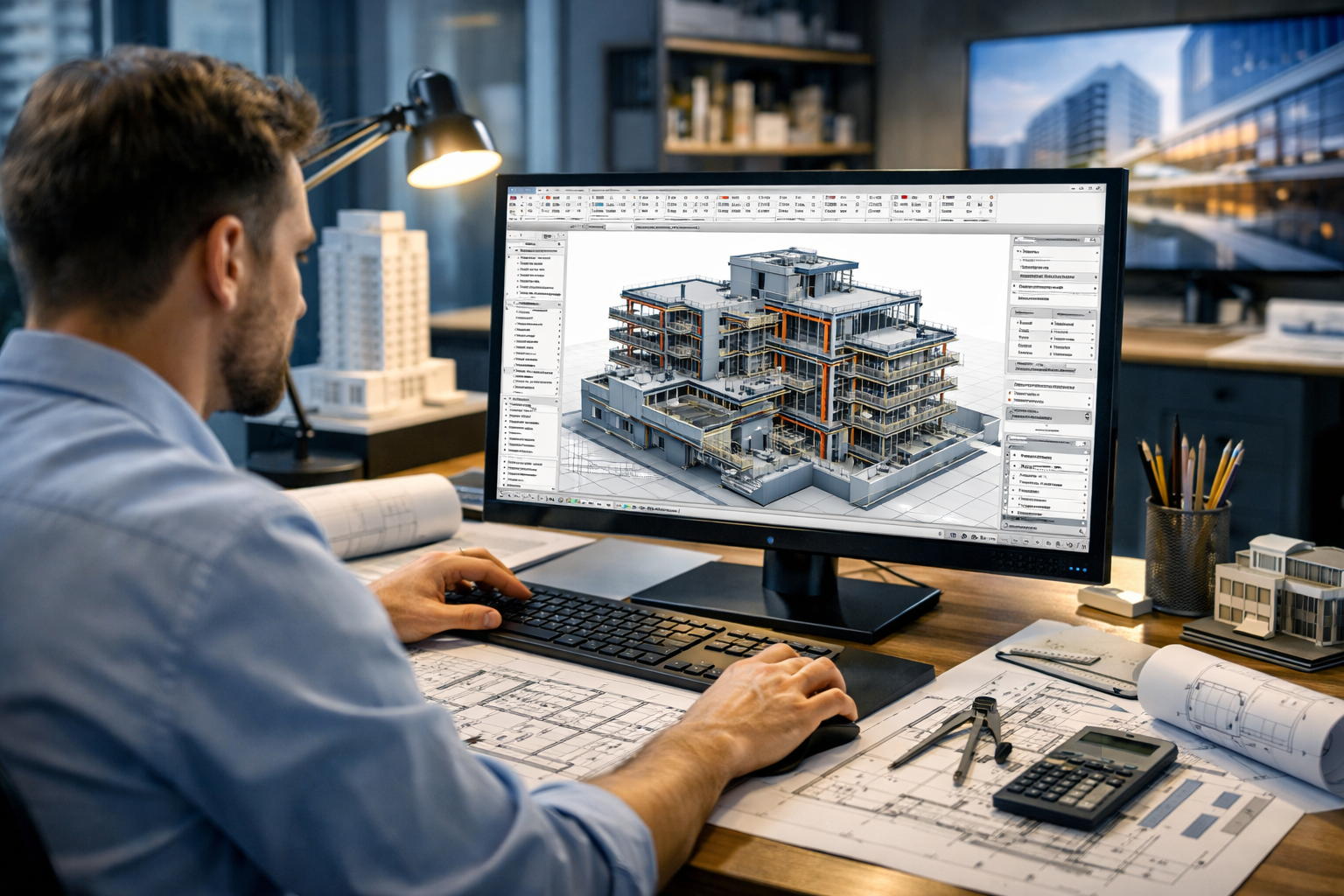
The demand for Revit Architecture professionals in India has grown rapidly as architecture, construction, and infrastructure companies shift from traditional CAD drafting to Building Information Modeling (BIM). Cities like Pune, Mumbai, and Bangalore are seeing increasing demand for architects, civil engineers, and interior designers who can work efficiently with Revit.
However, not every training institute teaches Revit the same way.
Many short courses focus only on basic tools and commands, leaving students unprepared for real architectural projects. At ABC Trainings, the 4-month Revit Architecture course is designed to teach students industry-level BIM workflows, ensuring they gain practical skills that employers actually expect.
In this guide, we compare:
What students learn at ABC Trainings in 4 months
What many other institutes often skip
Why this difference matters for your career
ABC Trainings is a Government Affiliated Training Company, MSME registered and ISO certified institute, focused on job-ready technical education.
Why Revit Architecture Skills Matter Today
Modern construction projects rely heavily on BIM-based planning. Unlike traditional CAD drafting, Revit allows architects to work with intelligent 3D models that include structural, architectural, and documentation data in a single environment.
With Revit skills, professionals can:
Create intelligent 3D building models
Automatically generate floor plans, elevations, and sections
Perform clash detection and coordination
Improve collaboration between architects and engineers
Produce construction-ready documentation
Because of these advantages, architecture firms now prefer Revit-trained candidates over traditional AutoCAD-only designers.
But mastering Revit requires structured training and real project practice, which is where course quality becomes crucial.
What You Learn in 4 Months at ABC Trainings
The Revit Architecture course at ABC Trainings Pune is designed as a complete BIM training program, not just a basic software tutorial.
Students progress from fundamentals to real architectural project workflows.
Month 1: Revit Fundamentals and BIM Concepts
The first month builds a strong foundation in Revit interface and BIM modeling concepts.
Students learn:
Introduction to Building Information Modeling (BIM)
Revit interface and project setup
Understanding levels and grids
Creating walls, doors, and windows
Floor and roof modeling
Basic 3D visualization
Navigation and view controls
Why this matters:
Many institutes rush through fundamentals, but proper understanding of project setup is critical for large architectural models.
Month 2: Architectural Modeling and Family Creation
In the second month, students move deeper into architectural components and customization.
Topics include:
Staircase and railing design
Curtain walls
Ceiling systems
Advanced wall structures
Revit families and parametric components
Custom furniture and fixtures
Interior architectural elements
Students begin working on real residential building models during this phase.
This is where students start understanding how real architectural models are structured.
Month 3: Documentation and Construction Drawings
This phase focuses on professional documentation, which many training centers ignore.
Students learn:
Floor plans and ceiling plans
Elevations and sections
Detail drawings
Annotation tools
Tagging and schedules
Material takeoffs
Sheet layout and printing
By the end of this module, students can produce complete architectural drawing sets directly from the BIM model.
This skill is extremely valuable for architecture firms and construction companies.
Month 4: Advanced BIM Workflow and Project Training
The final month focuses on real-world project workflows.
Students learn:
Worksharing and team collaboration
Project phasing
Design options
Advanced rendering and visualization
Model coordination
Clash management basics
BIM workflow used in architecture firms
Students complete a full architectural project model including:
3D building model
Construction drawings
Quantity schedules
Presentation views
This final project helps students build a strong portfolio, which is essential when applying for jobs.
What Many Other Institutes Skip
Many short-term courses promise to teach Revit quickly but often skip essential topics that are required in real projects.
Common gaps include:
1. No Real Project Practice
Some institutes only teach tool demonstrations.
Students never build a complete building model, which means they struggle in real jobs.
2. Limited BIM Understanding
Many courses focus on commands only, not BIM workflows.
Without BIM knowledge, students cannot work efficiently on large architectural projects.
3. No Documentation Training
Generating professional construction drawings is one of the most important Revit skills.
Yet many courses skip:
Sheet setup
Annotation standards
Scheduling
Material quantities
These skills are essential for architecture offices.
4. No Collaboration Workflow
Modern projects require teams to work on the same model.
Without training in worksharing and coordination, students are not ready for real projects.
Why the 4-Month Duration Matters
Learning Revit properly requires time for practice and project experience.
A 4-month structured program allows students to:
Understand BIM fundamentals
Practice architectural modeling
Create professional drawings
Complete real projects
Build a strong portfolio
Short 1–2 month crash courses often skip these crucial stages.
Who Should Join the Revit Architecture Course
This course is ideal for:
Architecture students
Civil engineering students
Interior designers
Diploma civil students
Draftsmen and site engineers
Professionals switching to BIM careers
Even beginners can start learning Revit with proper guidance.
Career Opportunities After Learning Revit
After completing a professional Revit course, students can pursue roles such as:
BIM Modeler
Architectural Designer
Revit Draftsman
BIM Coordinator
Interior BIM Designer
Construction Documentation Specialist
With experience, professionals can move into BIM management roles, which are highly valued in large construction projects.
Why Choose ABC Trainings in Pune
ABC Trainings focuses on practical, job-oriented technical training.
Key advantages include:
Industry-focused 4-month structured curriculum
Hands-on real architectural project training
BIM workflow understanding
Portfolio development
Government Affiliated Training Company
MSME Registered
ISO Certified Training Institute
Students receive training designed to make them ready for real architecture and construction projects.
Revit Architecture Course in Pune – Admission Details
If you are planning to build a career in architecture, BIM, or construction design, learning Revit from a structured program can make a significant difference.
For course details and admissions:
📞 Calling Number: 7039169629
💬 WhatsApp: 8698270088