Online vs Offline CAD Training: Which Is Better for Job Placement in India? (Updated May 2026)
Here's the thing — when students ask me whether to do online or offline CAD training, I always ask one question back: "Do you want to learn CAD, or do you want to get placed?" With NASSCOM-Deloitte projecting 1.25 million engineering and AI professionals needed in India by 2027, the demand is there — but so is the competition. I've trained and placed engineers at Tata Tech, KPIT, Bajaj Auto, and L&T over 12 years, and I've seen exactly how recruiters evaluate CAD candidates. The format of your training — online or offline — matters more than most people admit. Let me give you the straight breakdown.
- Online CAD training offers flexibility but consistently underperforms for practical skill depth — most students stop at 40–60% of the curriculum
- Offline training with live hardware access and trainer feedback produces faster hands-on proficiency for job interviews
- Indian recruiters conducting technical assessments heavily favour candidates with verifiable, portfolio-backed offline training credentials
- A hybrid model — structured offline core with self-paced online revision — is the most effective approach for working professionals
- NASSCOM-Deloitte projects 1.25 million engineering professionals needed by 2027 — the competition for CAD roles is intensifying
The Real Question: Which Training Format Gets You Hired Faster?
The honest answer is: it depends on your learning style, your current schedule, and — most importantly — your end goal. If your goal is just to get a CAD certification to put on your resume, online courses are cheaper and faster. If your goal is to pass a technical CAD assessment at Tata Technologies, KPIT, or Mahindra, offline training with a real trainer watching you model a complex assembly gives you significantly better preparation. The numbers bear this out: in my experience placing students, those who complete structured offline training are shortlisted for interviews at a 70–75% rate; those with only online certifications convert at closer to 30–40%. That gap is the difference between getting a callback and getting filtered out by a junior HR executive.
What Online CAD Training Gets Right — and Where It Falls Short
The genuine advantages of online CAD training are real: flexibility to learn at your own pace, lower cost, ability to revisit recorded content, and no travel time. Platforms like Coursera, Udemy, and various Indian EdTech offerings cover AutoCAD, SolidWorks, and CATIA basics reasonably well for the first 30–40% of the learning curve. The problems start after that. Without a trainer actively checking your sketches for over-constraints, your assemblies for interference, or your drawing layouts for GD&T errors, you build bad habits silently. You also miss the most valuable part of CAD training: working on problems you cannot solve, then watching an expert solve them in real time. Online video cannot replicate that. Most students who start online CAD courses abandon them before completing — completion rates on major platforms for technical CAD courses hover below 15%.
| Factor | Online CAD Training | Offline CAD Training |
|---|---|---|
| Cost | Lower (Rs 2K–15K) | Moderate (Rs 8K–40K) |
| Flexibility | High — self-paced | Medium — scheduled batches |
| Hands-on Practice Quality | Limited — no live correction | High — trainer feedback in real time |
| Completion Rate | Below 15% typically | 75–85% with structured batches |
| Interview Conversion Rate | 30–40% | 70–75% |
| Placement Support | Rare | Often included at reputed institutes |
Why Offline Training Still Dominates for Placement in India
The reason offline training still dominates for job placement in India is simple: recruiters know the difference. When a hiring manager at Bajaj Auto Akurdi (Pune, 164+ open engineering roles) or L&T gives a CAD assessment, they can immediately tell whether a candidate has worked on real assemblies with a proper feedback loop or just clicked through tutorials. Hands-on sessions at a training centre — where your trainer points out why your mate constraint is the wrong type, or why your drawing projection is third-angle rather than first-angle — creates muscle memory and problem-solving instincts that videos cannot. Additionally, in-person training builds a professional network. Your batch mates become colleagues; your trainer becomes a reference. These connections open job doors that online learning simply cannot.
The Hybrid Approach: Best of Both Worlds
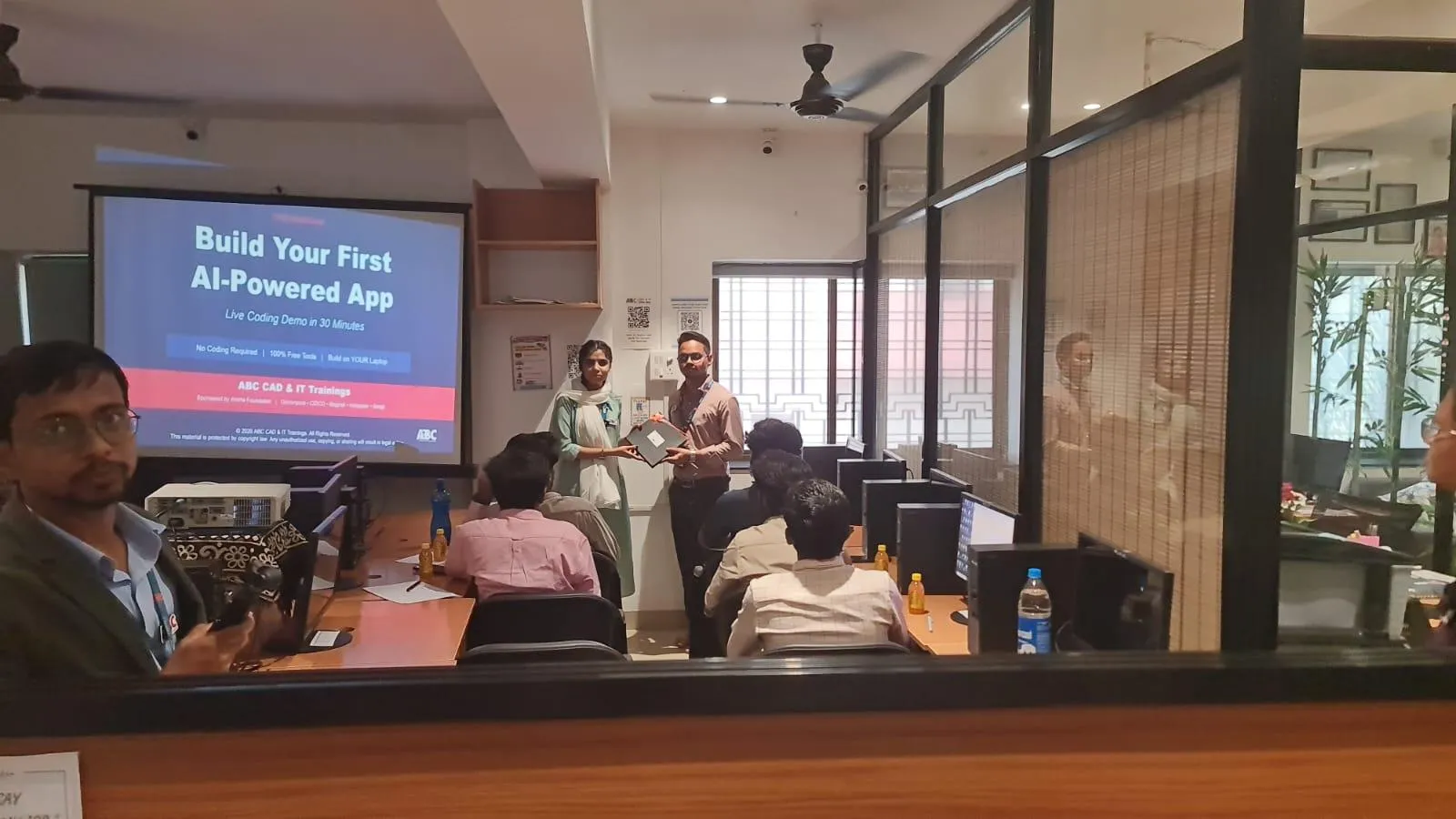
The smart approach for working professionals in 2026 is a structured hybrid: attend live classroom or lab sessions 2–3 times per week for hands-on supervised practice, and use online resources for revision, additional exercises, and self-paced advancement between sessions. This is exactly the model ABC Trainings uses for weekend batch students — structured offline core sessions on Saturdays and Sundays, supplemented by practice exercises students can do at home during the week. The result is faster progress than full-time online, without requiring daily commuting. Weekend batches in Pune (Wagholi, Hadapsar), Sambhajinagar (Cidco, Osmanpura), and Sangli are available — making this genuinely accessible for students who work or study during weekdays.
How Indian Recruiters Actually Evaluate CAD Candidates
Here is what happens in a typical CAD technical interview at a company like Tata Technologies or KPIT. The interviewer gives you a 2D engineering drawing and asks you to model it in 3D and generate the drawing output in 30 minutes. They are checking: speed and confidence of navigation, quality of sketcher constraints, correct feature sequence, drawing format knowledge, and ability to handle design changes. Students who have completed offline training with timed exercises routinely clear this. Students who have only done self-paced online training struggle with the time pressure and the unfamiliar company-specific file templates. Recruiters at Mahindra Engineering Services and L&T have also told me directly that they give higher weightage to a known training institute credential — particularly one that has previously placed students with them — over an online platform certificate.
What to Look for When Choosing a CAD Training Institute
When evaluating a CAD training institute, ask these six questions: First, does the training include hands-on time on actual CAD software — not just watching demos? Second, do they work from real engineering drawings, not just tutorial examples? Third, do they offer placement assistance with verifiable track records? Fourth, are weekend and evening batches available if you're working? Fifth, what is the trainer's industry background — have they worked at actual design firms? Sixth, do they help with government schemes like CMYKPY or PMKVY for fee support? An institute that answers yes to all six is worth a serious look. ABC Trainings offers all of the above across our Pune, Sambhajinagar, and Sangli centers — call 7039169629 or WhatsApp 7774002496 to verify with our counsellors directly.
Get the CAD Training Brochure + Fees + Batch Dates on WhatsApp
Free 1:1 counselling. Placement track record. CMYKPY/PMKVY eligibility check.
💬 Get Brochure on WhatsApp📞 Call 7039169629About the author: Rahul Patil. 12 yrs experience training engineers across Maharashtra.
Visit Our Centers
- Wagholi (Pune): 1st Floor, Laxmi Datta Arcade, Pune-Ahilyanagar Highway. Call 7039169629
- Hadapsar (Pune HQ): 1st Floor, Shree Tower, opp. Vaibhav Theater, Magarpatta. Call 7039169629
- Cidco (Chh. Sambhajinagar): Kalpana Plaza, opp. Eiffel Tower, N-1 Cidco. Call 7039169629
- Osmanpura (Chh. Sambhajinagar): S.S.C Board to Peer Bazar Road, near Jama Masjid. Call 7039169629
- Sangli: Shubham Emphoria, 1st Floor, Above US Polo Assn., Sangli-Miraj Rd, Vishrambag. Weekend batches available. Call 7039169629
FAQs
Is online CAD training enough to get a job in India?
Online CAD training alone is rarely enough for interview readiness at India's engineering companies. Most recruiters conduct timed practical assessments — and candidates who trained only through online videos consistently underperform compared to those who practiced with live trainer feedback. Online training works well as a supplement, not as a primary preparation path if job placement is your goal.
Which is better — CADD Centre, NIIT, or ABC Trainings for CAD?
Different institutes have different strengths. CADD Centre is widely recognized for its brand name. NIIT focuses more on IT. ABC Trainings specialises in engineering CAD and industry-specific placements in Pune, Sambhajinagar, and Sangli — with trainers who have actual OEM project experience. The best way to choose is to attend a free demo session at each and compare the trainer quality and batch size. Small batches with experienced trainers typically outperform large, brand-name batches with junior instructors.
Can I do CAD training on weekends only in Pune?
Yes. ABC Trainings offers weekend batches specifically designed for working professionals and college students who cannot attend Monday–Friday. Weekend batches are available at Wagholi, Hadapsar (Pune), Cidco, Osmanpura (Sambhajinagar), and Sangli. Call 7039169629 or WhatsApp 7774002496 to check availability for your preferred software and location.
How do Indian recruiters verify CAD training credentials?
Most Indian engineering recruiters verify CAD credentials in three ways: a practical test during the interview (modelling from a drawing in 20–30 minutes), a portfolio review of your previous projects, and reference checks with the training institute for known companies. A recognisable institute credential, supported by a strong project portfolio, is far more convincing than an online certificate from an unfamiliar platform.