Artificial Intelligence Beginner's Guide Ep.11 – Natural Language Processing Explained (Updated June 2026)
Every time you type a search query into Google, get a reply from a customer service chatbot, or see your email auto-categorised as spam — NLP is working behind the scenes. Natural Language Processing is the AI subfield that enables computers to understand, interpret, and generate human language. With NASSCOM and Deloitte projecting demand for 1.25 million AI and advanced tech professionals in India by 2027, NLP is one of the fastest-growing skill areas in the country — and companies from Infosys and TCS to early-stage startups are all building NLP-powered products. Episode 11 of our AI Beginner's Guide gives you the foundation: what NLP is, how it works at the technical level, and what tools and libraries you need to start building NLP applications right now.

- NLP (Natural Language Processing) is the AI subfield that enables machines to understand and generate human language
- Core NLP pipeline: tokenisation, stopword removal, stemming/lemmatisation, vectorisation, model
- Key techniques: Bag of Words, TF-IDF, word embeddings (Word2Vec, GloVe), transformers (BERT, GPT)
- Python libraries: NLTK, spaCy, Hugging Face Transformers — all free and widely used in industry
- AI and NLP engineers in India earn ₹6–18 LPA depending on experience, per AmbitionBox and 6figr data
What Is NLP and Why It Is Central to Modern AI
Natural Language Processing is the branch of Artificial Intelligence that deals with the interaction between computers and human language — text and speech. The goal is to make machines that can read text and extract meaning, answer questions in natural language, translate between languages, summarise long documents, and generate coherent new text. What most people don't realise is that NLP was one of the hardest problems in AI for decades — because human language is deeply ambiguous, context-dependent, and full of nuance that even humans sometimes get wrong. The breakthrough came in 2017 with the Transformer architecture, which changed everything. Today NLP powers products used by hundreds of millions of people every day: Google Search, Gmail smart compose, Amazon Alexa, and every chatbot you have ever interacted with on a banking or e-commerce site.

How an NLP Pipeline Works – From Raw Text to Insight
The NLP pipeline converts raw unstructured text into a numerical form that a machine learning model can process. Step 1: Tokenisation — split the text into individual tokens (words or subwords). "I love Pune" becomes the tokens I, love, Pune. Step 2: Normalisation — convert to lowercase, remove punctuation. Step 3: Stopword removal — remove common words like is, the, and that carry little meaning. Step 4: Stemming or Lemmatisation — reduce words to their root form (running becomes run). Step 5: Vectorisation — convert tokens to numbers. The simplest method is Bag of Words (count of each word); a better method is TF-IDF (Term Frequency-Inverse Document Frequency) which weights rare words higher. The good news is that Python libraries like NLTK and spaCy handle steps 1 through 4 in just 3 lines of code — you focus on the logic, not the implementation details.
| NLP Technique | Era | Key Idea | Best For |
|---|---|---|---|
| Bag of Words | Classical | Word frequency vectors | Simple text classification |
| TF-IDF | Classical | Weighted word importance | Document retrieval, search |
| Word2Vec / GloVe | Neural | Semantic word vectors | Similarity, clustering |
| LSTM / RNN | Deep Learning | Sequence modelling | Translation, text generation |
| BERT / GPT | Transformer | Attention, context-aware | QA, sentiment, NER, chatbots |
Word Embeddings and Why They Changed Everything in NLP
The problem with Bag of Words and TF-IDF is that they treat words as independent — they have no concept of meaning or context. The word "bank" (financial institution) and the word "bank" (river bank) look identical in a bag-of-words representation. Word embeddings solved this problem. In 2013, Google researchers introduced Word2Vec — a neural network that learns to represent each word as a 300-dimensional vector (a list of 300 numbers) based on the contexts where it appears in training data. Words with similar meanings end up with similar vectors: the vectors for king and queen are much closer to each other than either is to car. GloVe (Stanford, 2014) improved this further. These pre-trained embedding vectors are the building blocks of NLP applications built between 2013 and 2018. You can download pre-trained Word2Vec and GloVe vectors for Hindi, Marathi, and 100+ languages from open-source repositories.
Transformers, BERT, and the Modern NLP Revolution
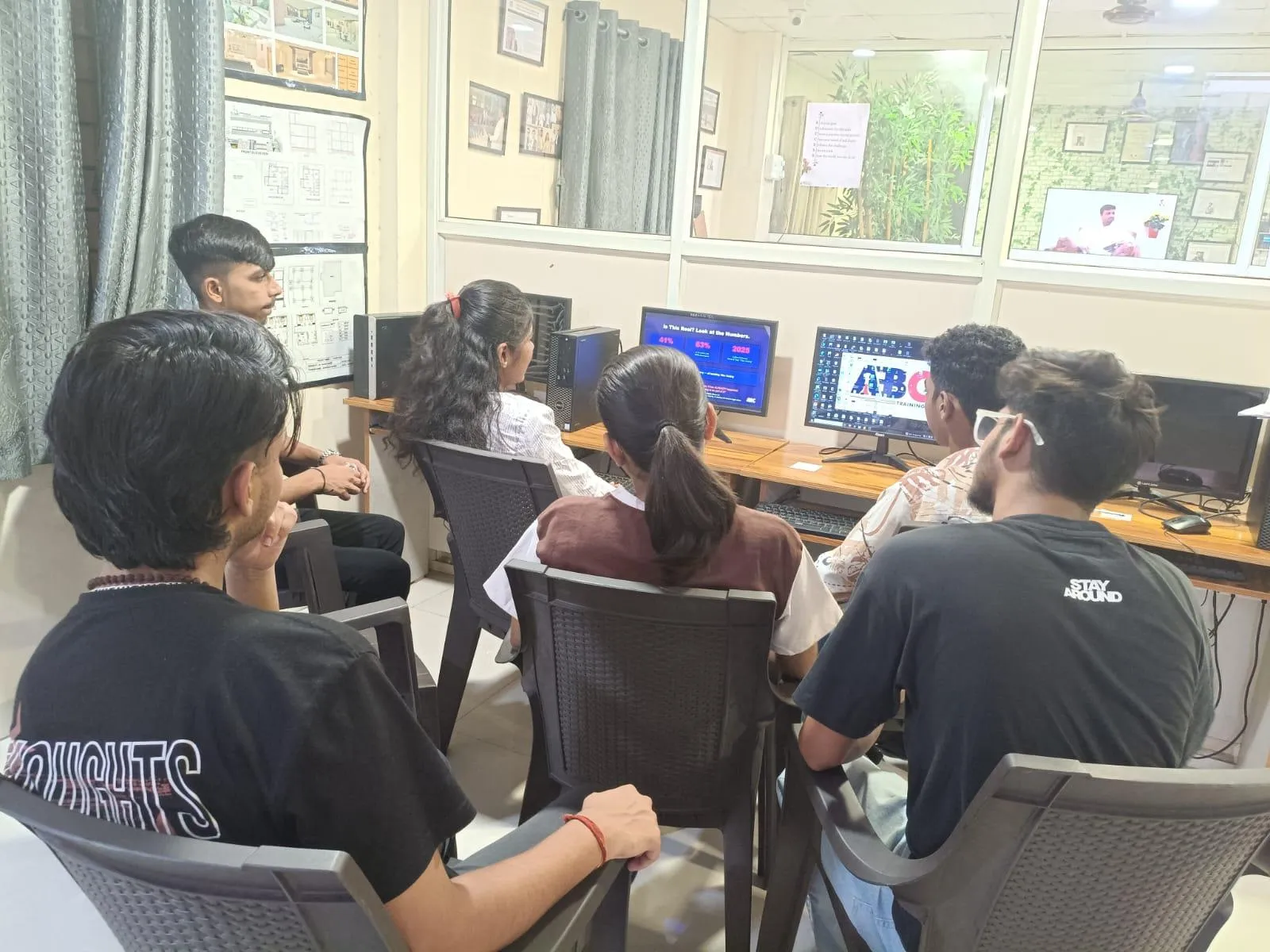
In 2017, Google researchers introduced the Transformer architecture in the paper Attention Is All You Need. This replaced recurrent neural networks (LSTMs) with a self-attention mechanism that could process entire sequences in parallel — making training vastly faster and the models vastly more capable. BERT (Bidirectional Encoder Representations from Transformers, 2018) was the first pre-trained Transformer model for NLP tasks. You download BERT already trained on billions of text tokens, then fine-tune it on your specific task (sentiment analysis, question answering, named entity recognition) with just a few thousand examples. GPT-3, GPT-4, and ChatGPT are all descendants of this architecture. Hugging Face Transformers library in Python lets you use BERT, GPT-2, and 200,000+ pre-trained models in 10 lines of code. This is exactly what students work with in ABC Trainings' AI Powered Application Development workshop.
Real-World NLP Applications in Indian Companies
Every major Indian IT company has NLP projects running today. Infosys builds NLP-powered document processing systems for banking clients (automatic KYC extraction, contract analysis). TCS's AI division uses NLP for customer service automation at BFSI clients. KPIT Technologies (Pune) builds voice command systems for automotive infotainment using NLP. Persistent Systems builds medical NLP applications that extract structured data from doctor notes. Even traditional manufacturing companies are adopting NLP: Mahindra uses NLP for supplier communication analysis; Tata Motors uses it for warranty claim text mining to identify recurring defects. The NASSCOM-Deloitte 2024 report projects 1.25 million AI and advanced digital roles by 2027 in India — NLP engineers are explicitly listed as a priority gap area in that report.
How to Start Your NLP Career in India – Tools, Skills, and Salaries
According to AmbitionBox and 6figr.com, an NLP engineer or AI specialist fresher at an Indian company earns ₹5–8 LPA. With 2-3 years of hands-on NLP project experience, salary rises to ₹10–18 LPA at companies like Infosys, KPIT, and Persistent Systems. Specialised NLP engineers at product companies and AI startups earn ₹20–40 LPA. To start: learn Python first (essential), then NLTK and spaCy for classical NLP, then Hugging Face Transformers for modern approaches. ABC Trainings' AI Powered Application Development workshop covers Python from scratch, then ML fundamentals, then NLP and computer vision — giving you a job-ready AI skill set with hands-on projects you can show to employers. Available at Pune (Hadapsar, Wagholi), Sambhajinagar (Cidco, Osmanpura), and Sangli centres.
CMYKPY Scholarship: Maharashtra's Chhatrapati Mahamanav Yogi Krantijyoti Phule Yojana offers ₹6,000–₹10,000 for skill training to eligible youth from reserved categories. With NASSCOM projecting 1.25 million AI roles by 2027, AI and NLP skills are among the most future-proof you can build. Check your CMYKPY eligibility before you enroll. Call 7039169629 or WhatsApp 7774002496.
Get the AI Powered Application Development Brochure + Fees + Batch Dates on WhatsApp
Free 1:1 counselling. Placement track record. CMYKPY/PMKVY eligibility check.
💬 Get Brochure on WhatsApp📞 Call 7039169629About the author: Mohd. Rafique Pasha, Data Science & AI Trainer, ABC Trainings.
Visit Our Centers
- Wagholi (Pune): 1st Floor, Laxmi Datta Arcade, Pune-Ahilyanagar Highway. Call 7039169629
- Hadapsar (Pune HQ): 1st Floor, Shree Tower, opp. Vaibhav Theater, Magarpatta. Call 7039169629
- Cidco (Chh. Sambhajinagar): Kalpana Plaza, opp. Eiffel Tower, N-1 Cidco. Call 7039169629
- Osmanpura (Chh. Sambhajinagar): S.S.C Board to Peer Bazar Road, near Jama Masjid. Call 7039169629
- Sangli: Shubham Emphoria, 1st Floor, Above US Polo Assn., Sangli-Miraj Rd, Vishrambag. Weekend batches available. Call 7039169629
FAQs
What is Natural Language Processing (NLP) in AI?
Natural Language Processing (NLP) is the branch of Artificial Intelligence that enables computers to understand, interpret, and generate human language — both text and speech. NLP applications include chatbots, search engines, email spam filters, machine translation, sentiment analysis, document summarisation, and voice assistants. It combines linguistics, statistics, and machine learning to convert unstructured human language into structured data that machines can process and act upon.
What Python libraries are used for NLP development?
The most widely used Python NLP libraries are: NLTK (Natural Language Toolkit) — the standard library for classical NLP tasks including tokenisation, stemming, part-of-speech tagging, and parsing. spaCy — a faster, production-grade NLP library with pre-trained models for named entity recognition, dependency parsing, and text classification. Hugging Face Transformers — the go-to library for modern transformer-based models like BERT, GPT-2, RoBERTa, and multilingual models. Gensim — specialised for Word2Vec, Doc2Vec, and topic modelling. All are free and open-source.
What is the difference between Word2Vec and BERT in NLP?
Word2Vec is a neural network model (2013) that learns fixed-size vector representations of words based on the contexts in which they appear. It captures semantic similarity but treats each word independently without considering the surrounding sentence context. BERT (Bidirectional Encoder Representations from Transformers, 2018) is a much larger transformer-based model that represents words in context — the same word gets different vector representations depending on the sentence. BERT understands nuance, ambiguity, and context that Word2Vec cannot. For most modern NLP tasks, BERT-family models significantly outperform Word2Vec.
What is the salary of an NLP or AI engineer in India?
According to AmbitionBox and 6figr.com, an NLP or AI engineer fresher in India earns ₹5–8 LPA at companies like Infosys, Wipro, or a well-funded startup. With 2-3 years of hands-on NLP and ML project experience, salary rises to ₹10–18 LPA. Specialised NLP engineers at AI product companies and MNCs earn ₹20–40 LPA. NASSCOM-Deloitte projects demand for 1.25 million AI professionals in India by 2027, making NLP one of the highest-growth career fields available today.