CATIA Training Jobs in Kupwad MIDC 2026
CATIA training is one of the most practical ways to improve your chances of getting hired in Kupwad MIDC manufacturing companies. I’m saying that as a trainer who has worked with 1000+ students across Maharashtra, including fresh diploma students, BE mechanical graduates, and working professionals who wanted to switch from shop-floor roles into design support jobs. Here's the thing: companies in and around Sangli, Miraj, Kupwad, Kolhapur and Pune don’t hire just because you completed a course. They hire when you can actually model parts, understand drawings, and work like a junior design engineer from day one.
That’s exactly where most students go wrong. They think learning a few CATIA commands is enough. Trust me, it’s not. The students who get placed are usually not the smartest in the class. They’re the ones who build discipline, practice properly, and stop making the same beginner mistakes again and again.
What kind of jobs can CATIA training help you get in Kupwad MIDC?

Kupwad MIDC has a strong manufacturing ecosystem, and nearby industrial belts connect to vendor networks serving bigger names across Maharashtra. If you’re trained well in CATIA V5, you can target roles such as junior design engineer, CAD engineer, product design trainee, tooling design trainee, fixture design support engineer, and production design coordinator.
Many smaller and mid-sized firms in industrial zones don’t always advertise with fancy job titles. Sometimes the opening is simply called “Design Engineer” or “Mechanical CAD Operator.” But the actual work may include 3D part modeling, assembly creation, 2D drafting, drawing corrections, BOM support, and design change documentation. Students who later move to Pune often target companies connected to Bajaj Auto, Tata Technologies, Mahindra Engineering, Bosch, Siemens, Thermax or Kirloskar vendor chains. A strong CATIA base makes that jump easier.
For freshers in Maharashtra, starting salaries usually range from ₹1.8 lakh to ₹3.2 lakh per year in local manufacturing and vendor companies. If your portfolio is strong and your interview performance is solid, you may see ₹15,000 to ₹22,000 per month at entry level. In Pune-linked roles or better design environments, some students move into ₹22,000 to ₹30,000 per month ranges after gaining 1 to 2 years of experience.
Why do beginners struggle in CATIA even after finishing a course?
What most people don't realize is that software learning and job readiness are not the same thing. I’ve seen students complete CATIA modules and still fail interviews because they never learned how industry work actually flows.
1. They memorize commands instead of understanding design logic
A student may know Pad, Pocket, Shaft, Rib, Drafting and Assembly commands, but when asked to model a bracket from a drawing, they freeze. Why? Because they learned button-clicking, not design thinking. In manufacturing companies, nobody will stand beside you and tell you which command to use first.
2. They ignore 2D drawings
This is one of the biggest mistakes. Students love 3D because it looks impressive. But interviewers often test your understanding of orthographic views, dimensions, tolerances, section views and projection. If you can’t read a drawing properly, your CATIA skill looks incomplete.
3. They practice only easy shapes
Many beginners keep repeating simple components that they already know. That feels productive, but it’s not. Real job tests include sheet metal parts, cast components, basic assemblies, exploded views, and drawing updates. If your practice is too comfortable, your progress stalls.
4. They build no portfolio
This one hurts placement chances badly. A certificate alone won’t impress a manufacturing company in Kupwad MIDC. They want proof that you’ve worked on parts, assemblies and drawings. Even five to eight well-documented practice projects can make a big difference.
5. They think software alone gets jobs
The good news is, you don’t need perfect English or a gold medal. But you do need basic communication, interview confidence, and the ability to explain your model. Students who can clearly say how they created a part, why they used a feature, and how they handled dimensions usually perform much better.
What separates placed students from the ones who stay stuck?
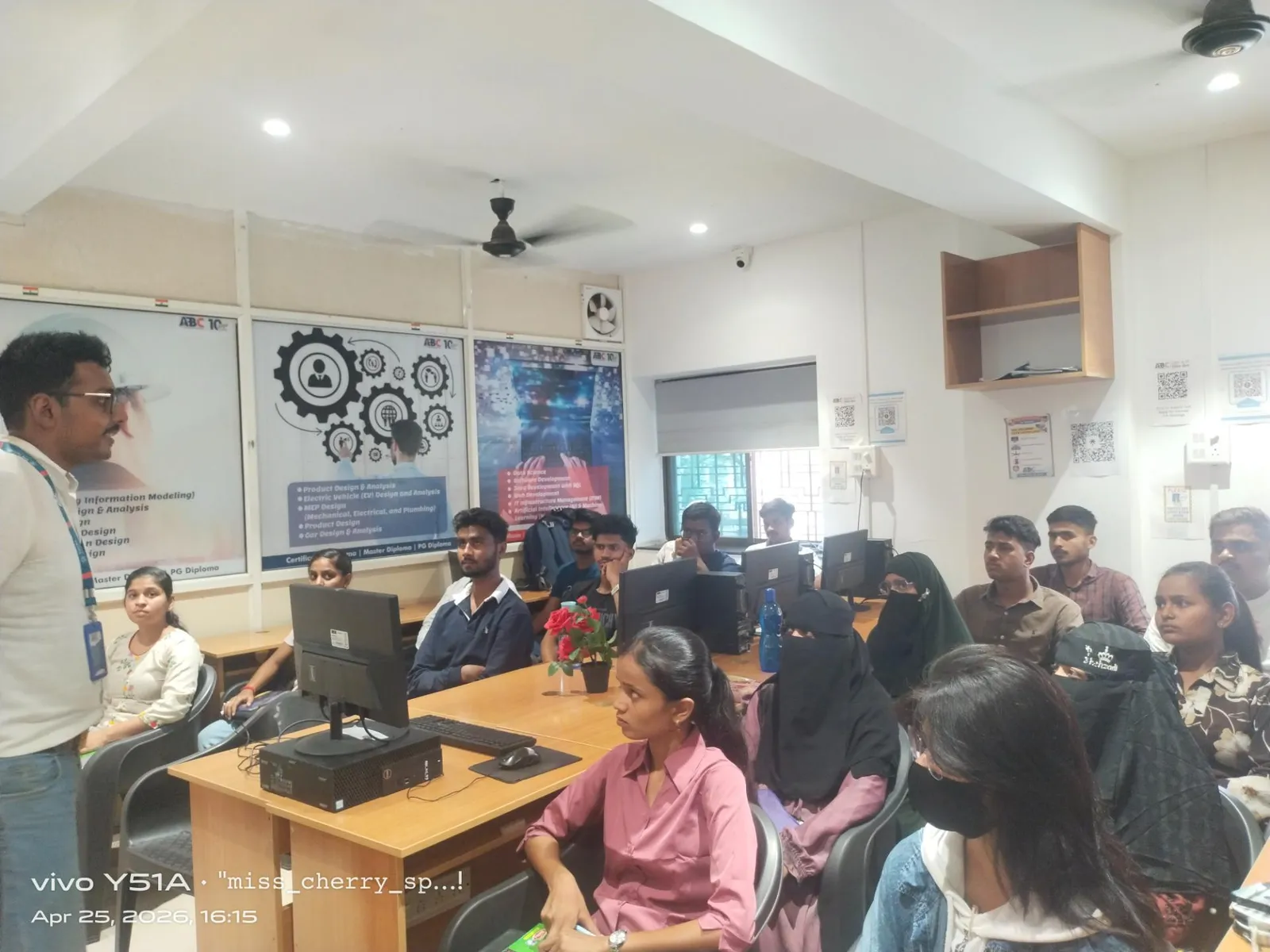
After training students for years, I can tell you the pattern is very clear.
Placed students practice with a routine
They don’t wait for motivation. They spend 60 to 90 minutes daily on modeling, drafting and revision. That consistency beats random 5-hour weekend study sessions.
Placed students ask better questions
Instead of saying, “Sir, this command is not working,” they ask, “Why did the sketch become under-constrained?” or “Why is this assembly failing after update?” That mindset matters because it shows problem-solving ability.
Placed students learn manufacturing context
They try to understand where the component is used, how it may be machined, assembled or fabricated, and what changes make a design easier to produce. Even basic awareness of manufacturing improves interview performance a lot.
Placed students take drawings seriously
They don’t treat drafting as boring. They know that companies need people who can generate clean drawings and revise them quickly when production issues come up.
Placed students don’t disappear after course completion
They stay connected, keep improving, attend mock interviews, update portfolios and apply consistently. Some students expect jobs immediately after finishing the last class. Trust me, the serious ones continue the effort for the next 30 to 60 days, and that’s often when results come.
How should you learn CATIA if your goal is a job, not just a certificate?
Start with CATIA V5 fundamentals, but don’t stop there. Your learning should move in a job-oriented order.
First, build sketching accuracy. Then learn part design properly. After that, move into assemblies and drafting. Once your basics are stable, practice industry-style components such as brackets, housings, flanges, clamps, shafts, covers and mounting plates. If possible, include simple sheet metal and fixture-related work.
Here’s a shortcut that actually works: for every 3D model you create, also make the 2D drawing. Most students skip this. That’s exactly why they struggle later.
Another pro tip: maintain a folder with versioned files. Name projects properly. Save PDFs of drawings. Keep screenshots of final models. During interviews, this makes you look organized and professional.
Which mistakes should you avoid during CATIA interview preparation?
Don’t say “I know CATIA” if you only know basics
Interviewers can detect that in two minutes. Be honest and specific. Say you’re comfortable with part modeling, basic assemblies and drafting, and currently improving on advanced practice.
Don’t go without project files
Carry your portfolio in laptop, phone or printed snapshots. If you’ve modeled parts relevant to manufacturing, you immediately stand out.
Don’t ignore aptitude and HR rounds
Even for CAD roles, many companies check attitude, stability and willingness to learn. Some students lose offers because they answer casually or show no seriousness about long-term work.
Don’t apply only in one city
If you’re from Sangli or Kupwad, apply locally, but also keep options open in Kolhapur, Satara, Pune, Chhatrapati Sambhajinagar and even trainee roles linked to larger ecosystems around Tata Technologies, KPIT Technologies, L&T or Mahindra Engineering support vendors.
How can ABC Trainings help you become placement-ready?
At ABC Trainings, students are pushed beyond software completion. That matters because the market doesn’t reward half-prepared candidates. A good CATIA training path should include command practice, drawing interpretation, model planning, portfolio creation, mock interviews and career guidance based on actual Maharashtra job patterns.
If you want to understand whether CATIA is the right fit for your profile, you can speak with ABC Trainings directly at 7039169629 or WhatsApp 7774002496. If you’re serious, don’t wait until graduation is over and panic starts. Start building skills early.
What is the smartest career strategy for CATIA students in Sangli and Kupwad?
Learn CATIA with job focus, not ego focus. Don’t waste three months trying to look advanced on social media while your drawing basics are weak. Build strong fundamentals, practice real components, maintain a clean portfolio, and attend interviews even before you feel fully ready. That’s how confidence grows.
What most people don't realize is that your first job doesn’t need to be perfect. It needs to be relevant. A ₹15,000 to ₹20,000 per month design support role in or near Kupwad MIDC can become a stepping stone to much better opportunities in Pune, Bengaluru or Chennai after you gain solid experience. The students who understand this move faster in their careers.
So yes, CATIA training can absolutely help you get a job in Kupwad MIDC manufacturing companies. But only if you treat it like a skill that must be proven, not just completed.
Is CATIA enough to get a job in Kupwad MIDC after diploma mechanical?
CATIA can be enough for entry-level design support roles if your basics are strong and you can read drawings properly. For diploma students, companies often value practical skill more than theory-heavy answers. If you add drafting practice, simple assemblies and a small portfolio, your chances improve a lot. Local companies may hire for trainee or junior CAD roles even if you are just starting out.
What salary can a fresher get after CATIA training in Sangli or Kupwad?
Freshers usually see offers between ₹15,000 and ₹22,000 per month depending on company type, confidence and project quality. Smaller firms may start lower, while better vendor or design support roles may offer more. If you perform well and gain 1 to 2 years of experience, moving toward ₹22,000 to ₹30,000 per month becomes realistic. Salary also improves if you are open to Pune or Kolhapur opportunities.
Which CATIA version should students learn for manufacturing jobs?
CATIA V5 is still widely relevant for mechanical design and manufacturing-related roles in India. Many training environments and interview tests are based on CATIA V5 workflows, especially for part design, assembly and drafting. If your fundamentals are strong in V5, adapting later becomes easier. The key is not the version name alone, but how confidently you can model and explain your work.
How long does it take to become job-ready in CATIA?
For most students, 3 to 5 months of serious training and daily practice is enough to become job-ready at fresher level. That includes learning commands, doing projects, improving drawing reading, and preparing for interviews. Students who practice consistently usually progress much faster than those who attend classes without revision. If you want proper guidance, call 7039169629 or WhatsApp 7774002496 to check the right training path.
Visit Our Centers
Chhatrapati Sambhajinagar
Corporate Office (HQ)
2nd Floor, Kandi Towers, Jalna Road, Amarpreet Chowk, Chhatrapati Sambhajinagar, Maharashtra 431001
Osmanpura Branch
Plot No 14, Shanya Sect, Near Sant Eknath Rang Mandir, Osmanpura, Chhatrapati Sambhajinagar, Maharashtra 431005
CIDCO Branch
Plot No 4, N-3, Cidco, Opp. High Court, Chhatrapati Sambhajinagar, Maharashtra 431003
Pune
Wagholi Branch
1st Floor, ABC Trainings, Laxmi Datta Arcade, Pune - Ahilyanagar Hwy, Wagholi, Pune, Maharashtra 412207
Hadapsar Branch
Bloom Hotel, ABC Trainings 1st Floor, S.no 156/3 Shree Tower Pune - Solapur Rd, Hadapsar, Pune, Maharashtra 411028
Sangli
Sangli Branch
2nd Floor, Vasant Market, Opp. City High School, Sangli, Maharashtra 416416
Start Your Career Journey Today
Join 10,000+ students who transformed their careers with ABC Trainings.
💬 WhatsApp: 7774002496📞 Call: 7039169629