Data Science Engineering Roadmap 2026: From Beginner to Job-Ready in 6 Months (Updated July 2026) (Updated July 2026)
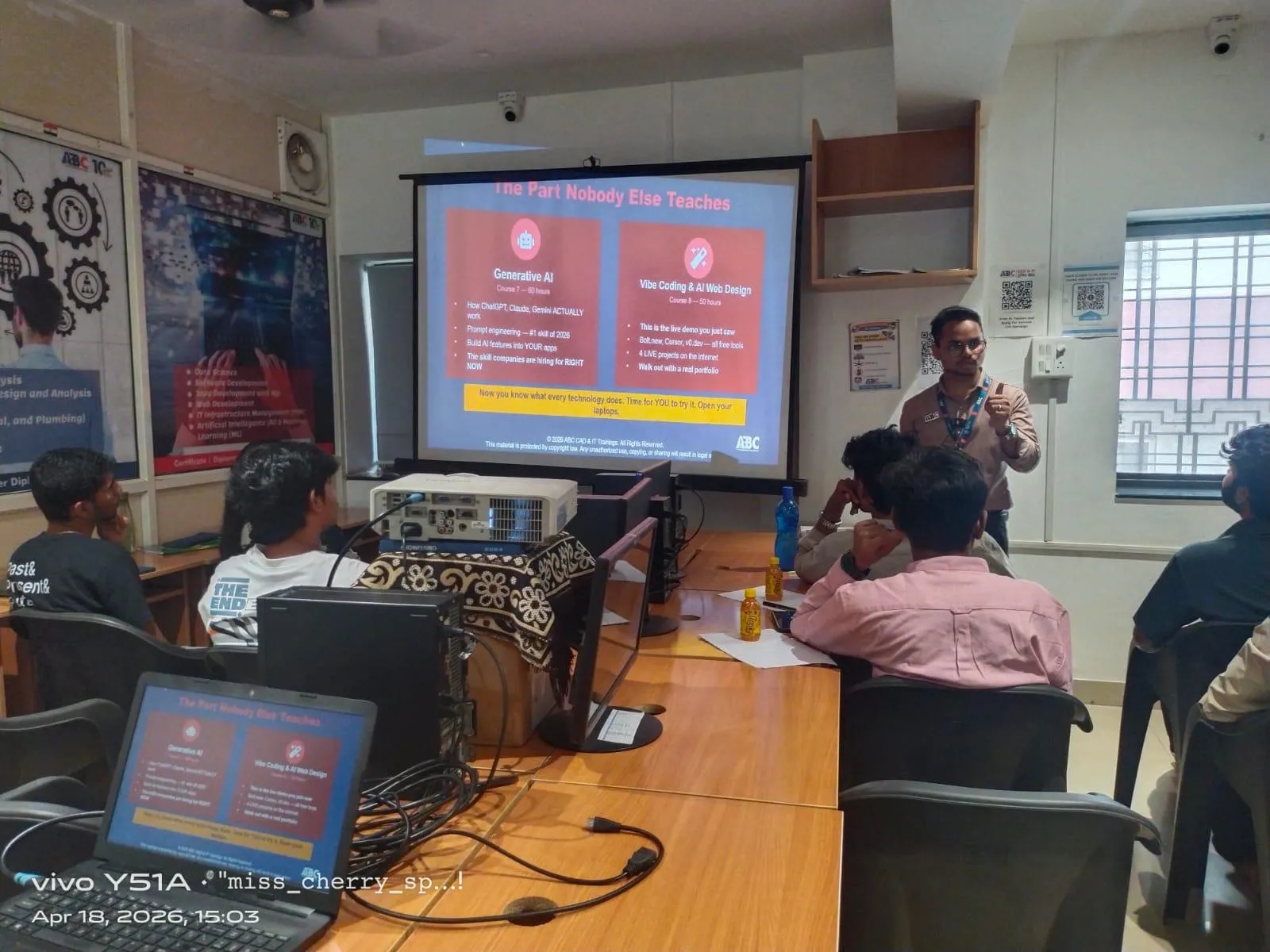
Data science engineering is the field that turns raw data into real business decisions — combining Python programming, data pipelines, machine learning and cloud deployment into one end-to-end role. As NASSCOM and Deloitte project a need for 1.25 million AI and data professionals in India by 2027, the good news is the career path is clearer than ever: you don''t need a PhD, you need a structured roadmap and the right tools. This guide is grounded in an ABC Trainings webinar delivered to engineering and CS students — so what you read here is exactly what industry-ready data science engineers are learning right now, not what a course catalogue says.
- Data science engineering = Python + data pipelines + ML + cloud deployment; all four layers are needed for real industry roles
- The 7-step workflow (collect → clean → EDA → model → evaluate → deploy → monitor) is what production systems actually follow at companies like Infosys, TCS and startups
- Starting salary for freshers with verified skills: ₹3.5–5.5 LPA in Pune/Hyderabad; ₹5–8 LPA with cloud + MLOps knowledge (AmbitionBox 2026)
What Is Data Science Engineering? The Definition That Actually Makes Sense
Data science is not just about charts or predictions — that''s what most people get wrong when they start. Data science engineering is a field that combines programming, data engineering, machine learning and cloud technologies to convert raw data into decisions that businesses act on. The goal is not analysis. The goal is decision-making at scale. In real companies, data engineers and ML engineers build systems that run continuously, handle large volumes of data and give reliable outputs that product teams and finance teams actually use. A data scientist who can only run notebooks but can''t deploy a model into production is only halfway there. Data science engineering closes that gap — it is the complete discipline from raw input to live business value.

The 7-Step End-to-End Data Science Workflow (What Happens in Real Companies)
The end-to-end data science workflow is the same seven-step process whether you are at a Pune IT firm, a Sambhajinagar manufacturing analytics team or a Bengaluru fintech startup. Step 1 is data collection — from databases (SQL, NoSQL), APIs, sensors, CSV files and web scraping. Step 2 is data cleaning and processing: handling missing values, fixing data types, removing duplicates and normalising — most practitioners spend 60–70% of their time here, and skipping it means even the best model will fail. Step 3 is exploratory data analysis (EDA) using Pandas, Matplotlib and Seaborn — understanding distribution, patterns and correlations before touching any algorithm. Step 4 is model building: selecting an algorithm (linear regression, decision trees, random forest, XGBoost), training on historical data. Step 5 is evaluation: accuracy, precision, recall, F1 score, RMSE — tested on unseen data. Step 6 is deployment: converting the model into a REST API using Flask or FastAPI, containerising with Docker, hosting on AWS, Azure or GCP. Step 7 is monitoring: detecting data drift, retraining models as behaviour changes. A model on your laptop has no business value — this workflow is what makes it real.
| Role | Key Skills | Fresher Salary India 2026 | Tools |
|---|---|---|---|
| Data Analyst | SQL, Excel, Python, Tableau | ₹3.5–5 LPA | MySQL, Pandas, Power BI |
| Data Engineer | Python, Spark, SQL, ETL pipelines | ₹4–6 LPA | PySpark, Airflow, AWS Glue |
| ML Engineer | Scikit-learn, TensorFlow, MLOps | ₹5–8 LPA | Flask, Docker, SageMaker |
| AI Engineer | LLMs, RAG, cloud AI services | ₹6–10 LPA | LangChain, Azure AI, Vertex AI |
| Data Science Engineer | All of the above, end-to-end | ₹5.5–9 LPA | Python + Cloud + MLOps full stack |
Python, SQL and the Core Tools You Actually Need in 2026
Python is mandatory — not optional. It is the backbone of data engineering and ML systems: data collection scripts, pipeline automation, model training, API development and cloud integration all run on Python. Core Python concepts to master first: variables, data types, conditional logic, loops, functions, lists, dictionaries and error handling. Then: Pandas and NumPy for data processing, Matplotlib and Seaborn for EDA, Scikit-learn for ML algorithms. For databases, both SQL and NoSQL are required — SQL databases (MySQL, PostgreSQL) for structured, consistent data with defined schema; NoSQL databases (MongoDB) for semi-structured or flexible-schema data like JSON documents. The practical skill test: can you write a Python script that pulls data from an API, cleans it using Pandas, stores it in a SQL table and trains a simple model? If yes, you are production-ready for an entry-level role.
From Machine Learning Model to Production: MLOps and Cloud Deployment
Here''s the thing most introductory courses skip: a trained model is worthless if no one can access it. Deployment is where data science engineering diverges from hobbyist data science. In industry, deployment means exposing a trained model as a REST API using Flask or FastAPI, packaging it in a Docker container so it runs identically across environments, and hosting it on a cloud platform — AWS (EC2, S3, Lambda, SageMaker), Azure (ML Studio, Azure Functions) or GCP (Vertex AI, Cloud Run). MLOps — machine learning operations — is the practice that keeps models healthy in production: monitoring for data drift, automated retraining pipelines, versioning models with MLflow or DVC, and CI/CD for ML code. Companies like Infosys, TCS, KPIT and mid-size Pune product companies now list MLOps skills as a differentiator in job descriptions — candidates who understand end-to-end deployment stand out from those who only know notebooks.
Data Science Career Roadmap in India 2026: Roles, Salaries and Timeline
The data science career roadmap in India for 2026 follows a clear progression: (1) Months 1–2: Core Python + SQL + data manipulation. (2) Months 3–4: EDA, statistics, and your first ML models with Scikit-learn. (3) Months 5–6: Cloud fundamentals (AWS or Azure), deployment with Flask or FastAPI, Docker. (4) Month 6+: MLOps tools, real project portfolio, internship or entry-level application. Starting salaries: Data Analyst ₹3.5–5 LPA; Data Engineer ₹4–6 LPA; ML Engineer (entry) ₹5–8 LPA (AmbitionBox, June 2026). Companies actively hiring data science freshers in Maharashtra: Infosys Hinjawadi, TCS Kharadi, KPIT Technologies, Bajaj Auto digital division, Mahindra Tech. For Sambhajinagar students, AURIC''s industrial expansion is creating manufacturing analytics roles — IoT data pipelines, ERP analytics and quality prediction systems — that combine data engineering with domain knowledge.
Students enrolling in the data science engineering programme at ABC Trainings may be eligible for the Chief Minister Yuva Karya Prashikshan Yojana (CMYKPY) scheme, which provides a training stipend of ₹6,000–₹10,000 for qualifying Maharashtra residents. Bring your Aadhaar card, bank passbook and educational certificates to the nearest ABC Trainings centre for an eligibility check. Centres in Wagholi, Hadapsar, CIDCO Sambhajinagar and Osmanpura all process CMYKPY enrollments. WhatsApp 7774002496 or call 7039169629.Get the Data Science Brochure + Fees + Batch Dates on WhatsApp
Free 1:1 counselling. Placement track record. CMYKPY/PMKVY eligibility check.
💬 Get Brochure on WhatsApp📞 Call 7039169629About the author: Ankush Shendge, IT Trainer, ABC Trainings.
Visit Our Centers
- Wagholi (Pune): 1st Floor, Laxmi Datta Arcade, Pune-Ahilyanagar Highway. Call 7039169629
- Hadapsar (Pune HQ): 1st Floor, Shree Tower, opp. Vaibhav Theater, Magarpatta. Call 7039169629
- Cidco (Chh. Sambhajinagar): Kalpana Plaza, opp. Eiffel Tower, N-1 Cidco. Call 7039169629
- Osmanpura (Chh. Sambhajinagar): S.S.C Board to Peer Bazar Road, near Jama Masjid. Call 7039169629
- Sangli: Shubham Emphoria, 1st Floor, Above US Polo Assn., Sangli-Miraj Rd, Vishrambag. Weekend batches available. Call 7039169629
FAQs
What is the difference between a data analyst and a data science engineer?
A data analyst works with existing data — building reports, dashboards and insights from structured data using SQL, Excel and BI tools. A data science engineer designs and builds the systems that collect, process and model data at scale, including ML pipelines, APIs and production deployments. Data science engineering is a broader, more engineering-oriented role that typically pays 30–50% more at the fresher level.
Do I need a mathematics or statistics background to start data science?
You need basic statistics — mean, median, standard deviation, probability distributions — but you do not need advanced calculus or linear algebra to start. Most data science practitioners learn the maths alongside the tools. What matters more at the entry level is your ability to clean data, write clean Python code and interpret model outputs. The maths deepens as your career grows.
How long does it take to become job-ready in data science engineering from scratch?
With a structured programme covering Python, SQL, EDA, core ML algorithms, cloud deployment and one real project, most engineering or science graduates become job-ready in 5–6 months of consistent practice. The key is completing a project that goes end-to-end: data collection, model training and a deployed API. That portfolio piece is what gets you past the resume filter at TCS, Infosys and mid-size Pune product companies.
Which Indian companies hire freshers for data science and ML engineer roles?
Companies actively hiring data science and ML engineer freshers in India (2026): TCS Digital, Infosys BPM, KPIT Technologies, Capgemini, Wipro AI Lab, Mahindra Digital. Manufacturing firms in AURIC Sambhajinagar are also opening data-analytics roles for IoT and ERP data. Most openings require Python proficiency plus at least one cloud platform (AWS or Azure).