Full Stack, AI & Data Science Career Roadmap: IT Expert Guide for 2026 Freshers (Updated July 2026)
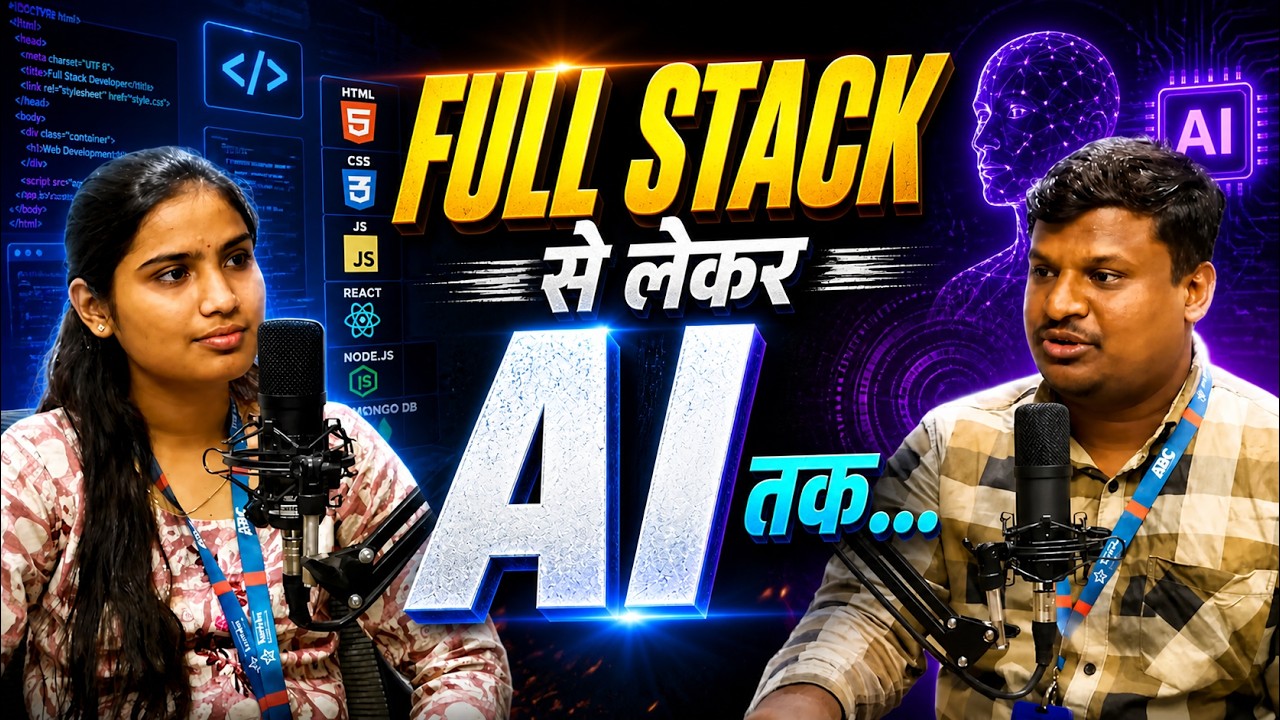
TCS cut 12,000 jobs in July 2025, and Infosys reduced bench headcount by a similar magnitude — yet IT hiring for hands-on full stack and data science roles continued growing. The paradox is real, and ABC Trainings' IT experts Vaishnavi Ratwad and Vitthal Gadekar break it down clearly in their Education and Beyond podcast: the engineers losing jobs are generalist back-bench resources; the ones getting hired are people who can build front-end to back-end with JavaScript frameworks like Angular 19 and Node.js, connect databases (SQL + MongoDB), and understand where Python and AI fit. NASSCOM-Deloitte projects 1.25 million AI-skilled IT roles needed by 2027 — that gap is India's biggest opportunity right now. This guide summarises the full IT career roadmap from their podcast, plus the real salary and hiring data you need to plan your path.
- Full Stack = Front-end (HTML/CSS/JS/Angular or React) + Back-end (Node.js/Python/Java) + Database (SQL/MongoDB)
- Web Development is front-end only; Full Stack covers both — better salary, broader job options
- JavaScript is the most versatile language — powers 90% of front-end and Node.js for back-end
- Angular 19 (Google-supported) and React are the top JS frameworks — build projects in one, learn fundamentals in both
- For freshers: build 2–3 projects, complete LinkedIn to 100%, apply on Naukri + LinkedIn + direct
- Data Science uses Python, SQL, ML libraries (Pandas, Scikit-learn) — learn AFTER strong programming foundation
- TCS/Infosys cut bench roles; hands-on full stack engineers are still in demand at product companies
What is Information Technology (IT)? Understanding the Full Picture in 2026
Information Technology covers any technology used to process, store, retrieve, and transmit information. In 2026, IT is not just software development — it includes AI systems (ChatGPT, DeepSeek, enterprise models), automation (DevOps, CI/CD pipelines), cloud infrastructure (AWS, Azure, GCP), data science, and cybersecurity. What ABC Trainings' IT Lead Vitthal Gadekar emphasises: IT is evolving so fast that by the time you're three years into a career, major new paradigms have appeared. That's why learning how to learn — picking up new frameworks quickly — matters as much as knowing Angular or React today. The IT sector in India employs 5.4 million people directly and many more indirectly; understanding its different verticals helps you pick the right entry point for your background and goals.
Full Stack Development Explained: Front-End, Back-End, and Database Roles
Full stack development means building both the visible part of an application (front-end) and the logic that runs behind it (back-end), plus storing and retrieving data (database). Front-end: HTML builds structure, CSS adds styling, JavaScript adds interactivity. Modern front-end uses frameworks like Angular (by Google) or React (by Meta) to build component-based applications. Back-end: handles user data, authentication, business logic. Technologies: Node.js (JavaScript on the server), Python (Django/Flask), Java (Spring Boot), PHP, ASP.NET. Database: SQL (MySQL, PostgreSQL — tabular data), MongoDB (JSON-document format — used with Node.js and React stacks). Web Development is front-end only. Full Stack is all three. As Vitthal Sir puts it: "A full-stack developer handles both the form a student fills and the database that stores the submission."
| Layer | Technologies | Learn Order | Time to Job-Ready |
|---|---|---|---|
| Front-End Basics | HTML, CSS, JavaScript | 1st | 6–8 weeks |
| Front-End Framework | Angular 19 or React 18 | 2nd | 8–12 weeks |
| Back-End | Node.js or Python (Django) | 3rd | 8–10 weeks |
| Database | SQL (MySQL) + MongoDB | 4th | 4–6 weeks |
| Projects + Portfolio | GitHub, Netlify, AWS free tier | 5th | Ongoing |
| Data Science / AI | Python, Pandas, Scikit-learn | After full stack base | 3–6 months extra |
JavaScript in 2026: Why It Dominates Front-End and Back-End Development
JavaScript was originally only a browser language. Since 2012, Node.js has made it a back-end language too. Today, 90% of websites use JavaScript on the front-end. This means knowing JavaScript deeply gives you a skill that works across front-end, back-end, and even mobile (React Native) — no other language does that. JavaScript has 2,500+ total programming languages to compete with, but its adoption by every browser and its frameworks (Angular 19, React 18, Vue 3, Next.js) make it the single most employable language for a full-stack career in 2026. What most people don't realise: TypeScript — a superset of JavaScript that adds static types — is used inside Angular and increasingly in Node.js projects. If you know JavaScript well, TypeScript takes 1–2 weeks to pick up, not months.
Angular vs React: Which JavaScript Framework Should You Learn First?
Angular 19 is Google's framework for building large-scale enterprise web applications with a component-based architecture. It includes built-in tools for routing, HTTP calls, form validation, and state management — and Google guarantees long-term support. Angular 19 reduced build times from 2–3 minutes to under a minute. React is Meta's library (not a full framework) for building UI components — it's simpler to start with but requires more decisions about routing, state, and data fetching. In the Indian job market, both Angular and React are in demand: large enterprises (banks, government portals, MNCs) tend to use Angular; startups and product companies lean toward React. Vitthal Sir's recommendation: learn Angular thoroughly first for its discipline and structure, then React for product-company interviews. Don't try to learn both at the same time — master one first.
Databases in 2026: SQL vs MongoDB — What Full Stack Developers Need to Know
Databases store all the data your application creates and retrieves. SQL (MySQL, PostgreSQL) stores data in tables with rows and columns — ideal for structured, relational data like user records, product catalogues, and financial transactions. SQL's query language is universal and taught in every computer science program. MongoDB stores data as JSON documents — flexible structure, no strict schema, ideal for real-time apps, content management, and APIs where the data shape varies. In full stack work: React/Node.js stacks often use MongoDB (the 'M' in MERN). Angular/Java or .NET stacks typically use SQL databases. Both have Django and other ORM layers that simplify queries. For freshers, learn SQL first — it's fundamental, universal, and tested in almost every IT interview.
How to Get Your First IT Job as a Fresher in India: A Step-by-Step Plan
Here is the honest fresher job search playbook from Vaishnavi and Vitthal's experience: (1) Build 2–3 real projects — a student portal, an e-commerce page, a data dashboard — not just tutorials. GitHub is your public portfolio. (2) Optimise LinkedIn to 100% — profile photo, headline with your skills (e.g., "Full Stack Developer | Angular | Node.js | SQL"), featured section with project links, 50+ connections. (3) Upload to Naukri.com and update your profile weekly to stay visible in recruiter searches. (4) Direct apply on company career pages — Infosys, Wipro, TCS, Mphasis, Hexaware, and mid-size product companies all have freshers programs. (5) Prepare for coding rounds on LeetCode or HackerRank — easy to medium problems in JavaScript or Python are asked at most product companies. The critical step: don't wait until your course is 100% done to start applying. Start applying at the 70% mark; interviews themselves teach you what to study next.
IT Career Salaries in India 2026: What Full Stack, Data Science & AI Roles Pay
In 2026, Indian IT salaries for full stack and related roles: Junior Full Stack Developer (0–2 yr): ₹3.5–6.0 LPA at service companies, ₹5–9 LPA at product companies. Frontend Developer (React/Angular, 2–4 yr): ₹6–12 LPA. Backend Developer (Node.js/Java, 2–4 yr): ₹6–14 LPA. Data Scientist (Python/ML, 2–4 yr): ₹7–15 LPA. AI/ML Engineer (3–5 yr): ₹12–24 LPA. Location matters: Pune, Bangalore, and Hyderabad pay 20–30% above Nashik or Nagpur for the same role. Companies like Infosys, TCS, Wipro, Cognizant, and Mphasis are the entry employers; product companies like Freshworks, Zoho, and Swiggy Tech pay higher. Starting at a service company for 1–2 years, then moving to a product company, is the standard Indian IT career trajectory for a 25–40% salary jump.
Under Maharashtra's CMKVY scheme, IT and software engineering students who complete government-certified full stack, data science, or AI-ML programs may receive ₹6,000–₹10,000 in skill development incentives. ABC Trainings' AI Powered Application Development program is MSME-certified — enquire at the Wagholi, Hadapsar, or Sambhajinagar branches for CMKVY registration.Get the IT Brochure + Fees + Batch Dates on WhatsApp
Free 1:1 counselling. Placement track record. CMYKPY/PMKVY eligibility check.
💬 Get Brochure on WhatsApp📞 Call 7039169629About the author: Amit Kulkarni. 8 yrs leading IT training at ABC Trainings, ex-Infosys.
Visit Our Centers
- Wagholi (Pune): 1st Floor, Laxmi Datta Arcade, Pune-Ahilyanagar Highway. Call 7039169629
- Hadapsar (Pune HQ): 1st Floor, Shree Tower, opp. Vaibhav Theater, Magarpatta. Call 7039169629
- Cidco (Chh. Sambhajinagar): Kalpana Plaza, opp. Eiffel Tower, N-1 Cidco. Call 7039169629
- Osmanpura (Chh. Sambhajinagar): S.S.C Board to Peer Bazar Road, near Jama Masjid. Call 7039169629
- Sangli: Shubham Emphoria, 1st Floor, Above US Polo Assn., Sangli-Miraj Rd, Vishrambag. Weekend batches available. Call 7039169629
FAQs
What is the difference between full stack development and web development?
Web development typically refers to front-end only — building what users see using HTML, CSS, and JavaScript. Full stack development covers both the front-end and the back-end (server logic, APIs) plus the database. Full stack developers can build a complete application independently, which is why they command higher salaries and are more versatile in job applications.
Which is better to learn first — Angular or React?
Angular is the better starting choice for most Indian engineering students because it provides a structured, opinionated framework with built-in routing, forms, and state management — fewer decisions to make upfront. Once you understand Angular's component architecture and TypeScript, picking up React takes 2–4 weeks. Starting with React can feel overwhelming because it requires choosing many additional libraries. Learn one deeply before touching the other.
How much does a full stack developer earn in India in 2026?
In 2026, junior full stack developers with 0–2 years' experience earn ₹3.5–6.0 LPA at service companies and ₹5–9 LPA at product startups. Mid-level developers with 2–4 years earn ₹7–14 LPA. Senior full stack engineers with 5+ years reach ₹15–28 LPA at MNCs and product companies. Location matters: Pune, Bangalore, and Hyderabad pay 20–30% more than Tier 2 cities for equivalent roles.
Can a non-IT engineering student switch to full stack development?
Yes — and it's more common than you might think. Mechanical, civil, and electrical engineers with no prior IT background switch to full stack development after 6–12 months of focused training. The key is building real projects and completing coding challenges during the transition. ABC Trainings has placed mechanical and civil graduates in IT roles at companies like Infosys and mid-size product firms within 8–12 months of starting the AI Powered Application Development program.