Machine Learning as a Branch of AI: Core Concepts Every Engineering Student Must Know (2026) (Updated July 2026)
NASSCOM and Deloitte project that India will need 1.25 million AI and machine learning professionals by 2027 — a gap no university alone can fill. Here's the thing: most students learn the buzzwords before they understand the concept. Machine learning isn't magic. It's a very specific idea — machines getting better at a task by learning from examples in data, without a human writing rules for every possible case. Once you understand that one sentence deeply, the rest of AI starts making sense.
- Machine learning is a branch of AI where machines learn from data without being explicitly programmed for every case
- Traditional programming: humans write rules. ML: the algorithm finds rules from patterns in data
- Three main learning types: supervised (labelled data), unsupervised (patterns in unlabelled data), reinforcement (learning from reward signals)
- ML powers recommendation engines, fraud detection, language translation, and medical diagnostics
- Data Scientists, ML Engineers, and AI Developers in India earn ₹6–₹20 LPA depending on experience
What Is Machine Learning? The One-Paragraph Answer
Machine learning is a branch of artificial intelligence that allows machines to learn and improve from data without being explicitly programmed for every scenario. The trainer at ABC Trainings explains it this way: in traditional software, a human writes every rule — "if temperature is above 37°C, flag as fever." In machine learning, you feed the system thousands of patient records and let it find that pattern itself. The machine learns the rule from examples. That is the core idea.
How Machine Learning Differs from Traditional Programming
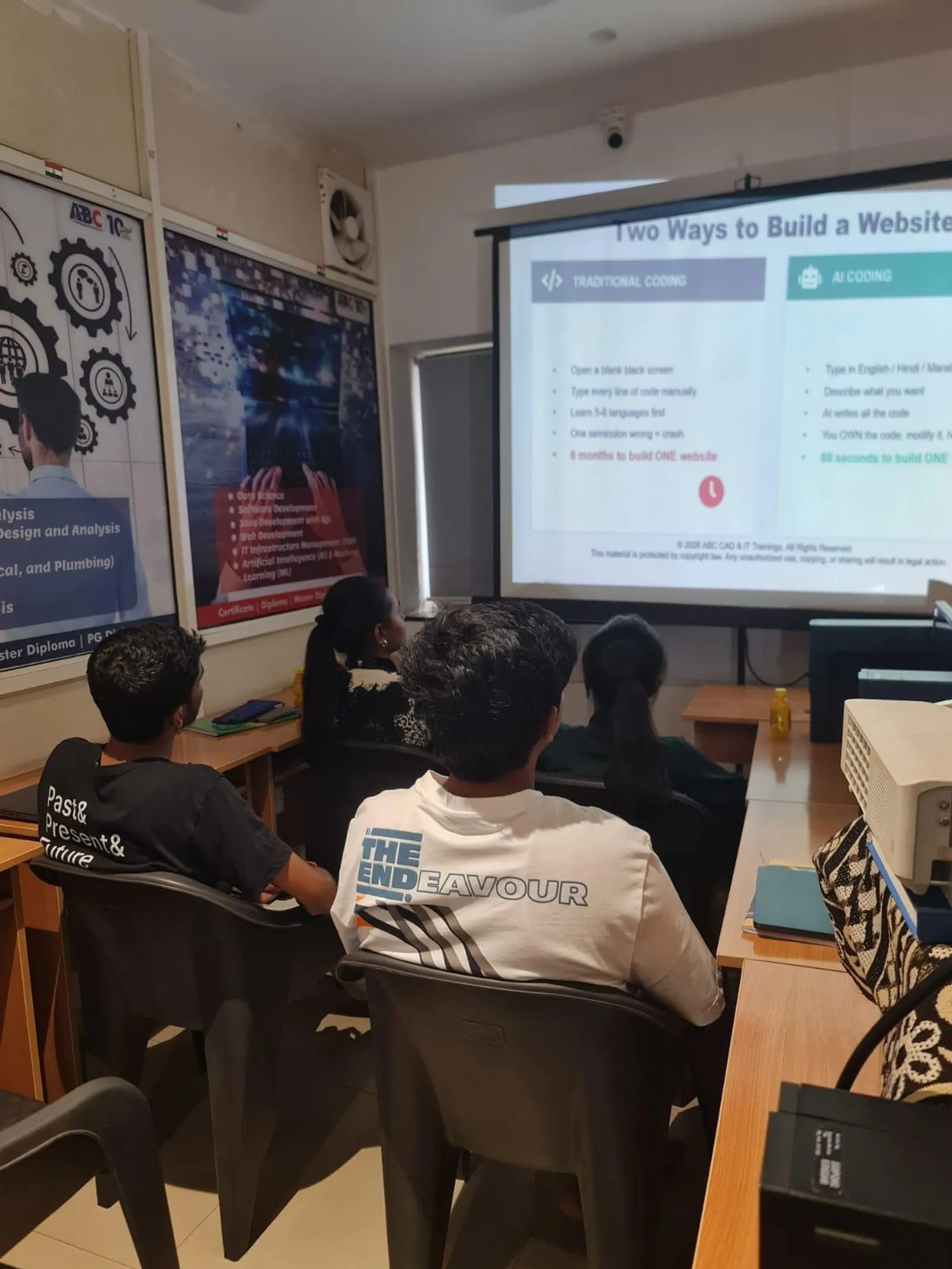
In traditional programming: input + rules = output. A programmer writes the rules. In machine learning: input + output (training data) = rules (the model). The algorithm figures out the rules by seeing many input-output pairs. This is why ML can do things no human could manually program — like recognizing faces in photos or translating languages in real time. There are too many rules to write by hand; ML finds them from data. Trust me, the moment this distinction clicks, you understand why ML is different from regular software development.
| Approach | Who Writes the Rules? | Example |
|---|---|---|
| Traditional Programming | Human programmer | if-else rules for tax calculation |
| Machine Learning | Algorithm learns from data | Spam filter learning from email examples |
| Deep Learning (subset of ML) | Neural network learns features | Face recognition in photos |
The Three Types of Machine Learning (Brief Overview)
Supervised learning trains on labelled data — you provide inputs with correct answers, and the algorithm learns to predict. Unsupervised learning finds patterns in data without labels — clustering customers by behaviour, for instance. Reinforcement learning trains through a reward signal — an agent (like a game AI) gets points for good actions and learns to maximize them. These three categories cover almost every ML application you'll encounter in an AI course or job.
Real-World Examples of Machine Learning You Use Every Day
Your YouTube recommendations are ML — supervised learning predicting which video you'll click next. Google Translate is ML — sequence-to-sequence deep learning trained on billions of sentence pairs. Credit card fraud detection is ML — anomaly detection that flags transactions statistically unlike your usual behaviour. Spam filters, autocorrect, voice assistants, medical imaging analysis — all ML. What most people don't realize is that you interact with ML models dozens of times per day without knowing it.
Machine Learning Careers in India: Salaries and Roles in 2026
In India's job market, entry-level ML roles start at ₹4–₹7 LPA for freshers with Python, basic statistics, and a portfolio project (source: AmbitionBox, 2025–26). Data Scientists with 2–3 years of experience and strong model-building skills earn ₹9–₹15 LPA. Senior ML Engineers and AI architects at companies like TCS iON, Infosys AI Centre, Persistent, and KPIT earn ₹18–₹30 LPA. The NASSCOM-Deloitte 2024 report projects over 300,000 net new AI/ML jobs in India by 2027.
What Skills Do You Need to Start Learning Machine Learning?
To start learning machine learning seriously, you need Python (especially NumPy, Pandas, scikit-learn), basic statistics (mean, variance, probability), and an understanding of what data is and how it's cleaned. The good news is: you don't need advanced mathematics at the beginner stage. Most ML courses start with concept understanding and practical model building before going deep into math. A motivated engineering student with Python basics can be building their first ML model within 8–10 weeks of structured learning.
Get the AI Powered Application Development Brochure + Fees + Batch Dates on WhatsApp
Free 1:1 counselling. Placement track record. CMYKPY/PMKVY eligibility check.
💬 Get Brochure on WhatsApp📞 Call 7039169629About the author: Amit Kulkarni. 8 yrs leading IT training at ABC Trainings, ex-Infosys.
Visit Our Centers
- Wagholi (Pune): 1st Floor, Laxmi Datta Arcade, Pune-Ahilyanagar Highway. Call 7039169629
- Hadapsar (Pune HQ): 1st Floor, Shree Tower, opp. Vaibhav Theater, Magarpatta. Call 7039169629
- Cidco (Chh. Sambhajinagar): Kalpana Plaza, opp. Eiffel Tower, N-1 Cidco. Call 7039169629
- Osmanpura (Chh. Sambhajinagar): S.S.C Board to Peer Bazar Road, near Jama Masjid. Call 7039169629
- Sangli: Shubham Emphoria, 1st Floor, Above US Polo Assn., Sangli-Miraj Rd, Vishrambag. Weekend batches available. Call 7039169629
FAQs
What is the difference between AI and machine learning?
AI (Artificial Intelligence) is the broad field of making computers intelligent. Machine learning is a specific technique within AI where computers learn from data. All machine learning is AI, but not all AI is machine learning — some AI systems use rule-based logic, expert systems, or robotics without any ML at all.
Can I learn machine learning without a strong maths background?
Yes, at the beginner stage. Starting with Python and understanding basic statistics (average, percentage, comparison) is enough to build your first ML models using libraries like scikit-learn. Advanced mathematics (linear algebra, calculus, probability theory) becomes important at the intermediate and research level, but many industry roles never require going that deep.
What programming language is used in machine learning courses?
Python is the industry standard for machine learning in 2026. The key libraries are: NumPy and Pandas (data handling), Matplotlib (visualization), scikit-learn (classical ML algorithms), and TensorFlow or PyTorch (deep learning). Most ML courses, including ABC Trainings' AI Powered Application Development program, are Python-based.
What is the career scope of machine learning in India in 2026?
Machine learning career scope in India is strong. NASSCOM and Deloitte project 1.25 million AI professionals needed by 2027. Entry ML roles start at ₹4–₹7 LPA; experienced ML engineers earn ₹12–₹25 LPA. TCS, Infosys, Wipro, Amazon India, Google India, and hundreds of product startups in Pune, Hyderabad, and Bengaluru are actively hiring.