Most BIM engineers in Pune start and finish their day inside Revit. That is the right foundation. But once you have modelled enough walls, floors and families, you hit a ceiling: anything that involves complex curved geometry, a parametric facade, or repeating a fiddly modelling task hundreds of times becomes painful by hand. This is exactly where Rhino.Inside.Revit and Grasshopper change what one engineer can deliver.
What Rhino.Inside.Revit actually is
Rhino.Inside.Revit is a free, open-source add-in that loads Rhino and Grasshopper as a process inside Revit. That single sentence carries a lot of weight. It means you can open the Grasshopper canvas while your Revit project is live, read elements out of Revit, generate or modify geometry with Grasshopper's visual nodes, and push the result straight back into Revit as native walls, floors, columns, adaptive components or direct shapes. Nothing is exported, nothing is re-imported, and the connection is live.
For a Pune engineer who already knows Revit, the learning curve is gentler than people expect. You are not abandoning your workflow; you are bolting a parametric engine onto it. You keep your sheets, schedules and coordination exactly as they are, and you reach for Grasshopper only when the geometry or the repetition justifies it.
Grasshopper in one paragraph
Grasshopper is a visual programming canvas. Instead of writing code, you drag components onto a canvas and wire them together. A slider feeds a number into a component, that component produces points, those points drive a curve, the curve drives a surface, and so on. Change the slider and the whole chain updates instantly. If you have used Dynamo for Revit, the idea will feel familiar — Grasshopper is the older, more mature cousin, with a far larger plugin ecosystem for geometry.
Where this earns its keep on Pune projects
Facades and panelisation. The glass curtain-wall towers going up in Kharadi, Hinjewadi and Baner increasingly use non-rectangular panels, tapering profiles and shading fins. Modelling a few thousand unique panels by hand in Revit is a week of work and a maintenance nightmare. In Grasshopper you define the panel logic once, and every panel rebuilds automatically when the architect moves a control point.
Complex roofs and form-finding. Auditoriums, stadiums and convention centres around Balewadi and MIT-WPU often need curved or tensile roof forms that Revit's native tools fight against. Rhino's surface modelling, driven from Grasshopper, handles these comfortably and then bakes a clean roof or mass back into Revit.
Repetitive structural layouts. Placing hundreds of foundation pads, balusters, louvres or parking bollards on a real Pune site is the kind of task that computational design eats for breakfast. Define the rule, point it at the Revit geometry, and let it run.
Data-driven geometry. Because Grasshopper can read and write Revit parameters, you can drive geometry from a spreadsheet of room areas, sun angles or cost data. That is where computational design starts to overlap with analysis and optimisation.
Rhino.Inside.Revit vs Dynamo — when to use which
This is the question every serious Pune BIM engineer eventually asks. The honest answer is that they are complementary, not competing. Dynamo lives natively inside Revit, ships with it, and is excellent for data handling, documentation automation, renaming, tagging and bulk parameter edits. Grasshopper, reached through Rhino.Inside.Revit, is the stronger tool the moment free-form or heavily parametric geometry enters the picture, and it has a deeper library of geometry plugins built over fifteen years.
A practical rule we teach: if the task is mostly about information — data, parameters, schedules — start with Dynamo. If the task is mostly about shape — facades, curved roofs, complex repetition — start with Grasshopper. An engineer who can move between both is genuinely rare in the Pune market and is paid accordingly.
A realistic learning path
You do not need a computer-science background. What you need is solid Revit fundamentals first — families, parameters and worksharing — and then a structured introduction to the Grasshopper canvas: data trees, list management and the Rhino.Inside.Revit components that read and write Revit elements. From there you build real deliverables: a parametric louvre facade, an automated column grid, a panelised dome. The skill becomes real only when it produces something you can show in a portfolio.
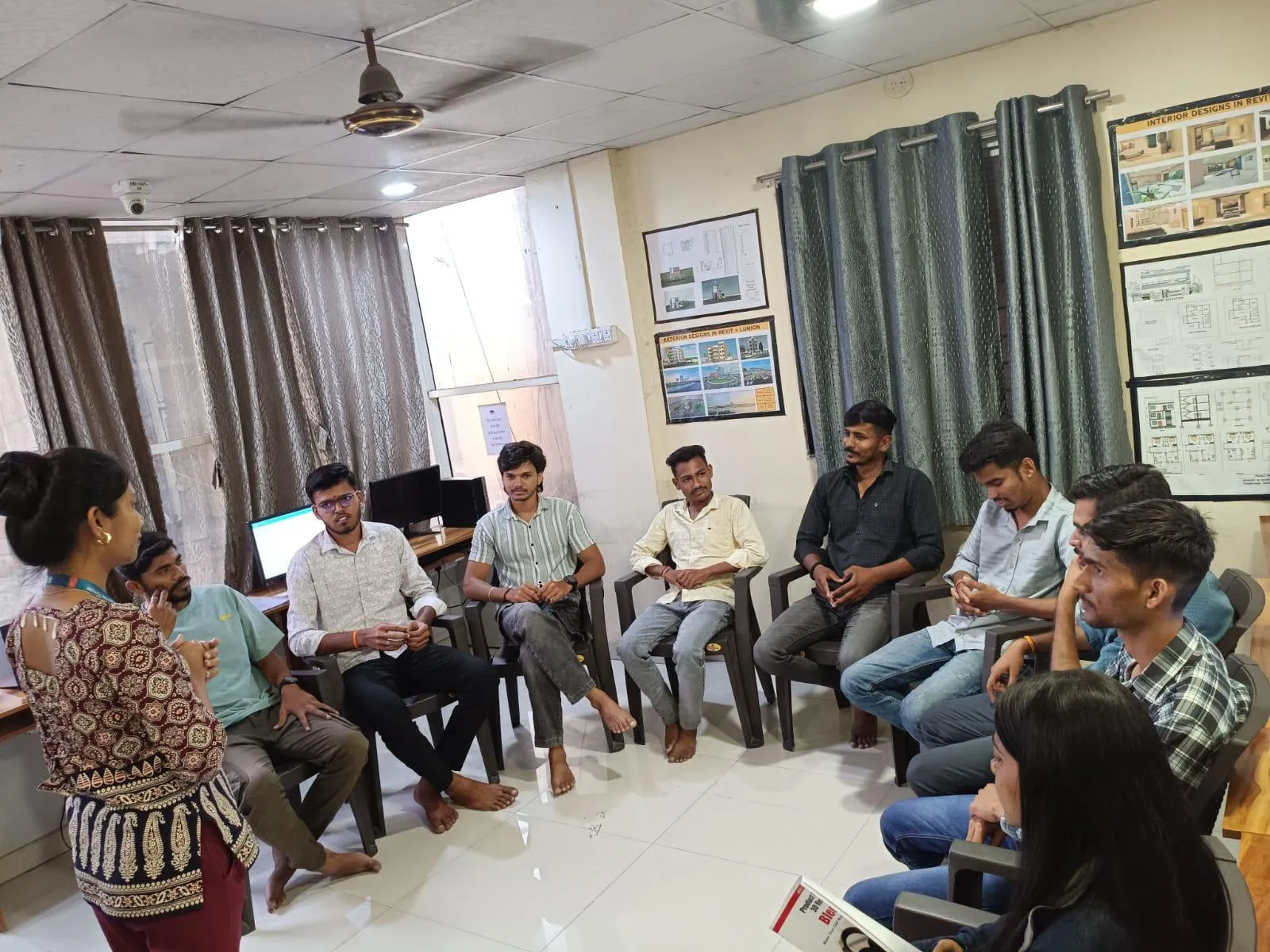
At ABC Trainings in Wagholi and Hadapsar, computational design is taught as an applied extension of core BIM, not as an abstract coding course. Every module ends with a tangible Revit output you can put in front of a hiring manager.
Is it worth the effort for a Pune career?
Core Revit gets you into the industry. Computational design is what separates a modeller from a designer. As more Pune AEC firms take on international work for the UK, the Middle East and Singapore — markets where parametric facades and ISO 19650 delivery are normal — the engineers who can automate geometry and information become the ones firms cannot easily replace. That is a strong place to be in any job market.
Frequently asked questions
Do I need to know Rhino before learning Rhino.Inside.Revit?
No. Rhino.Inside.Revit runs Grasshopper directly inside Revit, so you can start with the Grasshopper canvas and Revit components without modelling in Rhino first. Knowing basic Rhino helps with free-form geometry, but most Pune AEC work begins from the Revit side.
Is Rhino.Inside.Revit free?
The Rhino.Inside.Revit add-in is free and open-source, but it needs a licensed copy of Rhino 7 or later installed on the same machine. Students can use Rhino's evaluation period and Autodesk's free education licence for Revit while learning.
Will Grasshopper replace Dynamo for Pune BIM teams?
Not replace — complement. Dynamo is tightly integrated with Revit and great for data and documentation tasks. Grasshopper through Rhino.Inside.Revit is stronger for complex curved geometry, facades and panelisation. Strong candidates in Pune learn both.
What jobs use computational design in Pune?
Facade engineering, parametric architecture studios, structural geometry teams and AEC firms working on international projects in Hinjewadi and Kharadi increasingly ask for Grasshopper or Dynamo. It is a differentiator on top of core Revit skills.
Related guides for Pune BIM engineers
Get Brochure + Fees + Batch Dates on WhatsApp
Free 1:1 counselling. Placement track record. Government-affiliated, ISO & MSME certified.
💬 WhatsApp 7774002496📞 Call 7039169629Visit Our Centers
- Wagholi (Pune): 1st Floor, Laxmi Datta Arcade, Pune-Ahilyanagar Highway, Wagholi. Call 7039169629
- Hadapsar (Pune HQ): 1st Floor, Shree Tower, opp. Vaibhav Theater, near Bloom Hotel, Magarpatta, Hadapsar. Call 7039169629
- Cidco (Chh. Sambhajinagar): Plot no 258, opp. Eiffel Tower, N-1 Cidco. Call 7039169629
- Osmanpura (Chh. Sambhajinagar): S.S.C Board to Peer Bazar Road, near Jama Masjid. Call 7039169629
- Sangli: 1st Floor, above US Polo Store, Sangli-Miraj Rd, Gandhi Nagar, Vishrambag. Weekend batches available. Call 7039169629