AI predictive maintenance in India is no longer just a buzzword used in plant presentations. It's becoming a practical skill for engineers who want to work on machine reliability, condition monitoring, and Industry 4.0 projects. If you already understand the basics of maintenance types and simple sensor-based monitoring, this is where you go deeper. We'll look at the advanced techniques professionals use to predict machine failure before breakdown, how data is actually handled inside factories, and what settings and workflows matter when you're trying to build a system that works in the real world.
Here's the thing: machines almost never fail without warning. The warning signs are there in vibration, temperature drift, current fluctuations, lubrication quality, acoustic patterns, and operating context. What most people don't realize is that the challenge is not collecting data. The challenge is knowing which signals matter, how early they appear, and how to turn them into maintenance decisions that save downtime. Trust me, this is exactly where advanced AI predictive maintenance becomes valuable.
What is advanced AI predictive maintenance actually doing?
At a basic level, predictive maintenance tells you that a machine may fail soon. At an advanced level, it tries to answer five tougher questions: what is changing, why is it changing, how fast is it degrading, how confident is the prediction, and what action should maintenance take right now.
That means serious systems don't rely on one sensor or one threshold. They combine multi-sensor inputs, time-series analysis, trend deviation, anomaly detection, and failure pattern comparison. In a production environment like Bajaj Auto, Bosch, Thermax, or Kirloskar, the useful output isn't just a red alert. It's a ranked maintenance priority with probable cause, severity, and estimated time-to-failure.
Which machine signals predict failure before breakdown?
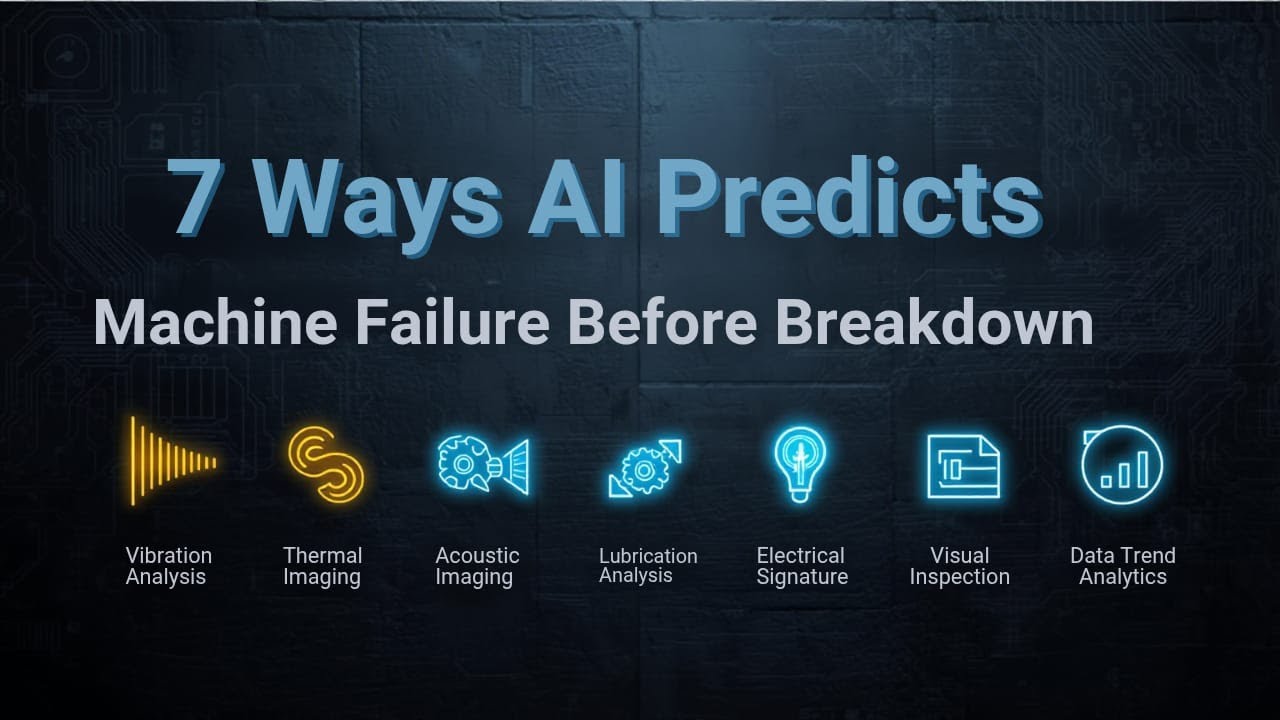
The strongest predictive maintenance systems usually combine these seven signal groups:
- Vibration signatures: bearing wear, shaft misalignment, looseness, imbalance
- Temperature trends: motor overheating, friction increase, lubrication breakdown
- Current and power draw: overload, motor stress, insulation issues
- Acoustic emissions: early crack formation, cavitation, abnormal friction noise
- Lubrication and oil condition: contamination, particle count, viscosity change
- Pressure and flow behavior: pump efficiency drop, blockage, valve issues
- Operational context: load, speed, shift pattern, ambient heat, start-stop cycles
The good news is that you don't always need all seven. But for advanced work, you should stop thinking in isolated readings and start thinking in sensor fusion. A motor with normal temperature but unusual vibration under only one load condition is often more informative than a simple over-temperature alarm.
How do power users build better failure prediction models?
Beginners often jump straight into machine learning models. Professionals don't. They first build a signal pipeline that cleans the data properly. If the data quality is weak, even the best model will give you confident nonsense.
A strong workflow usually looks like this:
- Synchronize sensor timestamps from PLC, SCADA, historian, and edge devices
- Remove sensor spikes, dropouts, and maintenance-period noise
- Segment data by machine mode: startup, steady load, overload, shutdown, idle
- Create rolling statistics such as RMS, kurtosis, crest factor, and moving averages
- Label known failure events and maintenance interventions
- Train separate models for anomaly detection and failure classification
What most people don't realize is that machine mode segmentation is a big deal. A vibration value that looks abnormal at idle may be completely normal at full speed. That's why advanced teams at Siemens, L&T, or Tata Technologies don't train one generic model across all states unless they have very carefully engineered features.
What features matter most in predictive maintenance projects?
If you're moving beyond basics, feature engineering is where your model starts becoming useful. Raw sensor values are rarely enough. You need features that capture change over time and machine behavior under real operating conditions.
For rotating equipment, useful advanced features include:
- RMS vibration across axes
- Peak-to-peak amplitude
- Kurtosis for impulsive faults
- Crest factor for early bearing damage
- Spectral energy around bearing fault frequencies
- Temperature rise rate, not just temperature value
- Load-normalized current draw
- Lubrication degradation trend per operating hour
Trust me, this one shift changes everything: don't ask only, “What is the value?” Ask, “How is the value changing relative to load, speed, and time?” That's where real failure prediction starts.
Which AI models are used for machine failure prediction in industry?
In Indian industry, the model choice depends on data availability and plant maturity. If failure history is limited, anomaly detection is often the first step. If you have enough labeled events, you can move into supervised prediction.
Anomaly detection models
These are useful when you don't have many failure examples. Autoencoders, Isolation Forest, and one-class methods can flag behavior that deviates from normal machine operation. They are practical for plants beginning digital maintenance adoption.
Supervised classification models
Random Forest, XGBoost, and gradient boosting methods work well when you have labeled data and engineered features. They're often easier to explain to maintenance teams than deep learning.
Time-series deep learning
LSTM and temporal models are used when long sequence behavior matters. But here's the thing: they are not automatically better. If your data is noisy and labels are poor, a simpler model with good features will outperform a fancy one.
Remaining Useful Life estimation
This is the advanced stage. Instead of only saying fail or no fail, the system estimates how much usable life is left. That's especially useful for high-value equipment in automotive, process plants, and heavy manufacturing.
How do companies reduce false alarms in predictive maintenance?
False alarms are one of the biggest reasons predictive maintenance projects fail after pilot stage. Maintenance teams stop trusting the system if it keeps flagging healthy machines.
To reduce false positives, advanced teams use:
- Multi-condition thresholds instead of fixed thresholds
- Alarm persistence rules, such as requiring abnormality for 10 to 30 minutes
- Confidence scoring tied to multiple sensors
- Maintenance feedback loops to confirm or reject alerts
- Separate alert logic for startup versus steady-state operation
This matters because a good model is not just accurate in Excel. It must be trusted on the shop floor. At companies like Mahindra Engineering, Bosch, or Thermax, the winning systems are the ones maintenance engineers actually use during shift decisions.
What software stack is common for advanced predictive maintenance in 2026?
By 2026, a practical stack in India often combines industrial data sources with analytics tools rather than one single platform. You might see PLC and SCADA data from Siemens TIA Portal, WinCC, or Ignition feeding into a historian, then processed in Python, SQL, Power BI, or cloud dashboards.
A typical advanced workflow may include Python 3.12 for preprocessing, pandas for time-series cleaning, scikit-learn for model building, SQL Server or PostgreSQL for event storage, and Power BI for maintenance dashboards. In IT and engineering service firms like Infosys, TCS, and KPIT Technologies, this hybrid stack is common because clients want both analytics and business reporting.
What jobs and salaries are realistic in Maharashtra for this skill?
If you build strong predictive maintenance skills, you can target roles such as condition monitoring analyst, reliability engineer, maintenance data analyst, industrial AI engineer, and digital manufacturing analyst.
Realistic salary ranges in Maharashtra in 2026 can look like this:
- Fresher with training project skills: ₹3.5 lakh to ₹5.5 lakh per year
- 1 to 3 years in maintenance analytics: ₹5.5 lakh to ₹8.5 lakh per year
- Industrial AI or reliability specialist: ₹8 lakh to ₹14 lakh per year
- Advanced consulting or OEM roles: ₹12 lakh+ depending on plant, domain, and software stack
Pune has the strongest demand because of automotive, manufacturing, and IT services. Chhatrapati Sambhajinagar has growing opportunities linked to plant operations and supplier networks. Sangli students usually benefit by building project portfolios that connect mechanical systems with Python, SQL, and dashboarding.
How should you learn this deeply instead of just watching theory?
Start with one machine type. Don't try to model an entire factory on day one. Pick a motor, pump, compressor, or blower. Collect or simulate sensor data. Build a clean dataset. Create trends. Detect anomalies. Then connect the output to a maintenance action.
The best student portfolios include one clear use case, one dashboard, one prediction logic, and one maintenance recommendation report. That's the kind of work that gets noticed in interviews at Tata Technologies, Siemens, L&T, or KPIT Technologies.
If you want structured guidance, ABC Trainings helps students in Maharashtra build practical projects in Python, SQL, analytics, and industrial applications. You can call 8698270088 or WhatsApp 7774002496 to understand which learning path fits your background.
The good news is that you don't need to be a data scientist first. You need to become very good at connecting machine behavior, sensor signals, and actionable decisions. Once you understand that bridge, AI predictive maintenance stops being theoretical and starts becoming a career skill.
Is AI predictive maintenance good for mechanical engineers in Maharashtra?
Yes, especially if you want to move into reliability, smart manufacturing, or Industry 4.0 roles. Pune has strong demand from automotive, process, and engineering service companies, while Chhatrapati Sambhajinagar and nearby industrial belts are also growing. If you combine mechanical basics with Python, SQL, and dashboarding, your profile becomes much stronger than a pure maintenance fresher.
Do I need machine learning before learning predictive maintenance?
No. You should first understand machine behavior, sensor types, failure modes, and time-series data. After that, machine learning becomes easier because you'll know what the model is actually looking at. At ABC Trainings, many students first build data understanding and only then move into prediction models.
Which software should I learn for predictive maintenance jobs in India?
Start with Python, SQL, Excel, and Power BI. Then learn how industrial data comes from PLC, SCADA, or historians, especially in Siemens-based environments. If you can clean sensor data, build a model, and show results on a dashboard, you'll already be ahead of many entry-level candidates.
What salary can a fresher get after learning predictive maintenance in Pune?
A realistic fresher salary is usually around ₹3.5 lakh to ₹5.5 lakh per year, depending on your projects and whether you're applying to a plant, OEM, or IT services company. With one or two strong industrial analytics projects, some candidates can push beyond that range. Your chances improve a lot if you can explain both the machine side and the data side clearly in interviews.
Visit Our Centers
Chhatrapati Sambhajinagar
Corporate Office (HQ)
2nd Floor, Kandi Towers, Jalna Road, Amarpreet Chowk, Chhatrapati Sambhajinagar, Maharashtra 431001
Osmanpura Branch
Plot No 14, Shanya Sect, Near Sant Eknath Rang Mandir, Osmanpura, Chhatrapati Sambhajinagar, Maharashtra 431005
CIDCO Branch
Plot No 4, N-3, Cidco, Opp. High Court, Chhatrapati Sambhajinagar, Maharashtra 431003
Pune
Wagholi Branch
1st Floor, ABC Trainings, Laxmi Datta Arcade, Pune - Ahilyanagar Hwy, Wagholi, Pune, Maharashtra 412207
Hadapsar Branch
Bloom Hotel, ABC Trainings 1st Floor, S.no 156/3 Shree Tower Pune - Solapur Rd, Hadapsar, Pune, Maharashtra 411028
Sangli
Sangli Branch
2nd Floor, Vasant Market, Opp. City High School, Sangli, Maharashtra 416416
Start Your Career Journey Today
Join 10,000+ students who transformed their careers with ABC Trainings.
💬 WhatsApp: 7774002496📞 Call: 8698270088