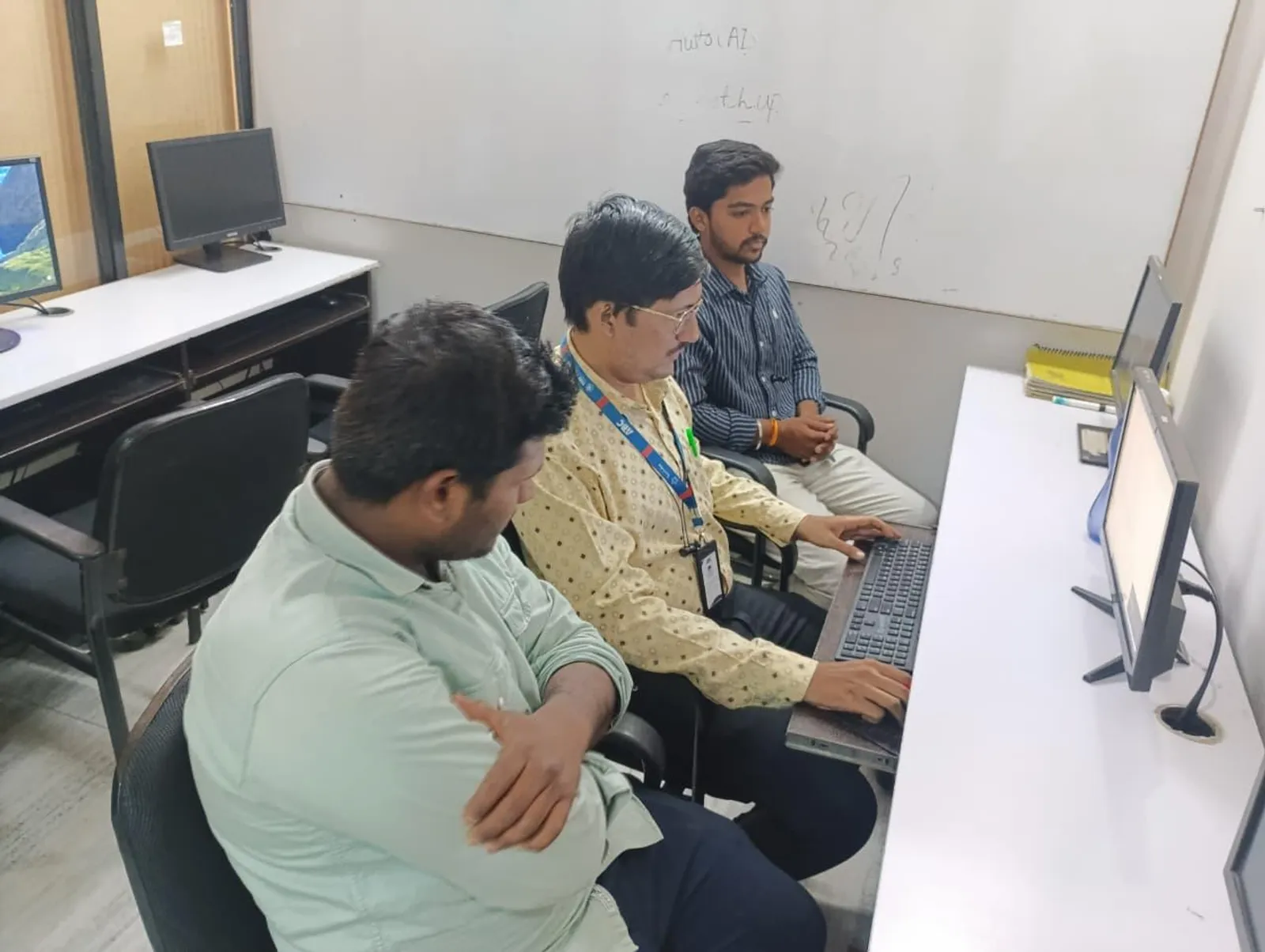
AutoCAD for Mechanical Engineers: 3D Solid Modeling Basics — Episode 12 (Updated May 2026)
NASSCOM projects that India's manufacturing sector will need 1.25 million AI-skilled professionals by 2027 — but on every mechanical engineering interview desk right now, the test is simpler: can you model a 3D part in AutoCAD? Episode 12 of our AutoCAD for Mechanical Engineers series picks up where Episode 11 left off and takes you into 3D territory: EXTRUDE, REVOLVE, UNION, SUBTRACT, and the solid editing tools that Pune-area manufacturers — Bajaj Auto, Tata Tech, Mahindra — use daily.

- 3D solid modeling in AutoCAD starts with a 2D profile and then extrudes or revolves it into a solid
- EXTRUDE, REVOLVE, UNION, SUBTRACT, and INTERSECT are the 5 commands to master first
- AutoCAD's 3D is not SolidWorks-level parametric — but it's what many small and medium manufacturers use
- The visual style, UCS, and viewcube navigation confuse beginners more than the modeling commands
- Practice on 3 real mechanical part exercises covered in this episode's video
Why 3D Modeling in AutoCAD Still Matters for Mechanical Engineers
Here's the thing — most mechanical engineering students want to jump straight into SolidWorks or CATIA for 3D. And yes, those are better parametric tools. But AutoCAD's 3D solid modeling matters for two reasons: first, a large number of small-to-medium component manufacturers in Pune's Bhosari and Pimpri-Chinchwad belts still run AutoCAD for both 2D and 3D work; second, understanding how solids are built from 2D profiles is the foundation for every parametric CAD tool you'll learn later. Skip AutoCAD 3D and you'll struggle with feature-based modeling concepts in SolidWorks.

Setting Up Your 3D Workspace: Visual Styles, UCS, and ViewCube
Switching from 2D to 3D in AutoCAD catches beginners out immediately — the workspace looks different. First: change your visual style to Realistic or Shaded (type VSCURRENT → select Shaded). Second: understand the User Coordinate System (UCS) — it's the orientation of your XY plane in 3D space. The UCSICON shows you where you are. Third: use the ViewCube (top-right corner) to orbit and orient your view — click on a face to see an isometric or orthographic view. Fourth: use the 3D Navigation toolbar for ORBIT, PAN, and ZOOM. These aren't modeling commands but they control what you see — and beginners burn a lot of time not knowing how to get back to a familiar view.
| Command | What It Does | Starting Shape | Typical Use |
|---|---|---|---|
| EXTRUDE | Push 2D profile into 3D | Closed polyline/region | Brackets, plates, blocks |
| REVOLVE | Spin profile around axis | Closed polyline/region | Shafts, discs, flanges |
| SUBTRACT | Cut one solid from another | Two overlapping solids | Holes, pockets, slots |
| UNION | Merge two solids | Two separate solids | Combined parts, assemblies |
Core AutoCAD 3D commands — ABC Trainings mechanical CAD course, May 2026
The Core Solid Modeling Commands: EXTRUDE, REVOLVE, SWEEP, LOFT
All 3D solids in AutoCAD start as 2D profiles. EXTRUDE takes a closed 2D shape (rectangle, polygon, closed polyline) and pushes it into a 3D solid along a path or distance. REVOLVE takes a 2D profile and spins it around an axis — perfect for shafts, discs, and cylindrical parts. SWEEP takes a 2D profile and moves it along a 2D path — useful for pipes and curved extrusions. LOFT creates a solid between multiple cross-section profiles — used for organic shapes and transition pieces. In Episode 12 we extrude a bracket profile and revolve a disc flange — the two most common operations you'll use.

Boolean Operations: UNION, SUBTRACT, and INTERSECT Explained
Boolean operations are how you create complex shapes by combining or cutting solids. UNION merges two or more solids into one. SUBTRACT removes one solid's volume from another — this is how you create holes, pockets, and slots. INTERSECT keeps only the overlapping volume of two solids. In practice: you model the base solid, then model the cut geometry (a cylinder for a hole, a box for a slot), position it correctly, and then use SUBTRACT to cut it out. This 'build and cut' workflow is how all solid modeling tools work, whether it's AutoCAD or SolidWorks. Episode 12 demonstrates creating a bracket with two bolt holes using SUBTRACT.
Editing Solids: FILLET, CHAMFER, SHELL, and PRESSPULL
Once you have a basic solid, FILLET rounds edges (critical for stress concentration reduction in mechanical parts — Bajaj Auto and Endurance Technologies specs always call for minimum fillet radii). CHAMFER creates angled cut-offs on edges. SHELL creates a hollow solid with a specified wall thickness — useful for housings and enclosures. PRESSPULL is AutoCAD's smart face-push tool: hover over any planar face, click, and drag to extrude or cut it. It's faster than EXTRUDE for quick modifications. SOLIDEDIT gives you edge, face, and body editing options. Learn these five and you can handle 90% of mechanical part modifications you'll be asked to do.
Episode 12 Practice Parts: Bracket, Coupling Flange, and Shaft Support
Episode 12 includes three practice parts, each built step by step in the video. Part 1: a rectangular bracket with two circular holes and a chamfered corner — uses EXTRUDE and SUBTRACT. Part 2: a coupling flange — uses REVOLVE to create the disc and SUBTRACT to add the bolt hole pattern. Part 3: a shaft support with a rectangular base and a cylindrical boss — combines EXTRUDE, REVOLVE, and UNION. These are standard interview test pieces used at mechanical engineering hiring drives in Pune's Wagholi, Hadapsar, and Chakan corridors. Complete them before your next interview.
Maharashtra students enrolling in CAD/CAM training may qualify for the Mukhyamantri Yuva Karya Prashikshan Yojana monthly stipend of Rs.6,000-10,000. Check your eligibility with an ABC Trainings counsellor at any of our Pune, Sambhajinagar, or Sangli centers.
Get the CAD/CAM Brochure + Fees + Batch Dates on WhatsApp
Free 1:1 counselling. Placement track record. CMYKPY/PMKVY eligibility check.
💬 Get Brochure on WhatsApp📞 Call 7039169629About the author: Rahul Patil. 12 yrs experience training mechanical and CAD/CAM engineers across Maharashtra.
Visit Our Centers
- Wagholi (Pune): 1st Floor, Laxmi Datta Arcade, Pune-Ahilyanagar Highway. Call 7039169629
- Hadapsar (Pune HQ): 1st Floor, Shree Tower, opp. Vaibhav Theater, Magarpatta. Call 7039169629
- Cidco (Chh. Sambhajinagar): Kalpana Plaza, opp. Eiffel Tower, N-1 Cidco. Call 7039169629
- Osmanpura (Chh. Sambhajinagar): S.S.C Board to Peer Bazar Road, near Jama Masjid. Call 7039169629
- Sangli: Shubham Emphoria, 1st Floor, Above US Polo Assn., Sangli-Miraj Rd, Vishrambag. Weekend batches available. Call 7039169629
FAQs
Is AutoCAD 3D useful for mechanical engineers or should I learn SolidWorks directly?
Both have value. AutoCAD 3D teaches you the foundational concepts of solid modeling (profile-based extrusion, boolean operations) that directly transfer to SolidWorks and CATIA. Many small-to-medium manufacturers in Pune still use AutoCAD for 3D. Learning AutoCAD 3D first (1-2 weeks) before moving to SolidWorks is the fastest overall path to full CAD proficiency.
What are the main commands for 3D solid modeling in AutoCAD?
The essential commands are EXTRUDE, REVOLVE, SWEEP, LOFT for creating solids; UNION, SUBTRACT, INTERSECT for boolean operations; and FILLET, CHAMFER, SHELL, PRESSPULL for editing. SOLIDEDIT handles face and edge modifications. Start with EXTRUDE and SUBTRACT — they cover 80% of real-world mechanical modeling tasks.
How long does it take to learn AutoCAD 3D after completing 2D?
Students who have solid 2D AutoCAD skills (from Episodes 1-11) typically become comfortable with 3D modeling in 3-4 weeks of regular practice. Episode 12 is designed as a one-session introduction; full 3D proficiency comes from completing the practice exercises and building your own models.
What salary can I expect as a mechanical CAD drafter in Pune after completing the full series?
A mechanical CAD drafter with full AutoCAD 2D+3D proficiency earns Rs.3-4.5 LPA as a fresher in Pune (AmbitionBox, May 2026). With 2-3 years of experience and SolidWorks added, this rises to Rs.5-8 LPA at companies like Bajaj Auto, Tata Tech, Mahindra, and their Tier-1 suppliers.