Artificial Intelligence Beginner's Guide Ep.7 – Machine Learning Algorithms Decoded Simply (Updated June 2026)
Ask any working data scientist at Infosys, TCS, or a Pune startup what they actually use every day — and the answer is usually a short list of well-understood machine learning algorithms, not exotic deep learning models. Machine learning algorithms are the mathematical procedures that computers use to learn patterns from data and make predictions on new data. With NASSCOM and Deloitte projecting demand for 1.25 million AI and advanced tech professionals in India by 2027, understanding ML algorithms is the single most hireable AI skill you can develop right now. Episode 7 of our AI Beginner's Guide takes the mystery out of it — you will understand what supervised, unsupervised, and reinforcement learning mean, and exactly how algorithms like linear regression, decision trees, random forests, SVM, and k-means work in plain terms.

- Machine Learning algorithms learn patterns from data and use those patterns to make predictions on new, unseen data
- Supervised learning uses labelled data; unsupervised learning finds hidden patterns without labels
- Key supervised algorithms: Linear Regression, Logistic Regression, Decision Trees, Random Forest, SVM, Gradient Boosting
- Key unsupervised algorithms: K-Means Clustering, DBSCAN, PCA
- ML engineers in India earn ₹5–18 LPA depending on experience, per AmbitionBox and 6figr data
What Is Machine Learning and How Do Algorithms Learn
Machine Learning is the subfield of AI where computers learn from data rather than following explicitly programmed rules. A traditional program is given rules and data, and produces answers. A machine learning program is given data and answers, and produces rules — the learned model. There are three main paradigms. Supervised Learning: the training data includes both input features and correct output labels. The algorithm learns to map inputs to outputs. Unsupervised Learning: the training data has no labels. The algorithm finds structure, patterns, or groupings on its own. Reinforcement Learning: an agent learns by taking actions in an environment and receiving rewards or penalties — used in game-playing AI and robotics. What most people don't realise is that 90% of real business ML applications are supervised learning — you have historical data with known outcomes, and you want to predict outcomes for new cases.

Supervised Learning Algorithms You Must Know
Linear Regression predicts a continuous numerical output (like a salary or a temperature) from input features. It draws the best-fit line through training data by minimising the sum of squared errors. Simple, interpretable, fast — and still widely used for baseline models. Logistic Regression predicts a binary class (yes or no, fraud or not-fraud, pass or fail) by estimating the probability of the positive class using the logistic function. Despite the name, it is a classification algorithm, not a regression one. Support Vector Machine (SVM) finds the maximum-margin hyperplane that separates classes — excellent for high-dimensional data like text classification and image features. SVM is still used at companies like Infosys for spam detection and document classification. k-Nearest Neighbours classifies a new point based on the majority vote of its k nearest training examples — simple and effective for recommendation systems and anomaly detection.
| Algorithm | Type | Output | Best For |
|---|---|---|---|
| Linear Regression | Supervised | Continuous value | Price prediction, demand forecasting |
| Logistic Regression | Supervised | Binary class probability | Spam detection, fraud classification |
| Random Forest | Supervised | Class or value | General tabular data, feature importance |
| XGBoost | Supervised | Class or value | Competitions, structured data prediction |
| K-Means | Unsupervised | Cluster labels | Customer segmentation, grouping |
| PCA | Unsupervised | Reduced dimensions | Visualisation, preprocessing speed-up |
Decision Trees, Random Forests, and Ensemble Methods
A Decision Tree splits the dataset into subsets based on the most informative feature at each step, forming a tree structure of if-else decisions. Easy to interpret — you can print the tree and read the rules as plain English. The problem: individual decision trees overfit to training data. Random Forest solves this by training hundreds of decision trees on random subsets of the data and features, then averaging their predictions (for regression) or taking majority vote (for classification). The diversity of the trees cancels out overfitting. Random Forest is one of the most reliable general-purpose ML algorithms — it handles missing values, requires minimal feature scaling, and works well right out of the box. Gradient Boosting (XGBoost, LightGBM, CatBoost) builds trees sequentially, each one correcting the errors of the previous — these are the algorithms that win Kaggle competitions and are used in production fraud detection at Indian banks and NBFC companies.
Unsupervised Learning – Finding Hidden Structure in Data
Unsupervised learning finds structure in unlabelled data. K-Means Clustering divides data into k clusters by iteratively assigning each point to the nearest cluster centre and updating the centres. Used in customer segmentation at e-commerce companies, in document topic grouping, and in image compression. DBSCAN (Density-Based Spatial Clustering) finds clusters of arbitrary shapes and automatically identifies outliers — useful for anomaly detection in manufacturing sensor data at plants like Skoda VW or Bosch. Principal Component Analysis (PCA) reduces the dimensionality of data while preserving most of the variance — used to visualise high-dimensional data and to speed up downstream models by reducing feature count. Autoencoders (neural network-based unsupervised learning) compress data into a low-dimensional representation — used for anomaly detection in time-series industrial data and for generative applications.
How to Choose the Right ML Algorithm for Your Problem
Choosing the right algorithm depends on the problem type, data size, and need for interpretability. For small datasets with tabular data, start with Logistic Regression (classification) or Linear Regression (regression) as a baseline. If accuracy matters more than interpretability, try Random Forest or XGBoost — they work well on almost any tabular dataset without heavy tuning. For very large datasets, neural networks (deep learning) become more competitive. For image data, always start with a pre-trained CNN. For text data, start with a pre-trained BERT model. For clustering, K-Means works for spherical clusters; use DBSCAN for irregular clusters or when the number of clusters is unknown. The honest advice: do not spend time on algorithm selection before understanding your data. 80% of ML project success comes from clean data and good feature engineering — the algorithm choice is the last 20%.
Machine Learning Careers in India – Where to Work and What to Earn
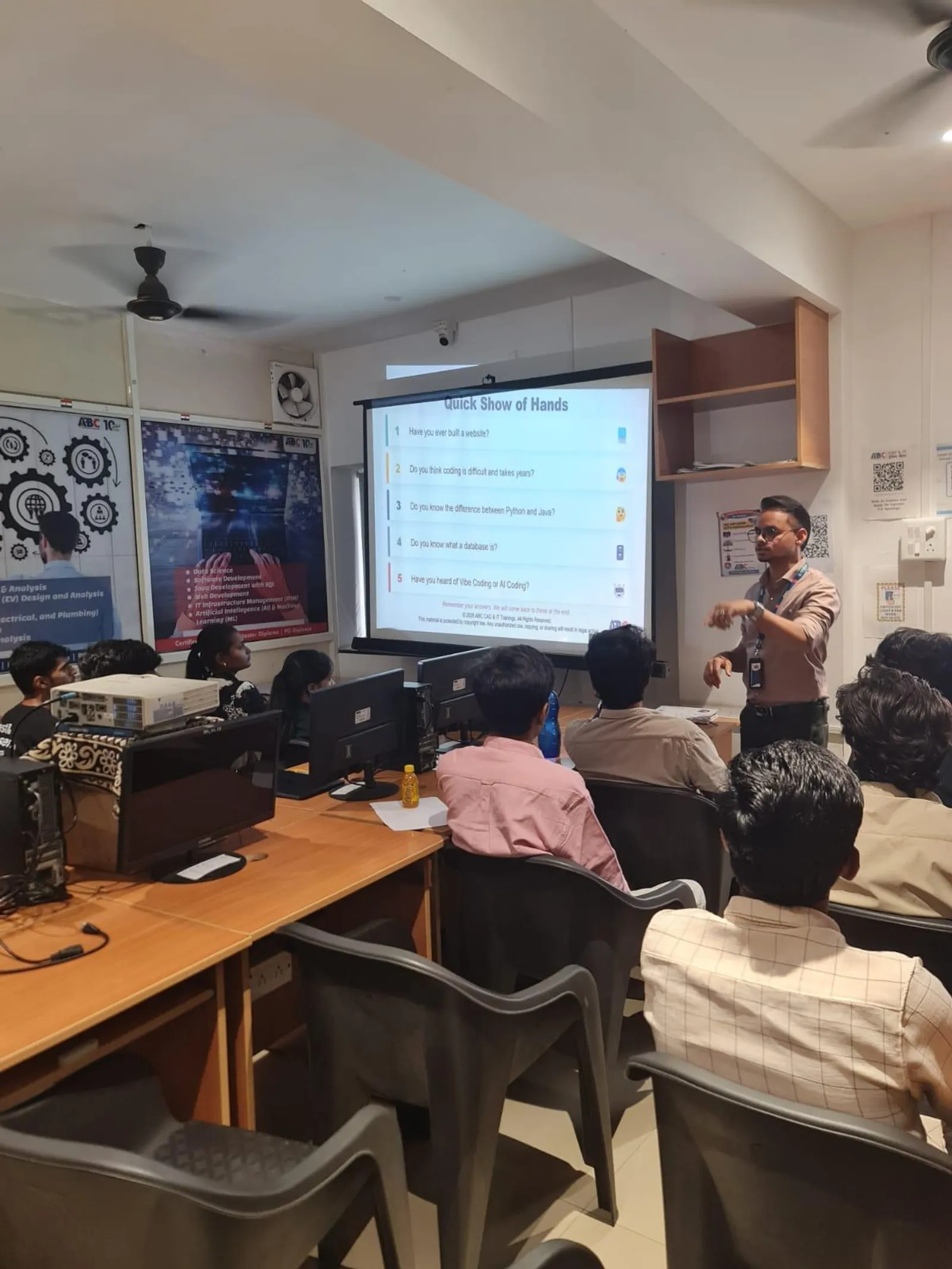
ML engineers and data scientists are in strong demand across India. Infosys, TCS, Wipro, and Cognizant collectively hire thousands of ML-trained graduates annually for their AI practice divisions. KPIT Technologies (Pune) hires ML engineers for automotive AI projects — predictive maintenance, fuel efficiency optimisation, ADAS systems. Persistent Systems (Pune) builds healthcare ML applications. Startups in Pune's Baner-Pashan corridor — Amdocs, Symantec, Veritas — all have ML teams. According to AmbitionBox, a fresher ML engineer in India earns ₹5–8 LPA. With 2-3 years of experience and deployed ML projects, salary rises to ₹10–18 LPA. NASSCOM-Deloitte projects 1.25 million AI roles in India by 2027. ABC Trainings' AI Powered Application Development workshop covers Python, statistics, all major ML algorithms with hands-on scikit-learn projects, and an end-to-end ML deployment exercise — the complete package for a job-ready ML career.
CMYKPY Scholarship: Maharashtra's Chhatrapati Mahamanav Yogi Krantijyoti Phule Yojana offers ₹6,000–₹10,000 in training assistance for eligible youth. PMKVY 4.0 has already certified 2.1 crore candidates nationally — AI and ML are priority digital skill sectors. Check your eligibility and enroll now. Call 7039169629 or WhatsApp 7774002496.
Get the AI Powered Application Development Brochure + Fees + Batch Dates on WhatsApp
Free 1:1 counselling. Placement track record. CMYKPY/PMKVY eligibility check.
💬 Get Brochure on WhatsApp📞 Call 7039169629About the author: Mohd. Rafique Pasha, Data Science & AI Trainer, ABC Trainings.
Visit Our Centers
- Wagholi (Pune): 1st Floor, Laxmi Datta Arcade, Pune-Ahilyanagar Highway. Call 7039169629
- Hadapsar (Pune HQ): 1st Floor, Shree Tower, opp. Vaibhav Theater, Magarpatta. Call 7039169629
- Cidco (Chh. Sambhajinagar): Kalpana Plaza, opp. Eiffel Tower, N-1 Cidco. Call 7039169629
- Osmanpura (Chh. Sambhajinagar): S.S.C Board to Peer Bazar Road, near Jama Masjid. Call 7039169629
- Sangli: Shubham Emphoria, 1st Floor, Above US Polo Assn., Sangli-Miraj Rd, Vishrambag. Weekend batches available. Call 7039169629
FAQs
What is the difference between supervised and unsupervised machine learning?
Supervised learning uses labelled training data — input features paired with correct output labels. The algorithm learns to map inputs to outputs. Examples: classifying emails as spam or not-spam (labels: spam, not-spam), predicting house prices (labels: actual sale prices). Unsupervised learning uses unlabelled data — there are no correct answers provided. The algorithm discovers hidden structure, patterns, or groupings on its own. Examples: clustering customers by purchase behaviour, reducing data dimensionality with PCA. Most real business ML applications are supervised learning because companies have historical data with known outcomes they want to predict.
Which machine learning algorithm should a beginner learn first?
For a complete beginner, start with Linear Regression (for predicting continuous numbers) and Logistic Regression (for classifying yes or no outcomes). They are mathematically simple, interpretable, fast to train, and used in production at major companies. Once you understand these, move to Decision Trees, then Random Forests, then XGBoost — these three algorithms cover the vast majority of real-world tabular data ML problems. Learn all of these using Python's scikit-learn library, which provides a consistent and clean API for every major algorithm.
What is Random Forest and why is it popular in industry?
Random Forest is an ensemble learning algorithm that trains hundreds of decision trees on random subsets of the training data and random subsets of features, then combines their predictions by majority vote (for classification) or averaging (for regression). The diversity of the trees cancels individual overfitting. Random Forest is popular because it: works well out of the box with minimal tuning, handles missing values without preprocessing, provides feature importance scores, is resistant to outliers, and scales to large datasets. It is used in production at Indian banks for credit scoring, at e-commerce companies for recommendation systems, and at manufacturing firms for predictive maintenance.
What salary does a Machine Learning engineer earn in Pune or India?
According to AmbitionBox and 6figr.com, a Machine Learning engineer or data scientist fresher in India earns ₹5–8 LPA at companies like Infosys, TCS, KPIT, or a funded startup. With 2-3 years of project experience and deployed ML models, salary rises to ₹10–18 LPA. Experienced ML engineers at product companies, MNCs, and AI startups earn ₹20–40 LPA. NASSCOM-Deloitte projects 1.25 million AI and digital roles in India by 2027, making ML one of the safest career bets available.